



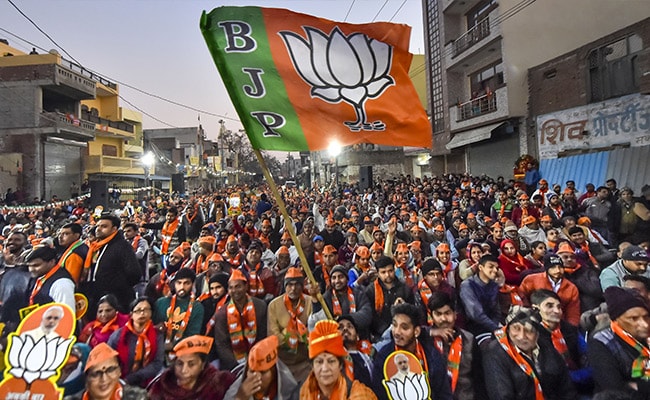
This year has been full of ups and downs for political parties in India. Apart from the general elections, elections were held in eight states, with honors shared between the ruling Bharatiya Janata Party (BJP)/National Democratic Alliance (NDA) and the opposition Congress/India faction. NDA has got a boost to its ‘Mission 400’ with the entry of Nitish Kumar, Chandrababu Naidu and Jayant Chaudhary before the general elections. However, the opposition dealt a blow to the BJP and prevented it from crossing the 300-mark, while the Congress improved its performance by securing around 100 Lok Sabha seats.
In subsequent state elections, while the India Bloc won in Jammu and Kashmir and Jharkhand, the BJP-led alliance bounced back to win in Haryana and Maharashtra. Despite the BJP appearing to be weakening, the party made a strong comeback, with the opposition losing some of its gains in the Lok Sabha elections. Additionally, cracks within the India faction began to appear, as parties such as the Samajwadi Party (SP) and Trinamool Congress (TMC) took independent stances in Parliament on issues such as the Sambhal riots and Bangladesh violence, while the Congress continued to focus on other issues. kept. issues.
A timeline of major political events
- January 2024: India Block architect Nitish Kumar returns to NDA
- March 2024: TDP and RLD join NDA
- June 2024: In a shocking result, the BJP, which had raised the slogan of “Chaar Sau Paar” (Mission 400), could not even get a simple majority, with the NDA failing to touch 300 seats.
- June 2024: BJP ends Naveen Patnaik’s BJD’s 25-year tenure in Odisha by retaining Arunachal. TDP in alliance with JSP and BJP registers big victory in Andhra Pradesh
- October 2024: BJP gave a crushing defeat to Congress in Haryana. National Conference-Congress alliance wins Jammu and Kashmir elections
- November 2024: Making a strong comeback after the defeat by MVA in the Lok Sabha elections, the BJP-led Mahayuti wins a thumping majority in Maharashtra. JMM-led India faction secured two-thirds majority in Jharkhand on the strength of tribals. identity (Proud) And Maiyya Samman Yojana.
What are the lessons for political parties from 2024?
no room for complacency
The parties cannot afford to become complacent. BJP faced overconfidence during the Lok Sabha elections when it launched Mission 400. This sent a wrong message among voters, supporters and workers, making them believe that the BJP would come to power regardless of their votes. As a result, voter turnout went down in strong booths and anchor segments. Similarly, the Congress party in Haryana, confident of victory because of its performance in the general elections and the support of key community groups like farmers, women wrestlers and youth, lost to the powerful machinery of the BJP. The MVA also became over-confident after winning 30 out of 48 seats in the Lok Sabha, believing that the vote was a rejection of the BJP’s brand of politics. MVA leaders mistakenly took the mandate as a vote against the betrayal of Eknath Shinde and Ajit Pawar. However, as the Mahayuti course-corrected, Eknath and Ajit emerged as the de facto Sena and NCP leaders respectively.
women are kingmakers
Women voters, often ignored, are emerging as kingmakers in elections. The increasing level of awareness and literacy has empowered women to take independent voting decisions and they are turning out to vote in greater numbers. To woo this important voter segment, parties have launched women-centric schemes, such as cash income support (Ladli Lakshmi, Ladki Bahin, Maiyya Samman Yojana, Grihalakshmi), free or subsidized gas cylinders, free transport in state buses, And micro loans for entrepreneurship. Mahayuti’s victory in Maharashtra and India Bloc’s victory in Jharkhand can be attributed to cash income support schemes for women.
Do not take voters lightly
Voters are always ahead of all of us – journalists, stringers, experts, analysts, pollsters, activists and leaders. It is becoming difficult to read his mind. Most of these groups failed to predict voter sentiment in Madhya Pradesh and Chhattisgarh in 2023 and in Odisha, Haryana, Maharashtra, Andhra Pradesh, Jammu and Kashmir and Jharkhand in 2024.
The interplay of factors such as caste, class, group, beneficiary status, local and national issues, likes and dislikes, anti-incumbency, leadership, candidates, party symbols, cash distribution and many others, determine voter behaviour.
End of presidential style elections?
In the 2024 Lok Sabha elections, the BJP lost 63 seats compared to 2019 (303 vs 240), yet Narendra Modi continues to top the popularity charts, the best prime ministerial candidate ever against his nearest rival Rahul Gandhi. and have a high level of satisfaction with them. government performance
However, the Lok Sabha elections also became localized in states like Maharashtra, Uttar Pradesh and Rajasthan, hurting the BJP’s prospects. Only 10% people voted based on the prime ministerial candidate, compared to 17% in 2019. Only a quarter of BJP voters cited Modi as a reason for voting, down from a third in 2019.
The rise of hyper-local competitions
This year’s elections, especially state elections, have increasingly been characterized by highly local contests, where local issues dominate. Various factors including anti-incumbency against local MLAs, caste dynamics, development work by MLAs, rebel candidates, dummy candidates, influential people, vote-cutting, resources, star campaigners, inter-party rivalry, sabotage, betrayal and cash/liquor distribution , play leading roles. In such a scenario, MLAs with strong organizational networks or parties with strong structures have an advantage.
Dominant castes are losing relevance
The dominant castes in Haryana and Maharashtra—Jats and Marathas—which were at odds with the BJP governments in these states, were unable to remove him from power. BJP has been successful in neutralizing this influence. This has pitted non-Yadavs against Yadavs (the most influential OBC group) and non-Jatavs against Jatavs in Uttar Pradesh and other Hindi-belt states.
In Haryana, BJP was successful to some extent in making the contest Jat versus non-Jat. In Maharashtra, the Maratha movement lost its appeal in this election, and the community also faced significant counter-solidarity from OBCs, leading to Mahayuti’s victory in the Marathwada region as well.
Return of the pro-government era
The results suggest that we are entering an era of pro-incumbency, where governments remain in power most of the time due to the lack of effective governance and viable opposition. The NDA returned to power at the Centre, albeit with a reduced majority, while the BJP retained power in Arunachal and the Sikkim Krantikari Morcha (SKM) in Sikkim. The BJP won Haryana for a record third time, and Mahayuti and India Bloc retained power in Maharashtra and Jharkhand respectively. Incumbents retained power in six of the eight elections held this year (except Jammu and Kashmir) with a 75% strike rate. Only in Andhra Pradesh and Odisha did the existing governments lose.
Organization matters, social media is just noise
A strong organization is the backbone of any political party. The BJP is undoubtedly a stronger organization than the Congress, thanks to the support of the Rashtriya Swayamsevak Sangh (RSS). Following the setbacks in the general elections, the RSS and its affiliates held thousands of meetings in Haryana and Maharashtra to seek support for the BJP. The Congress, whose organization has weakened over the past decade, failed to strengthen it after its surprise performance in the Lok Sabha elections.
You need to have feet on the ground to deliver on party manifesto promises, gather public feedback, mobilize voters and ensure high turnout on polling day. On this front, BJP performs better than Congress. While regional parties like Jammu and Kashmir and Jharkhand have the organizational strength to take on the BJP, the Congress is surrounded by an ecosystem of YouTubers and sycophants who paint a rosy picture with little understanding of the ground reality.
It’s not just about the issues, idiot!
The issues dominate media discussions and TV debates, but although the issues are important, they are not the only factor in voting decisions. Inflation, unemployment, corruption, agricultural and rural distress and lack of development are the major issues in the elections. For voters who prioritize the issues, the key questions are which party has the better track record in addressing these challenges, and which party is better placed to solve them?
For many voters, leadership, candidates, party symbols, caste, class, beneficiary status, loyalty and relationships play a more important role. Unemployment is a big issue, but for a section of the youth, issues like Hindutva or leadership may matter more.
Bread and butter concerns matter
When discussing issues, bread and butter issues matter more to voters than rhetoric. For the Congress, the Rafale issue did not resonate with voters in 2019, and now Rahul Gandhi’s focus on the Adani issue is waning. Rahul did not raise enough issues related to farmer suicides, inflation or unemployment in Maharashtra. Similarly, the local leadership, busy in ticket wrangling and alliances, failed to address the grassroots issues.
(Amitabh Tiwari is a political strategist and commentator. In his earlier incarnation, he was a corporate and investment banker.)
Disclaimer: These are the personal opinions of the author


