



Somanahalli Mallaiah Krishna, or SMK, was one of the most well-educated, suave, sophisticated, soft-spoken politicians of Karnataka, who has served as a member of both the Houses of the Karnataka Legislature and the Indian Parliament. He was a pioneer of reforms in all aspects of administration of Karnataka.
When he took over the reins of power from the JH Patel-led Janata Dal government in 1999, Karnataka’s economy was in a very bad shape. With the Congress gaining power under his leadership, Sri Krishna became the Chief Minister (1999–2004). He opened the door to closer engagement with the World Bank, civil society organizations and industry experts to initiate reforms. He played a key role in introducing several reforms in fiscal and public expenditure management, governance, private sector development, and poverty and human development monitoring.
SM Krishna (1932-2024) a life in pictures
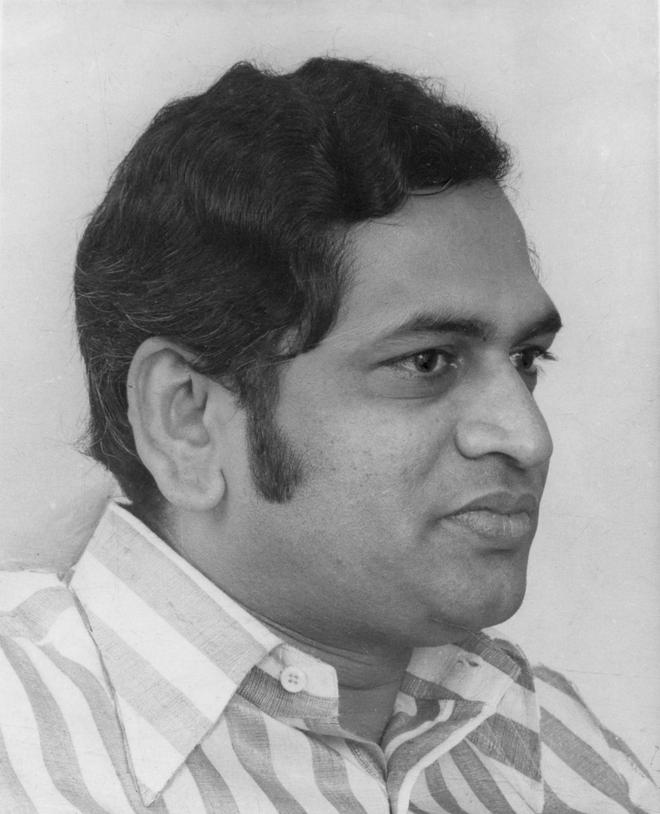
A photograph of SM Krishna was published in The Hindu on January 30, 1983. He was then part of Congress-I from Mandya constituency.
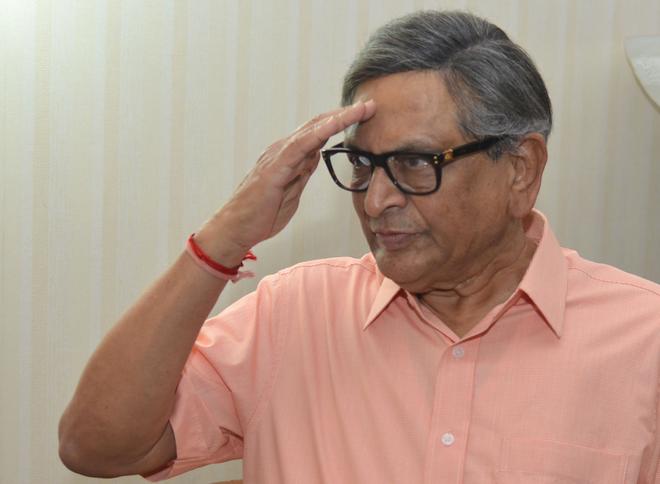
Senior Congress leader SM Krishna was greeted by his well-wishers at his residence on his 83rd birthday.
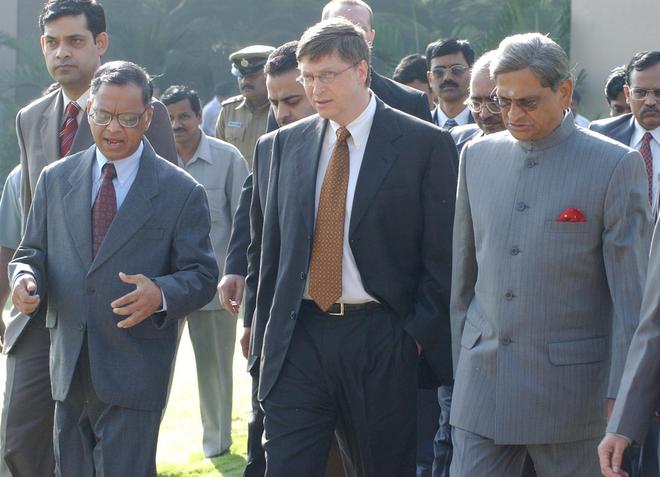
Bill Gates, Chairman and Chief Software Architect, Microsoft Corporation (center) arriving with Narayana Murthy, Infosys (left) and Karnataka Chief Minister Shri S.M. Krishna at Infosys Campus, Electronics City.
SMK with Salman Khurshid
SM Krishna was seen with Kannada actor Dr Rajkumar after he was released by forest robber Veerappan, who had kidnapped him in 2002.
SM Krishna with MK Karunanidhi, then Tamil Chief Minister R. Gopal was seen with the publisher of Tamil magazine ‘Nakkiran’.

Karnataka matinee idol, Dr. Rajkumar welcoming the audience and fans after receiving the highest state award ‘Karnataka Ratna’ from the Governor of Karnataka, Shri Khurshid Alam Khan, in Bengaluru on November 14, 1992. Karnataka, Shri S. Bangarappa (right) and Assembly Speaker Shri S.M. Krishna (further left) is also visible.
SM Krishna addressing a press conference as Chief Minister of Karnataka at the Vidhana Soudha in January 2002.
SM Krishna, Mallikarjun Kharge and other ministers look at the map of the proposed Devanahalli International Airport in Bengaluru.
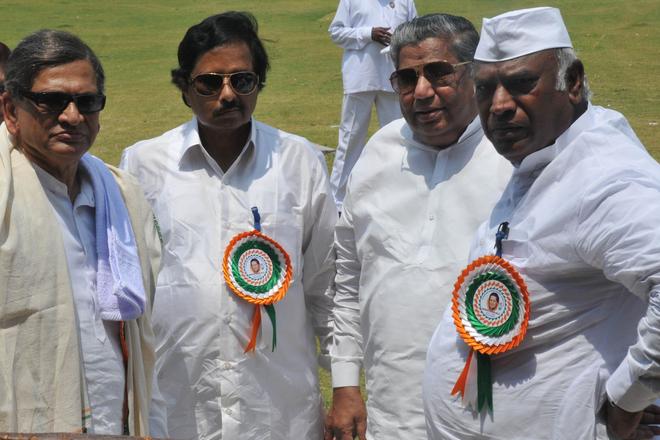
Former Chief Ministers SM Krishna, S. during the Bharat Nirman rally at MBA Ground in Davanagere on 23 March 2009. Bangarappa, N Dharam Singh and Mallikarjun Kharge are leaders of the opposition in the Legislative Assembly.
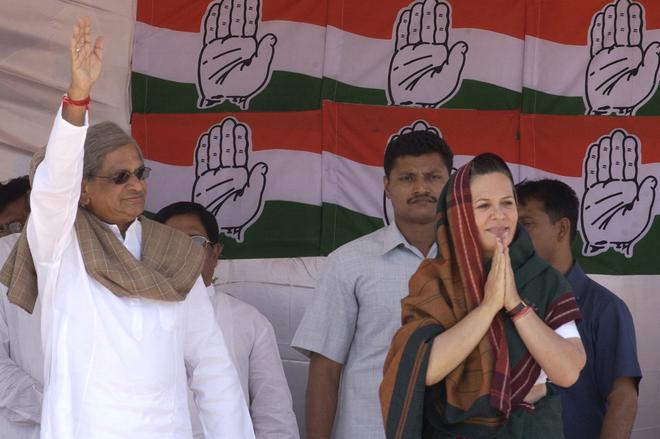
Congress President Sonia Gandhi and Chief Minister SM Krishna greeting the crowd during a public meeting in Kolar in 2004.
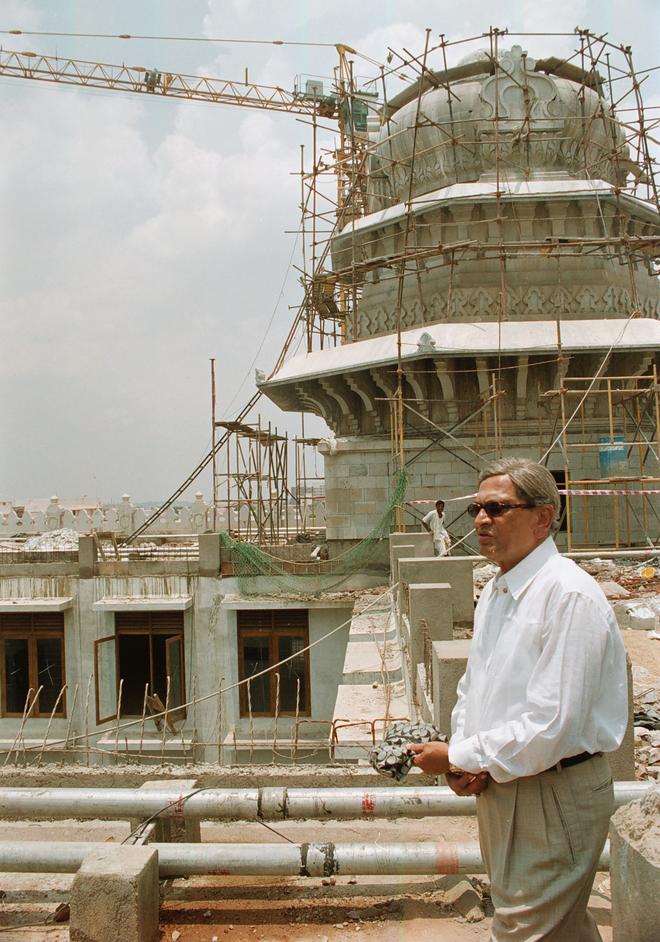
SM Krishna inspecting the work progress at Vikas Soudha, Bengaluru in 2004.
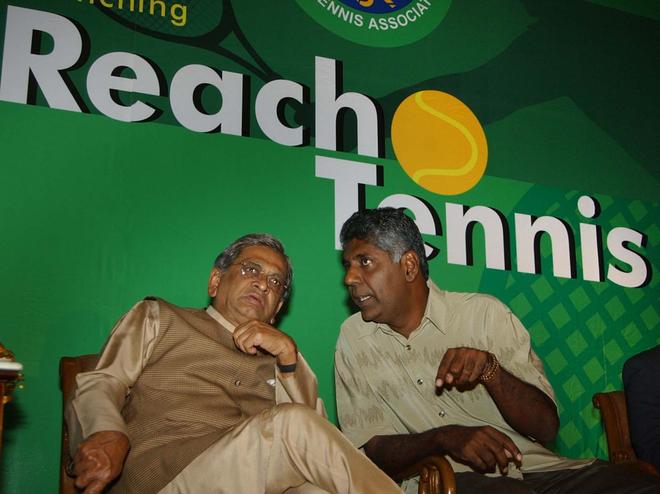
SM Krishna and veteran tennis player Vijay Amritraj at an event at KSLTA in Bengaluru.
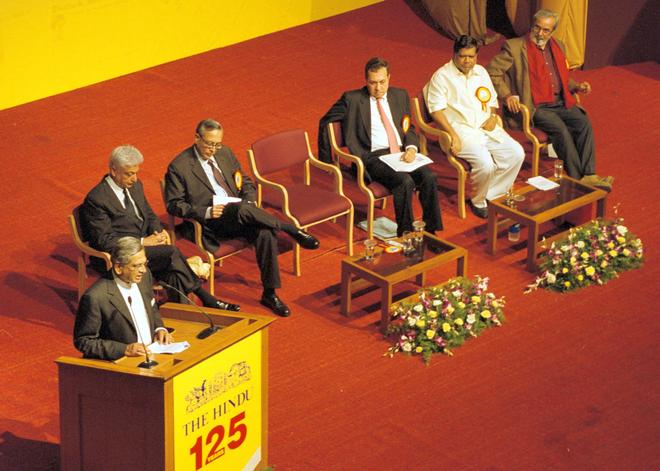
SM Krishna addressing the gathering at the 125th year celebrations of ‘The Hindu’ at Ambedkar Bhawan, Bengaluru on November 08, 2003. (From left) Azim Premji, Chairman, Wipro, N. Murali, Joint Managing Director are also seen. Director, ‘The Hindu’, N. Ram, Editor-in-Chief, ‘The Hindu’, Jagadish Shettar, Leader of Opposition in the Karnataka Assembly and URANanthamurthy, renowned writer.
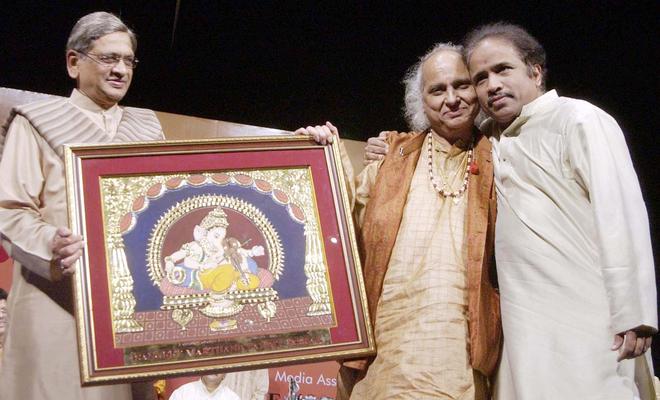
Pandit Jasraj died on 20 January 2004 in Bangalore, after the death of violinist L. Being honored by SM Krishna along with Subramaniam.
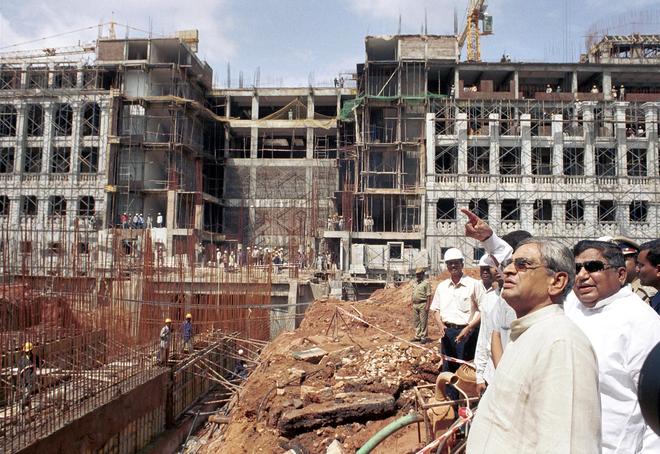
Chief Minister SM Krishna and Public Works Minister Dharam Singh inspecting the progress of work at Vidhana Soudha South Block in Bengaluru on August 4, 2003.
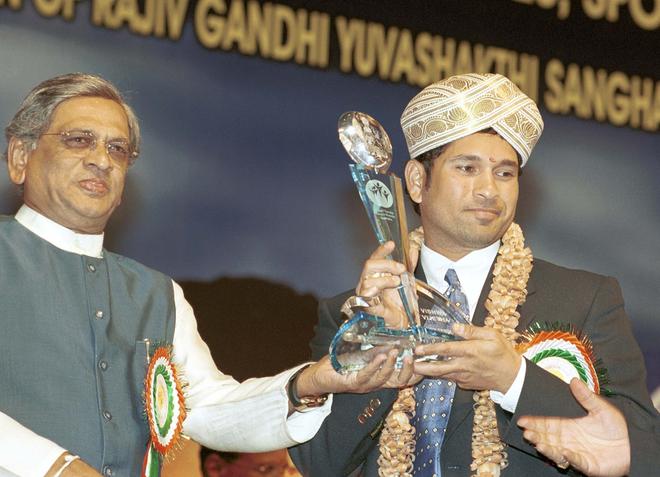
Cricketer Sachin Tendulkar honored by Chief Minister SM Krishna at the inauguration ceremony of Rajiv Gandhi Yuva Shakti Sangh in Bengaluru in August 2003.
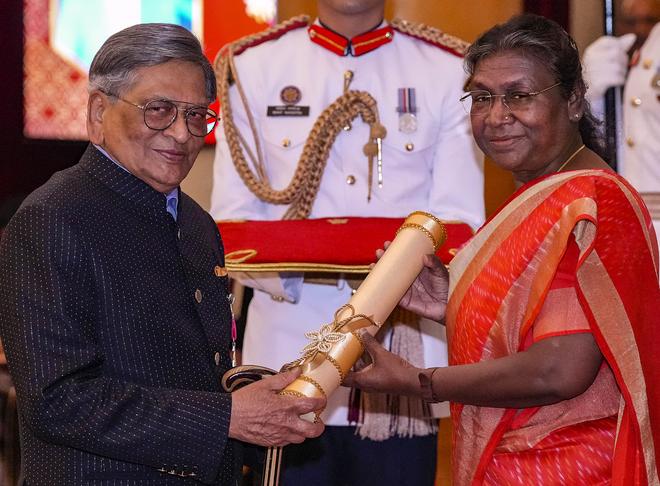
President Draupadi Murmu confers Padma Vibhushan on former Union Minister SM Krishna during the Padma Awards 2023 ceremony at Rashtrapati Bhavan in New Delhi.
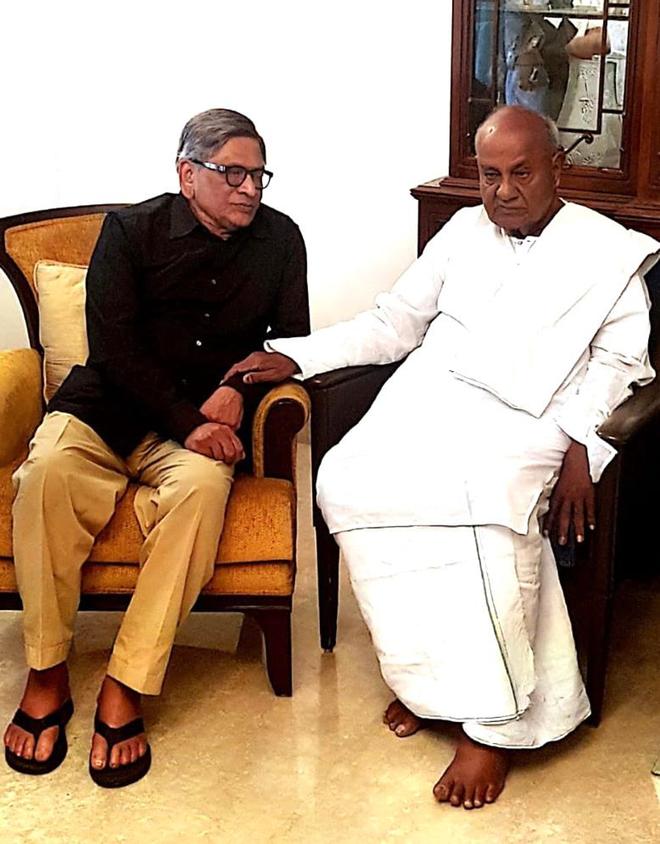
Former Prime Minister HD Deve Gowda consoling former Chief Minister SM Krishna and his family members at his residence in Bengaluru after his son-in-law VG Siddhartha went missing in Mangaluru.
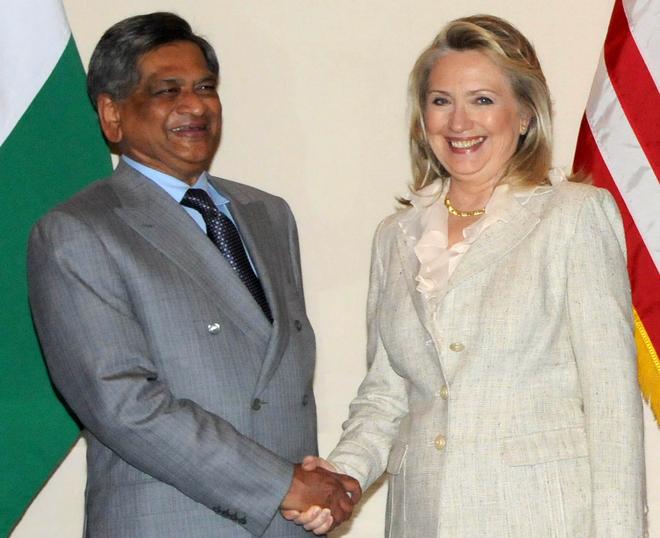
The then US Secretary of State Hillary Clinton met SM Krishna during her tenure as External Affairs Minister in New Delhi on May 8, 2012.
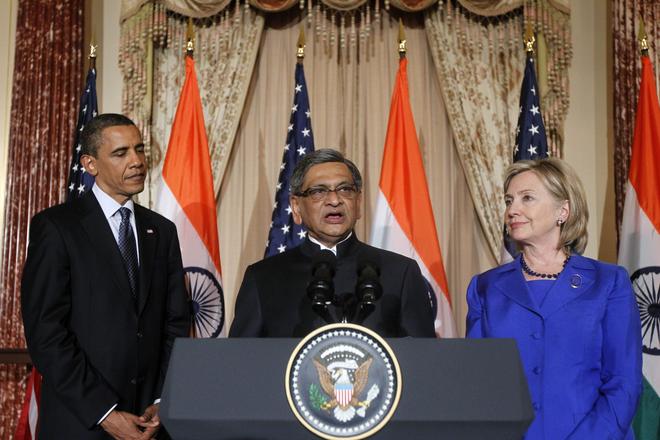
President Barack Obama, left, stands with Secretary of State Hillary Rodham Clinton, Indian Foreign Minister SM Krishna speaks during the US-India Strategic Dialogue reception at the State Department in Washington, June 3, 2010.
1,3
During his tenure, the attendance punching system was introduced in major government offices including the Vidhana Soudha. DM Nanjundappa Committee was formed to remove regional imbalance. He believed that Karnataka could prosper and progress only when equal importance was given to both urban and rural areas.
comprehensive reform
During his rule, Karnataka provided a legislative framework for reforms by passing laws and imposing user charges in the health and irrigation sectors. Karnataka was the first state to pass the Fiscal Responsibility and Budgetary Management (FRBM) Act in 2002.
In view of the many problems in the power sector, the Karnataka Electricity Reforms Act was enacted in 1999. Karnataka Electricity Board was dissolved and KPTCL was incorporated under the Companies Act in June, 2002.
Karnataka has institutionalized the annual cycle of medium term fiscal planning (MTFP). Notable laws include the Karnataka Transparency in Public Procurement Act, 1999, and the Karnataka Industries (Facilitation) Act, 2002, which was amended in 2015, which mandated a single-point government-industry interface and set deadlines for government clearances. Were among. Passed during his tenure.
The Krishna government constituted expert committees on Panchayat Raj (1999), Administrative Reforms Commission (2001), Tax Reforms Commission (2000), and Revenue Reforms Commission (2002) to make the administration efficient, effective, transparent, responsive and accountable. . The task force comprising eminent personalities drawn from professional, private and civil society organizations was constituted in almost all sectors to carefully study and make recommendations to promote the all-round development of Karnataka.
During his time e-governance was introduced in the delivery of public services in all cities and towns, citizens’ charters were widely displayed in government offices, and a system of online complaints and public hearings was introduced for resolution of grievances in service delivery. Was started. E-governance projects like Bhoomi, Khazane, Cauvery and Mahithi (known as BangaloreOne Center in Bengaluru) service centers were implemented.
Competing with then Chief Minister of Andhra Pradesh Chandrababu Naidu in attracting investment, the Krishna government opened the doors to PPPs in the infrastructure sector – construction of roads, airports, power plants, waste disposal, health and education, and essential Collection of bills for services. ,
In 2003, the World Bank held its Annual Bank Conference on Development Economics (ABCDE) in Bengaluru, the first time it was held outside Washington.
Special place for Bengaluru
It is argued that SM Krishna’s support of the reforms and his willingness to allow autonomy to agency heads, as well as the strong support of the Bangalore Agenda Task Force (BATF), led agency heads to show interest in implementing the reforms. Encouraged. BATF was not only a model adopted by other Indian cities, but the concept was also introduced to other donor countries by the World Bank. The Krishna regime used the BATF to avoid criticism regarding projects and policies by taking advantage of the intellectual reputation of members.
Bengaluru City Corporation introduced a popular and optional Self-Assessment Scheme (SAS) for payment of property tax, which not only reduced corruption by eliminating red tape, but also significantly increased revenues during his tenure.
Work on the international airport in Bengaluru, development of the Outer Ring Road around the city, and most of the flyovers, underpasses, over-bridges and grade separators were started during Krishna’s tenure. He has a special place in his heart for the garden city Bengaluru.
His commitment to implementing reforms contributed to a significant improvement in the state’s financial position in 2005–06. The average collection rate of all taxes increased from 97% of budget estimates in 2001 to 106% in 2006. In 2006, the state government withdrew from bank loans. The additional revenue was used for construction of roads, flyovers, ring roads, housing layouts, housing complexes without burdening the state exchequer.
CM at the wrong time?
Shri Krishna perhaps in some ways became Chief Minister at the wrong time. The administration faced many difficulties during 2001–02 as the government was busy resolving the dispute over sharing of Kaveri river water with Tamil Nadu. The kidnapping of Kannada matinee idol Dr. Rajkumar and his release after 109 days of imprisonment, and the murder of former minister H. Nagappa and the resulting public outcry dominated the government’s time and energy. Irregularities of monsoon became the reason for suicide of farmers. Shri Krishna was really upset and was not in a position to implement his vision completely.
“If he had taken over the leadership of the state government perhaps a decade earlier, or perhaps later, I am sure he would have done much better. But then perhaps the real Krishna would not have appeared. Because, it is only when a person faces adversities and difficult challenges that his true potential is revealed,” said veteran journalist Gabriel Vaz, who followed Krishna’s tenure closely.
Despite these difficulties, many believe that Karnataka has made a significant leap forward in terms of comprehensive reforms.
Many believe that Mr Krishna ‘misjudged’ the mood of the voters when he decided to hold assembly elections six months before his term ended with the 2004 Lok Sabha elections. In the 2004 assembly elections, an apparently ‘disgruntled’ urban constituency and ‘neglected’ rural voters ousted the Congress and Chief Minister SM Krishna from power.
published – December 10, 2024 02:55 PM IST


