



The Supreme Court on Thursday issued a nationwide direction barring all courts from considering fresh cases or passing orders to survey mosques to determine whether there are temple structures beneath them. This interim order acts as a blanket pause on the growing litigation initiated by Hindu groups seeking to reclaim places of worship, effectively halting litigation and proceedings in high courts, and raising concerns over religious sensitivities and legal It marks a significant intervention by the judiciary in a case fraught with complexities. ,
Read also, Women should not misuse cruelty laws for ‘personal vendetta’ against husbands: Supreme Court
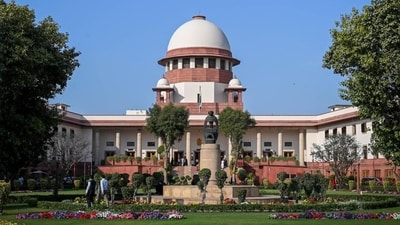
The direction came from a special bench headed by Chief Justice of India (CJI) Sanjiv Khanna, which clarified that trial courts cannot go ahead of the Supreme Court while ruling on challenges to the Places of Worship (Special Provisions) Act, 1991.
“Since the matter is sub-judice before this Court, we deem it appropriate to direct that, although fresh suits may be filed, no suit shall be filed and no proceedings shall be taken till further orders of this Court. “Further, in the pending suits, no court shall pass any effective interim order or final order, including orders directing survey, etc., until the next date of hearing/further orders of this court,” the bench ordered. Gave, which also included Justice PV. Sanjay Kumar and KV Vishwanathan. The court has scheduled the next hearing for February 17, 2025.
Read also, Supreme Court asks states/UTs to disclose figures of vacant posts in jails
The direction comes amid a surge in litigation initiated by Hindu groups seeking revival of alleged historical temple sites, leading to legal proceedings in district and high courts. These disputes have given rise to significant controversy and conflicting orders, leading to increased political and communal tensions across the country. From Gyanvapi Masjid in Varanasi to Shahi Idgah in Mathura, from Shahi Jama Masjid in Sambhal to Taj Mahal in Agra, from Dargah Sharif in Ajmer to Bhojshala in Madhya Pradesh, several petitions seeking redefinition of the character of various structures have been filed across the country. Have emerged throughout.
Despite the importance of the issue, the case has seen little progress in the Supreme Court over the past two years.
Justice Khanna took over as CJI from Justice Dhananjay Y Chandrachud on November 11. He then constituted a three-judge bench on December 7, paving the way for Thursday’s intervention.
The Places of Worship Act enacted in 1991 is at the heart of the issue. The Act, which the court is deliberating over at the behest of two parties – one challenging it and the other seeking its strict enforcement – was enacted to preserve the religious character of all places of worship. As they were on August 15, 1947. The law clearly prohibits changing the religious nature of sites and includes stringent penalties for violations, although it exempted the Ram Janmabhoomi-Babri Masjid site in Ayodhya because of the ongoing litigation at the time.
In its order on Thursday, the Supreme Court also pointed to its 2019 Ayodhya verdict, in which a five-judge bench had underlined the importance of the Act in protecting the secular fabric of the country. The judgment emphasized that the law embodies the principles of equality and non-regression, which does not allow for re-consideration of settled issues.
“When you have a judgment by a Constitution bench laying down certain principles, civil courts cannot compete with the Supreme Court,” the bench said on Thursday. The court decides the case.
The restraining order was issued amid a bitter competition between lawyers representing the Hindu and Muslim parties. Senior lawyers Abhishek Manu Singhvi and Raju Ramachandran, appearing for Muslim organizations, strongly advocated stopping the proceedings, especially the survey, in subordinate courts to avoid conflicting decisions.
Senior lawyers Rakesh Dwivedi, Maninder Singh and Vikas Singh, representing Hindu groups, opposed the order, arguing that such a ban should not be issued without a full hearing. Solicitor General (SG) Tushar Mehta, representing the central government, also argued that outside parties should not be allowed to interfere in ongoing trials.
However, the bench was unambiguous, noting that the issues under consideration go beyond challenges to the 1991 Act and extend to its applicability and enforcement. “When these questions are pending before us it would not be appropriate for any other court to pass orders,” the bench said.
During the proceedings, the bench also remarked that those attacking the validity of the Act would have to present an effective counter to Section 3 of the Act. This provision prohibits individuals and groups of people from converting, in whole or in part, a place of worship of any religious denomination into a place of worship of a different religious denomination – or even a different section of the same religious denomination . ,
The court gave four weeks time to the central government to clarify its stand on the Act, which has been awaited for more than two years despite a growing number of petitions. Although the Supreme Court admitted petitions challenging the Act in March 2021, the Center has refrained from filing a definitive response.
The delay came amid growing challenges to the Act, primarily from Hindu petitioners, who claim it violates their fundamental rights to reclaim and restore religious sites allegedly destroyed during historical invasions. Does.
The petitioners include BJP leader Subramanian Swamy, who argues that the Act impairs their right to pray in temples forcibly converted during foreign invasions, and lawyer Ashwini Upadhyay, who argues that the law discriminates against Hindus, Buddhists, Jains and Discriminates against Sikhs. Upadhyay claims that this law violates the fundamental rights of these communities to conserve and manage places of worship.
Another notable challenge came from Kumari Krishna Priya, a member of the Kashi royal family, who argues that the Act is discriminatory because it exempts the Ayodhya Ram Janmabhoomi site, while treating the Kashi Vishwanath temple in Varanasi and other important places equally. Exemption has been denied. Krishna’s birthplace in Mathura.
Recent years have seen a rise in legal suits demanding surveys of major mosques, including the Gyanvapi Mosque in Varanasi and the Shahi Idgah Mosque in Mathura, to ascertain whether they were built over demolished temple structures. Were. These cases have escalated into lower courts, leading to judicial orders that have further polarized opinion.
While the Supreme Court had initially refrained from imposing a complete stay on such cases, Thursday’s direction emphasized the urgency of putting a halt to the growing disputes until the top court delivers a definitive verdict.
The Places of Worship Act, enacted by the Congress-led government in 1991, aimed to freeze the status of all religious places as of August 15, 1947, except the Ram Janmabhoomi-Babri Masjid site. For decades, the law remained unopposed, facing no significant legal challenges.
However, the Supreme Court’s 2019 Ayodhya verdict rekindled demands to reclaim other religious sites, intensifying the debate over the constitutionality of the Act.
The petitioners argue that the law unjustly prevents Hindus from addressing historical wrongs and restoring religious sites destroyed or altered during the invasions. They claim that the Act unilaterally imposes restrictions on Hindu, Buddhist, Jain and Sikh communities while exempting others.
On the other hand, Muslim groups including Jamiat Ulema-e-Hind argue that repealing the law will break communal harmony and weaken the secular ethos of the Constitution. They caution that reopening these disputes could rekindle fear among minorities and destabilize the social fabric of the country.
Muslim clerics and groups welcomed the Supreme Court’s directive, while Hindu petitioners described it as a “minor hurdle” in their struggle to reclaim their religious sites.
“We welcome the directions of the Supreme Court and it will be a relief not only for the entire state but for the entire country. The common people, especially Muslims, were uneasy about cases being filed against their religious places. We hope that the Supreme Court in its final judgment will strengthen the implementation of the Places of Worship Act to prevent all future disputes. This will be in the interest of the nation,” said Maulana Khalid Rashid Farangi Mahali, member of the All India Muslim Personal Law Board (AIMPLB) and city qazi of Lucknow.
On the other hand, Supreme Court lawyer Vishnu Shankar Jain, who has filed the petition on behalf of Hindu parties demanding a survey of mosques in Varanasi and Mathura, said he is for the “liberation” of Kashi, Mathura and other places of worship. Will continue the fight.
“The order passed by the apex court is a small setback in our struggle to get back our cultural heritage. But together we can and we will succeed. Miles to walk before sleeping,” Jain wrote in a post on X.


