



On August 7 this year, Aparna Sankaran, an M.Sc. student at the University of Hyderabad (UoH), sighted what many botanists consider lucky and rare to find — a 20-centimetre highly specialised deceptive slender herb, bearing flower right in the backyard of her School of Life Sciences during a field exercise. A cheater plant, endemic to the peninsular Indian plateau, it has a unique pollination strategy and is studied as one of evolution’s marvels.
Its floral scents mimic pheromones of potential food or sex to lure kleptoparasites like bees and flies, trapping them for up to 24 hours to collect pollen. “However, there is no pollinator’s reward, such as nectar, but a major loss of fitness for flies when they are freed, and most of them starve to death,” explains Annemarie Heiduk, pollinator biologist at University of KwaZulu-Natal, South Africa, in the internationally popular ‘In Defense of Plants’ podcast.
For Aparna and her mentor Siddharthan Surveswaran, spotting this elusive plant was a moment of sheer excitement. “Sir said it was Ceropegia spiralis; his favourite plant. He had been looking for it for years,” recollects Aparna.
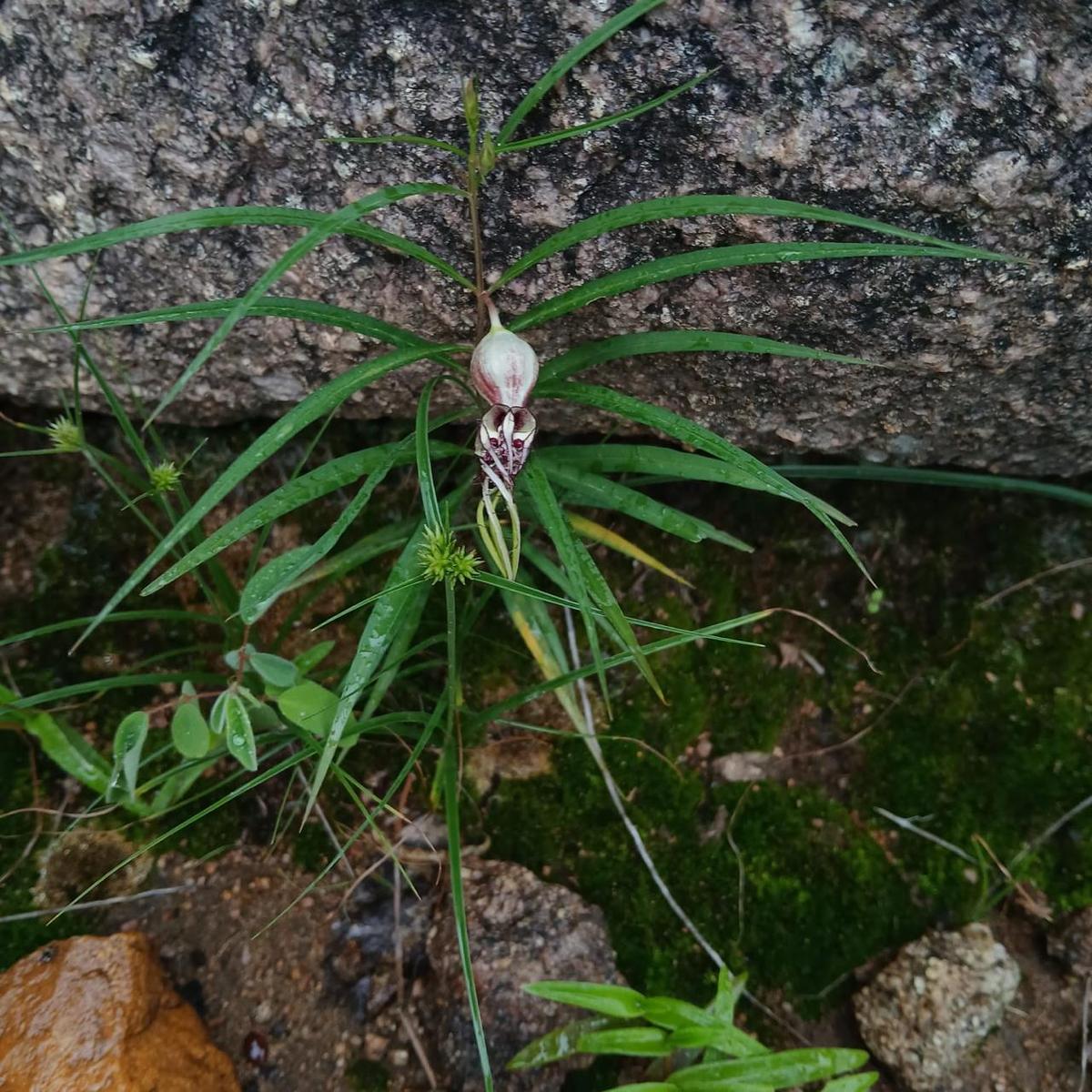
The elusive Ceropegia spiralis sighted by M.Sc student Aparna Sankaran on August 7 in University of Hyderabad.
| Photo Credit:
By Arrangement
Heiduk studied 14 species of Ceropegia. The plant is recorded as vulnerable, according to Red Data Book of Indian Plants, published by Botanical Survey of India (BSI) in 1988.
Two months later, when Aparna returned to the site, she could not find the Ceropegia — one of the hundreds of endemic herbaceous (non-woody plants), geophytes (plants with underground storage organs like bulb, tuber and rhizome) and grass species. Its home, a thriving grassland ecosystem in the south of the 1800-acre walled university campus, was gone too. Excavators had razed the area, replacing the swampy, blooming ecosystem with a barren, dry landscape. “It looked like a house that had been robbed — messy and shattered,” she recalls.
While grasslands globally face threats from agriculture, urbanisation and industrialisation, the culprit at the UoH is Miyawaki tree plantations, promoted as ‘biodiversity’ initiatives. The university permitted the Urban Forestry Wing of the Hyderabad Metropolitan Development Authority (HMDA) to plant trees in its open spaces, despite experts warning of irreversible damage to native habitats.
Heartbroken, Aparna wrote to newspaper editors on November 9 about the death of her natural lab, but did not receive any response. She even drafted a student petition but semester exams came in the way of action. But Surveswaran emerged as a vocal critic of the university administration and HMDA.
Grassland ecosystem
On October 29, he sent an e-mail titled ‘An urgent appeal to stop destruction of biodiversity on the campus’ to 16 university heads, including Vice-Chancellor B.J. Rao, Registrar Devesh Nigam and the Internal Quality Assurance Cell (IQAC).
The detailed appeal included the campus biodiversity profile, elevation map, journal articles, and photographs: “The university campus holds the last refuge of some endemic and ecologically important plants native to Telangana. Is there an alternative, something like pausing it and discussing this project, weighing the pros and cons of this insane destruction of the wetland ecosystem? This is not a lonely voice, I am sure.”
The mail was circulated to some media outlets by one of its recipients a week later, but failed to gain attention.
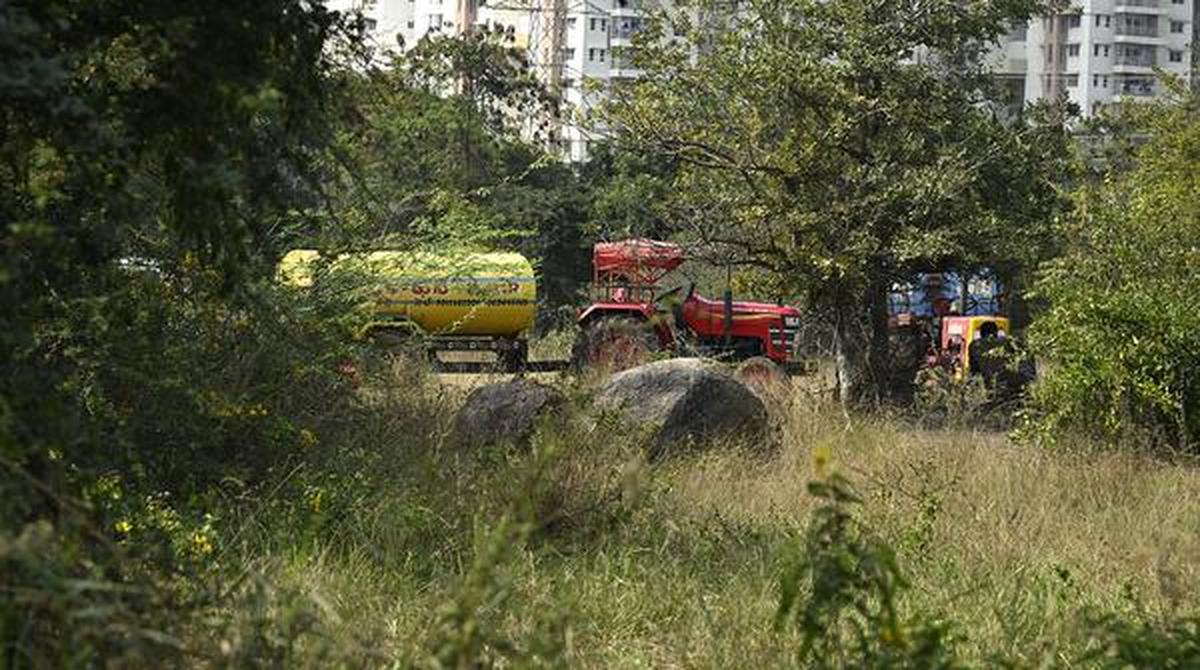
Newly-planted saplings in the south campus of University of Hyderabad. The area was a swampy grassland until September, when the HMDA razed it for the proposed Miyawaki forest plantation; nursery polybags line the path in the south campus of UoH as planting operations continue at a brisk pace; and plantation workers saplings take a break in the south campus.
| Photo Credit:
G. RAMAKRISHNA
Tropical grasslands, or savannas, are vegetation dominated by grasses with scattered trees, unlike forests. Telangana, part of the Deccan Plateau, hosts 273 grass species, as recorded by the Botanical Survey of India between 2017 and 2022, with UoH representing the region’s rich biodiversity.
Researchers Jayashree Ratnam of the National Centre for Biological Sciences, Abi T Vanak of the Ashoka Trust for Research in Ecology & Environment, and Tarsh Thekaekara of the Dakshin Foundation, highlight the neglect of Indian savannas in conservation, overshadowed by forests due to colonial forestry’s focus on timber and a misconception that grasslands lack endemism.
But a 2021 study led by Ashish N Nerlekar of Texas A&M University, along with 11 other researchers from across the country, found “exponential rise in the endemic plant discovery”: 206 endemic plant species of which 43% were described in the last two decades, counter the assumption that Indian savannas support no endemic plants. Of them, the most (88) were found in undivided Andhra Pradesh. And in the UoH perspective, “the older the ecosystem has for plant community assembly, the more it is likely to contain endemic species”.
Researcher Vanak, along with J.W. Veldman (Texas A&M University) and Brazil-based Fernando Ao Silveira, emphasises that tree plantations harm savanna ecosystems. They argue savannas naturally have low tree density, a narrative grossly missing in policies that prioritise afforestation. Colonial-era policies valuing trees over herbs have led to the conversion of thousands of acres of Indian savannas into plantations under the guise of conservation.
The Wasteland Atlas of India, 2019, by the Department of Land Resources, states that 119 sq.km wastelands became non-wastelands and 496 sq.km non-wastelands became wastelands, an increase by 377 sq.km in Telangana. It also declares 17% of India’s geographical area as wasteland.
First coined by the British, the term ‘wastelands’ was defined in 1985 by the National Wasteland Development Board as “degraded land, which can be brought under vegetative cover, with reasonable effort, and which is currently underutilised and (that) land which is deteriorating for lack of appropriate water and soil management or on account of natural causes.”
The Surveswaran-Seshagirirao effect
Surveswaran (48), a Ph.D graduate from The University of Hong Kong and former conservation officer there, joined UoH in 2022 after a stint at Christ University, Bengaluru. With 38 publications, his work reflects a deep interest in Ceropegia species, which he has studied since 2009.
Associate Professor in the Plant Science department, he is the only botanist in the university who is focused on plants as entities rather than their molecular or cellular aspects, apart from the Horticulture department that handles and maintains plants for aesthetic purposes.
Surveswaran is seen as filling the shoes of the late K. Seshagirirao, a UoH botany doyen who cataloged its flora. Seshagirirao identified 724 flowering species on the campus by 2002, cited in his widely referenced ‘University of Hyderabad Flora’. However, his online database has expired, and only partial documentation from his M.Phil disseration work in 1986 remains in the university library.
The unofficial blog site of former Vice-Chancellor Ramakrishna Ramaswamy in 2011 describes Seshagirirao as ‘BioDiplomat-Seshagiriravu’, where he wrote about his 2003 list of 734 flowering plant species at UoH, including several threatened taxa under International Union for Conservation of Nature. “It is interesting to note that the number of recorded species from the campus is higher than the numbers recorded in entire districts in Andhra Pradesh: Ranga Reddy (694), Medak (704), Adilabad (673), and Nalgonda (506),” Seshagirirao had written.
Following Seshagirirao’s death in 2017, his herbarium specimens (plants dried, pressed and preserved for future reference) were reportedly discarded. “We didn’t find a single sheet,” says Sushant Kumar, a doctoral student. “But Surveswaran sir is rebuilding the project from scratch, in three samples of each specimen — one to preserve at UoH, the second at BSI, Telangana, and the third in an institute in another State. But much of the ecosystem was destroyed even before it could be catalogued,” adds Kumar, sharing a list of the 115 plant species identified since 2022.
Seshagirirao’s contribution went beyond identifying 734 species. The New York Botanical Garden’s Index Herbariorum, where 396 million botanical specimens are housed, lists UoH under code UH with 3,762 specimens collected by him and two others.
Ramaswamy’s blog lauding the biodiversity efforts of Sudhakar Marathe, then head of English and dean of Humanities, through his macro photography and Nature Club activities, also leads to a comment by Appa Rao Podile, professor in the Plant Science department. He mentioned a proposal was sent to the University Grants Commission XI plan committee for using scientific methods to allow the UoH to preserve, showcase and educate the public on the importance of plant biodiversity. But “unfortunately, other requirements got priority over this apparently ‘insignificant proposal’ that was developed as an outreach activity”.
In 2016, a year after Appa Rao became Vice-Chancellor, UoH collaborated with HMDA and Confederation of Real Estate Developers’ Association of India (CREDAI) to plant over one lakh saplings across 250 acres in half a day as part of the Telangana Ku Haritha Haram afforestation programme, according to the university news portal.
It was also during his tenure that UoH was accorded the ‘Institute of Eminence’ (IoE) status in 2019, promoting the tagline ‘National needs, global standards’. IoE, according to the UGC, aims to transform higher education institutions into world-class teaching and research hubs with 19 strict benchmarks, including global rankings, merit-based admissions and reputed publications.
Plantation efforts in 2016 and 2017 were not as smooth, show reports. On December 3 this year, alumnus Ravi Jillapalli marked the seventh anniversary of the ‘4th deforestation in two-year period at UoH’ with a Facebook post featuring 34 images of land cleared for plantation, resembling the current scenario.
“This is rogue activity in the name of biodiversity. What is the need for plantation, by uprooting old ones or clearing grasslands, in a naturally occurring habitat like UoH? I suspect there is huge money involved,” says Ravi, now a research associate at Northwestern University, Chicago.
A doctoral student in Animal Biology back then, Ravi is remembered as “an aggressive campaigner for campus flora and fauna, who even caught hold of poachers and objected to plantation drives.” He ran a group called ‘Wild Lens’.
The only ones
The GIS elevation map in the e-mail shows the south and southwest UoH campuses at a low of 555 metres and the east at a high of 630 metres. The open habitat features seasonal pools, aquatic flora and fauna, and a vibrant succession of plants — pink Parasopubia, blue and violet Exacum or spiky blue devils, chocolate lilies, and yellow and snowy whites — captured vividly in photos and videos.
“These tiny ones live in succession with much of their activity underground. They are resilient and clever in making the best of the conditions, which also makes their identification difficult and time-taking. Their only goal in life is to grow, flower or fruit, seed set, die, and the cycle repeats,” says Kobita Dass Kolli, an independent researcher in her fifth year of documenting floral species of Hyderabad.
Kolli is a former UoH plant science student and labmate of Seshagirirao in 1985. Her organisation ‘Nature Lovers of Hyderabad’, with team members Tejah Balanthrapu and Sadhana Ramchander, appealed to current V-C B.J. Rao to halt the plantation drive.
“The current ecosystem provides water catchment, water purification, carbon and nitrogen fixation, pollination services, aesthetic value, invaluable diversity and above all they are the living heritage of Telangana,” it reads. Their November 13 appeal remains unacknowledged.
Associate Professor Joby Joseph, from the UoH’s Centre for Neural and Cognitive Sciences, supports Surveswaran’s cause. His Nikon Zf mirrorless camera with a 600 mm lens placed horizontally on his table, like a machine gun on a tripod, and Deep Learning by Ian Goodfellow, a textbook on machine learning, tell his to-do things at 11 a.m.
“Nobody will be convinced if you say grasslands are destroyed and birds won’t come. You should say deer won’t get its food, they all will die; you should talk to a deer ecologist,” he jokes, seated in his worn chair, beard framing his grin.
On eBird, the global bird observation platform managed by Cornell Lab of Ornithology, UoH is a hotspot with 233 species recorded since September 1989. Among 91 birders, Joseph ranks first, having documented 198 species.
But now, Joseph is worried. Shrinking grasslands on campus mean losing birds like the Booted Eagle, Brown Shrike, Painted Sandgrouse, Grey Francolin, and 30 others he loves to photograph and showcase during campus bird walks.
Scrub and grassland birds as documented by Joby Joseph, professor in the Centre for Neural and Cognitive Sciences, UoH.
Every year, photos taken by students and teachers of grasses concealing spotted deer, strolling peafowl, or vibrant flora adorn UoH’s New Year calendars. Now, those once-thriving expanses, dug up like graves, resemble barren egg trays, with its erstwhile natives found in the corner as debris.
The last man standing
The university administration responded to queries about land use, sapling targets, review processes and grassland destruction, stating: “The UoH would like to clarify that no trees were uprooted. This is false information. Every year the GHMC undertakes plantation on campus after their experts clear the same. This year also GHMC has undertaken the plantation of indigenous species without destruction to the grasslands.”
However, an HMDA official clarified they are using the Miyawaki method — a dense Japanese plantation technique — to create a fast-growing green belt. With 4,000 saplings per acre (or 4,046 sq.metres), over 30,000 saplings have been planted as of December first week.
Field visits reveal plantation areas extend beyond the south campus, with trucks carrying bamboo sticks and saplings arriving even past the campus dumping yard.
Interaction with this official also indicated that the university did not conduct an internal consultation before granting permission. The development, as per the minutes, was also not mentioned in the biannual IQAC meetings, “for promoting quality in academics, research & administration” held on March 12 and November 1 this year. “We are doing this with the university’s consent; their botany head said OK. We can stop if they say no; it’s only based on their utility,” says the official, requesting anonymity, adding that there is no target number of saplings, but “open spaces” can be used.
The permission letter for the plantation, dated September 11, features two signatures, in red and green ink. The latter one approves, “Pl. put up”. The letter, opening with the subject ‘request to take up plantation drive’ has ‘request’ and ‘appreciate’ two more times, and appears more like an invitation.
Surveswaran, characteristically surrounded by posters of phylogeny, his two laptops and a steel water bottle, refuses to comment on the goings-on or his crucial mail. “Unplanned Miyawaki plantations might prove successful in a short run, but in the long run, they would wipe out the native plant biodiversity of Telangana region, and it might impact not only plants but insects, birds, reptiles and mammals,” he says, after much persuasion.
In his room, a glass window faces east, with blinds raised to let in sunlight. On the sill, a jade plant in a gold pot and two repurposed plastic bottles serve as planters. “That’s Ceropegia spiralis. I picked it in Maharashtra,” he says, adjusting his glasses.
(Student names have been changed to protect their identity)
Published – December 13, 2024 08:23 am IST


