



Anjamma was sorting fish on the beach somewhere on the Tharangambadi coast when she saw a huge wave rising. She immediately released her day’s catch and started running towards her home where her mother was alone with her four children. “I was running to pick up the kids and yelling at my mother,” says Anjamma, “then the wave hit her.” “I lost consciousness and remembered waking up near my neighbor’s house. There was debris on me.”
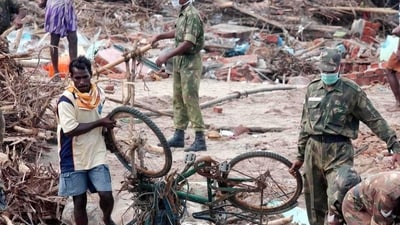
Anjamma saw her neighbor’s daughter’s hands hanging near the debris and she pulled her out; The girl was alive. After this, she limped towards the remains of her home. Only one of his four children was there. The rest of them, along with his mother, were swept away in the tsunami. “I only found my daughter Saujanya lying unconscious, without clothes,” says Anjamma. She found the body of her four-year-old daughter Sandhya on the road and the bodies of her other two children, Sharmili and Akhilan, in the hospital.
Read this also Center approved Rs 944 crore as cyclone Fangal relief to Tamil Nadu, more promised after assessment report
The three children were buried in a mass graveyard in Tharangambadi in the erstwhile Nagapattinam district, the worst-affected area in Tamil Nadu. A magnitude 9.1 submarine earthquake in the Indian Ocean region triggered a massive tsunami that devastated India’s eastern coast.
It was 26 December 2004.
At least 10,749 people were killed in India, many families were left homeless and some victims remained unaccounted for. According to the then Thanjavur District Collector K Radhakrishnan, around 7,900 people were killed in Tamil Nadu alone. And the district of Anjamma was the worst affected: “6,065 people were from Nagapattinam, which accounted for 75% of the deaths in the state,” says Radhakrishnan.
family broke up
Anjamma along with her husband Ayyadurai and daughter Sowjanya were shifted to a house allotted for tsunami survivors in Tharangambadi. “Soujanya swallowed a lot of water in the tsunami but she somehow survived. But, since then her entire body has become swollen and swollen and she can never recover,” says Anjamma. The girl died in 2023. Anjamma has her photograph but does not have photographs of any of her other children.
They have two more children – post-tsunami babies, Kesavan, 19, and Sandhya, 16, named after their youngest daughter, who died. Hundreds of families like Anjamma lost their children in the tsunami. Many mothers had to undergo reverse sterilization to have children – a government scheme to help women after the tsunami – because they had previously gone through Tamil Nadu’s population control programme. Anjamma did not do this, which made it easier for him. But life was better before the tsunami, she says.
Read this also Indian Ocean most affected by global warming, least known among oceans: Experts
“I tell my children now that our life was very happy. We had very little money but we were a happy family before the wave destroyed it,” says Anjamma. Her husband is still a fisherman but is barely able to make ends meet. “We struggle to get food twice a day. The house is almost falling apart and floods every time it rains.”
The National Disaster Management Authority (NDMA), India’s apex body for disaster management headed by the Prime Minister, was established in 2005 after the tsunami. Many of its guidelines were drawn from the experience of relief and rehabilitation in Nagapattinam, says Annie George, who worked for 15 years in the tsunami-hit community of Nagapattinam as CEO of the NGO Coordination and Resource Center (NCRC).
Functioning from the Nagapattinam District Collectorate, the NCRC comprised two NGOs (SNEHA and the South Indian Federation of Fishermen’s Societies), the district administration and the United National Development Project (UNDP). “After the tsunami, every step was full of trial and error, but we have learned from that to create a disaster management protocol now,” says George. “There were a lot of discussions in Chennai and Delhi on the experience of Nagapattinam on what the final policy should be. For example, NDMA has instructions on coordination mechanisms (between government and community) based on the lessons learned from the 1994 cyclone in Nagapattinam and Orissa. Nagapattinam had village information centers where people could talk directly to government agencies.
There was no shortage of help after the tsunami; 400 NGOs worked on relief and 200 on rehabilitation. The challenge was to reach the last person in the line. “We had to make sure that the most visible didn’t get the lion’s share of help and the least visible didn’t suffer,” says George. “There was a challenge in trying to understand the nuances of resettlement. When agriculture was affected, it affected farmers in different ways.”
Read this also Twenty years after Indian Ocean tsunami, Thai former fisherman is ready
trying to move forward
A little more than 300 km away, in Chennai, tsunami-affected families were relocated to the city’s suburbs. Tamil Nadu constructed 11,000 houses in Chennai, of which 7,000 were built with World Bank funding under the Emergency Tsunami Reconstruction Project.
One such area is Kannagi Nagar on the outskirts of south Chennai, where more than 15,000 families now live. Here each of these families is crammed inside a 150 square feet house. Some have taken nearby houses on rent by paying fees to the government.
Ravi Kumar, an auto driver, was playing cards with his friends on the beach in Santhome, Chennai, when the tsunami struck. Part of more than 1,000 families in Thidir Nagar, he and everyone else fled to the St. Thomas Cathedral Basilica for shelter. It is believed that a wooden pillar was erected on these footprints by Thomas the Apostle. No one died due to the monstrous wave.
Now, 20 years later, Kumar and others have been shifted to Kannagi Nagar. “For the last 20 years, ever since we came here, we have had to struggle for everything,” says Kumar.
“We were brought in a lorry like garbage and dumped here,” says K Sheela, another resident shifted to Kannagi Nagar. “We were better off where everyone had jobs, good houses and a healthy life.” “
When they came here in February 2005, there was no water or electricity. Hundreds of people protested. Eventually they got these facilities, but the state is now demanding maintenance dues, failing which, they have threatened not to transfer the houses in the names of the beneficiaries. Maintenance charges have increased 50 per month in 2005 250 from 2015. “It is a flat maintenance charge considering the increase in material cost and other charges. The decision was taken after much deliberation,” a state government official said on condition of anonymity.
Vanessa Peter, founder of the Information and Resource Center for Disadvantaged Urban Communities, says this increase has only increased the burden on families who are already vulnerable. “The government will have to issue sale letters to these families on priority and address the infrastructure issues in various housing programmes,” says Peter. It is believed that it is such indifference that has led people living in displaced houses in the tsunami quarters in Tondiarpet, in the northern part of Chennai, to sell their kidneys to survive – an issue that came to light in 2007 resulting in Hospitals have been blacklisted and those providing the facilities are being arrested.
A Anita in Kannagi Nagar says it was the community that saved her from such desperate measures born out of poverty. She was a middle-school student when the tsunami struck. She and her disabled mother survived. Now with two children of her own (her mother died a decade ago), Anita credits her well-being to her neighbors and NGOs. She works with the civic body to collect data from households by going door-to-door.
Survivors have formed close-knit communities that care for each other, and have created community leaders. In Nagapattinam, at the Annai Sathya Government Children’s Home, where about 100 children who lost one or both of their parents in the tsunami were kept, survivors and rescue workers, including Radhakrishnan, came together at a reunion on 22 December. Was brought.
“In general, all disasters help us recalibrate, and the tsunami has especially institutionalized the NDMA and state and district level disaster management agencies. Radhakrishnan says if a tsunami hits now, there is enough time to warn people through early warning systems, and there is better infrastructure for people to flee from the coast to inland. “In 2004, in Nagapattinam and Mayiladudurai, there were not enough link roads for people to escape.”


