



December 26, 2024, is the 20th year since 2004 Indian Ocean earthquake and tsunamiThe tsunami generated by the magnitude 9.1 earthquake originated off the Sumatran coast and was the third largest (by magnitude) in the world since 1900. The source was in the Sunda Trench, 30 km below sea level, where part of the Indo-Australian Plate subducts beneath the Burma Microplate, which is a part of the Eurasian Plate.
The 2004 earthquake ruptured 1,300 km of the plate boundary, creating a rift stretching from Sumatra in the south to the Cocoa Islands in the north. The earthquake was felt in Indonesia, Bangladesh, India, Malaysia, Maldives, Myanmar, Singapore, Sri Lanka and Thailand. It caused severe damage in northern Sumatra and the Andaman and Nicobar Islands and killed hundreds of people. The tsunami was most effective on remote coasts, affecting 17 countries in the Indian Ocean.
Overall, with a staggering death toll of approximately 227,000 people and more than 1.7 million displaced, the 2004 tsunami is the deadliest in recorded history.

unprecedented magnitude
Less than six years later, a magnitude 9.1 earthquake struck off the east coast of Japan on March 11, 2011, the largest earthquake ever to hit that country. It generated a tsunami that was up to 39 meters high and traveled 8 km inland. The twin disasters killed more than 18,000 people, displaced more than 500,000, and resulted in the Fukushima Daiichi nuclear power plant disaster.
Although there have been devastating tsunamis in the past – for example 1960 Chile and 1964 Alaska – two 21st century events have taught us important lessons. In particular, the 2004 tsunami highlighted how vulnerable the world was to natural hazards. It descended like a bolt from the sky, striking in the most unexpected places, and emphasizing the importance of dealing with disaster risk through preparedness and resilience.
Margaretha Wahlstrom, head of the United Nations Office for Disaster Risk Reduction (UNISDR), said in a panel discussion: “Ten years after the Indian Ocean tsunami, the world has taken important measures to make the world a safer place against disasters.”
The 2004 tsunami surprised researchers and hazard managers alike with its transoceanic reach. Since there was no recorded history of such a large event, the research community did not expect it to occur on the eastern seaboard of India. The only previous tsunamis were in 1881, caused by a major earthquake (magnitude ~8) off Car Nicobar Island, and the second tsunami was caused by the eruption of Krakatoa in 1883. These events produced only small sea waves as recorded by tide gauges at various points on the east coast.
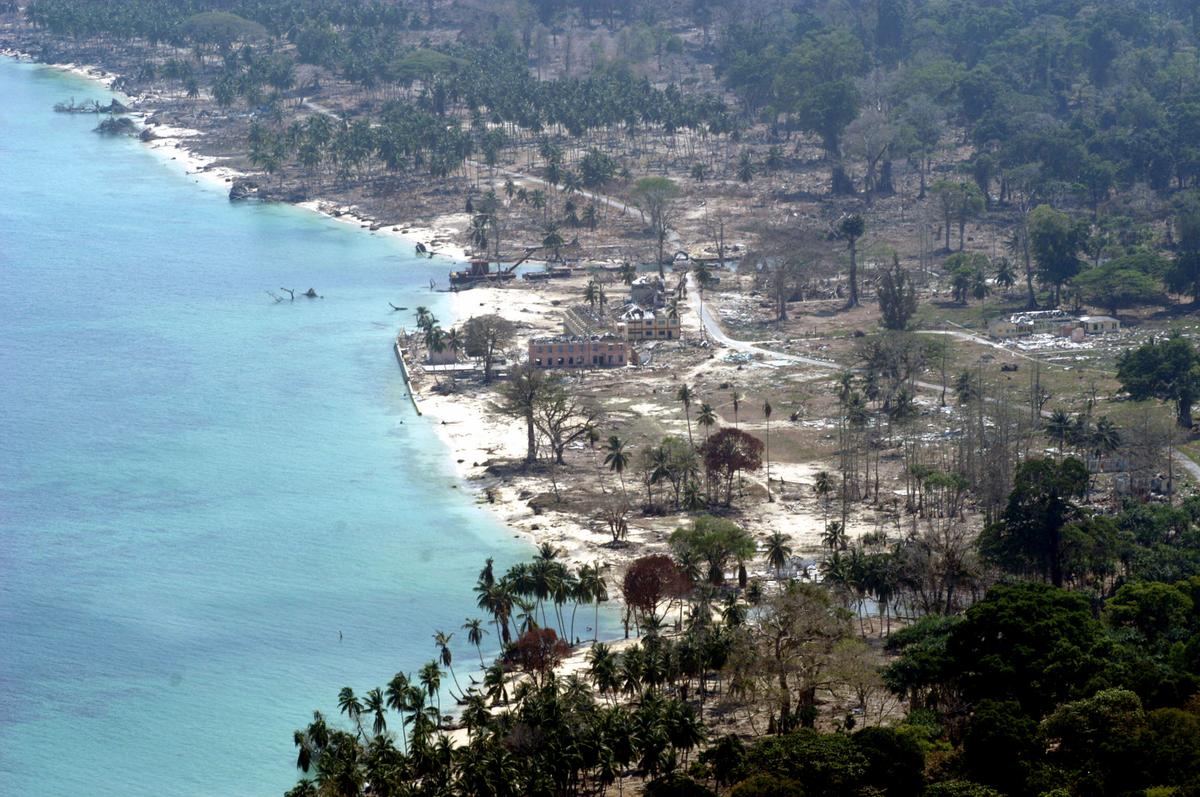
This view from the air shows the coastal devastation on Katchal Island, part of the Andaman and Nicobar Islands, in 2005. The island lost about 90% of its population in the tragedy of December 26, 2004. , Photo Credit: AFP/Getty Images
However, in the two decades since 2004, researchers have made tremendous leaps in the scientific understanding of tsunami generation and the technical aspects of earthquake monitoring. The Indian Tsunami Early Warning Center (ITEWC), established in 2007 by the Union Ministry of Earth Sciences, Government of India, is perhaps the most important step in this direction.
Operating from the Indian National Center for Ocean Information Services (INCOIS) in Hyderabad, ITEWC operates seismic stations as well as bottom pressure recorders and tidal stations throughout the Indian Ocean Basin – all 24/7. These systems can broadcast tsunami observations offshore and into the deep sea, providing early warning. Earthquake data from stations operated by the India Meteorological Department (IMD) and 350 global stations are also available on INCOIS.
Ocean monitoring systems also pass data in real time. For example, in about 10 minutes, the system can identify a potentially tsunami-causing earthquake and issue a tsunami alert or warning based on expected severity for countries bordering the Indian Ocean. India is the fifth country in the world, after the US, Japan, Chile and Australia, to have such an advanced tsunami warning system.
a new practice
The 2004 incident also stimulated important new developments in research. Tsunami geology work initiated by Brian Atwater of the US Geological Survey inspired researchers in Asian countries, including India, to explore it. Evidence of tsunami in historyAtwater’s work on the Washington coast of the western US had revealed evidence of an earthquake and tsunami in the 1700s, as well as those of his predecessors. An interesting part of this work was the use of changes in land elevation caused by earthquakes, which stressed or killed trees. Atwater used these impact impressions to determine when a piece of land had deformed and thus when it was suffering the effects of a tsunami earthquake.

Observations of depleted mangrove swamps revealed how the 2004 earthquake had caused height changes of up to 3.5 meters in some locations in the Andaman and Nicobar Islands. Scientists also wondered whether there might have been events in the past that led to the destruction of mangroves. As it turned out the 2004 earthquake had reopened the coffins of the past and exposed their skeletons in the form of dead roots clinging to the tidal platforms during low tide. Such roots exposed near Port Blair were used to estimate that the last earthquake occurred about a thousand years ago.
Excavations at Mahabalipuram, the port of the Pallava dynasty, revealed evidence of a similar tsunami. This was the first evidence of a tsunami by an Indian team before 2004. Researchers also examined sedimentary deposits on mainland islands and coastal areas to find evidence of other ancient tsunamis, while learning to distinguish between tsunami and storm deposits.
This effort is a good example of how the 2004 tsunami inspired the science of tsunami geology to become a new practice, leading to many new research papers and doctoral theses. The demand for more information about tsunamis also helped accelerate the use of GPS systems and earthquake equipment. With funding from the Ministry of Earth Sciences, research institutions established several new stations along the Andaman and Nicobar Islands, thereby strengthening seismic observations and geologic studies.
In another important step, tsunami modeling using mathematical tools helped researchers determine the extent of the flood. In particular, this disaster provided a stark reminder that nuclear power plants installed off Indian coasts may be vulnerable to heretofore underestimated risks. While the Kalpakkam Nuclear Power Plant faced huge waves, it automatically shut down after rising water levels tripped detectors. There was no release of radioactive material and the reactor was restarted six days later.
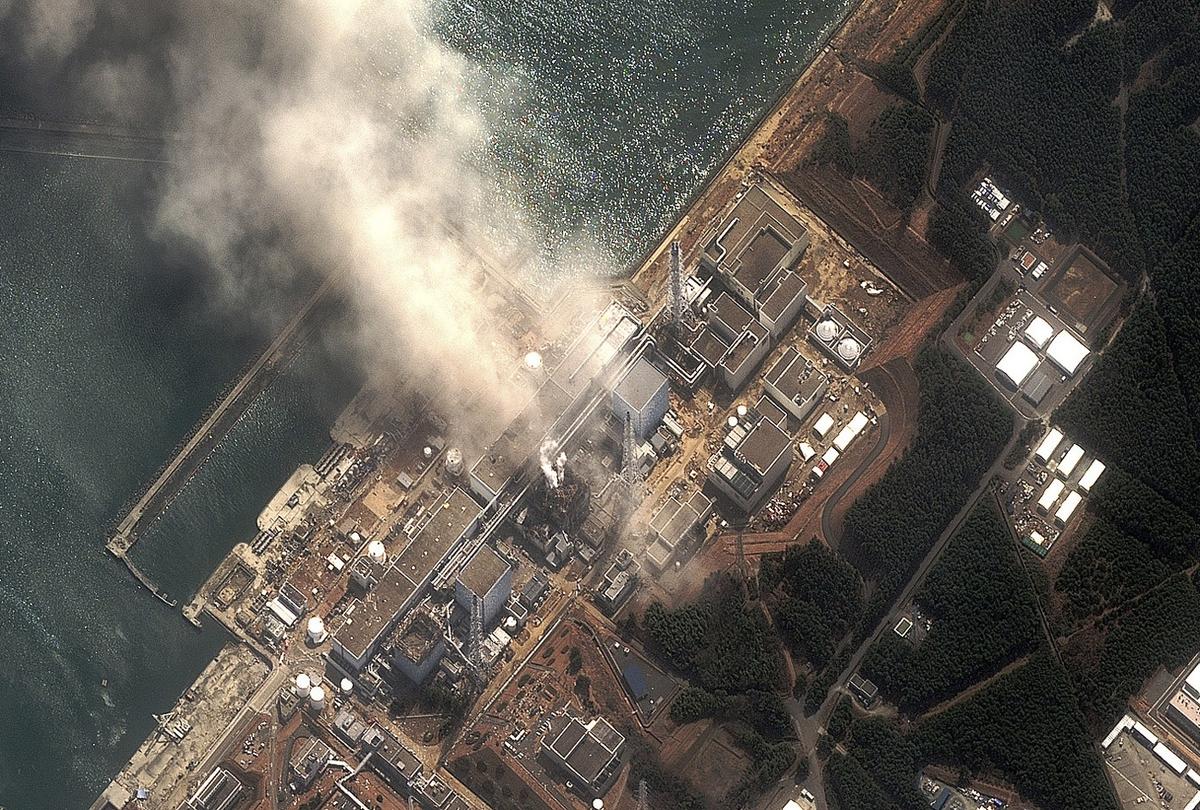
No. In this handout satellite image taken March 14, 2011, reactor 3 of the Fukushima Daiichi Nuclear Power Plant is seen burning after an explosion following an earthquake and tsunami. Photo Credit: DigitalGlobe
But the 2011 Tohoku earthquake reminded the world and India how quickly a nuclear disaster This can happen in the absence of failsafe. It was clear that radiation from the Fukushima facility had entered the human food chain. Researchers also found radioactive cesium in the breast milk of some women tested near Fukushima Prefecture three months after the disaster. What would have happened if the waves in 2004 had been strong enough to damage the reactors at Kalpakkam?
This question continues to resonate as the government is working on major developmental projects in Great Car Nicobar, including the construction of an international transshipment terminal. Some experts have also argued that the last major earthquake to affect the region before 2004 was over a millennium ago, so there is no imminent danger. But this question depends on how much we still don’t know. What if an unbroken patch of subduction zone between Myanmar and India gives way? The possibility of a sudden rupture of an as yet unknown part of the crust between Great Nicobar and Car Nicobar and causing a powerful earthquake and tsunami cannot be ruled out.
Experts and policymakers should also pay attention to other problematic locations, such as the Makran coast in the northern Arabian Sea and the Myanmar coast along the northern Indian Ocean. Both of these have the potential to cause large tsunamis. The Makran Coast, cutting across Iran and Pakistan, could direct the tsunami’s energy toward India’s west coast, which also hosts nuclear reactors and the city of Mumbai.
a major milestone
Science tells us that tension between tectonic plates builds until it reaches a critical stress, at which point the stored potential energy is released in the form of an earthquake. Subduction zones such as the Andaman-Sumatra region are becoming important as they provide signals for earthquake generation. The discovery of slow slip – tectonic faults that move several orders of magnitude slower and usually to a slightly greater depth – has also added a new dimension to this picture.

Recently, researchers have been studying seismic slip at plate boundaries to understand the processes that occur before and after large earthquakes. He has elucidated the occurrence of preseismic and post-seismic slip transients using laboratory experiments and numerical simulations. Some of these studies have implications for earthquake prediction: they indicate a formative process that initially involves stable, slow rupture growth within a limited area on a fault just before unstable, high-speed rupture occurs. it occurs.
a paper Published in 2015 (co-authored by one of the authors of this article) had indicated a clear movement of the ground beneath in the South Andaman between 2003 and 2004, before the earthquake – a silent event with a moment magnitude of 6.3. This event could have been a precursor to a megathrust earthquake. Analysis of geodetic data on a comprehensive set of global earthquakes. published in Science Short-term precursory fault slips were also confirmed before larger earthquakes.
As it happened, the 2004 Andaman–Sumatra earthquake became a major milestone in modern seismological research, providing a wealth of data to help science gain new insights into how earthquakes occur and the associated hazards.
Kusala Rajendran is a former professor at the Center for Earth Sciences, Indian Institute of Science, Bengaluru. CP Rajendran is Assistant Professor at the National Institute of Advanced Sciences, Bengaluru. He is the author of the book ‘The Rumbling Earth – The Story of Indian Earthquakes’.
published – December 26, 2024 05:30 AM IST


