



Eight-year-old Jameli Meghna, a Class 3 student of Korrapadu village, has to make a dangerous journey of about 3 km from her village through a dense forest full of poisonous snakes to reach school every day.
Yet, she is still pursuing her educational dreams along with 17 other children from her village. She bravely crosses three raging rivers and slippery roads to reach her school. This adventure becomes even more risky during the rainy season, when the roads on the hill tops become unsuitable for trekking due to landslides.
Despite growing awareness about the importance of formal, accessible schools remain a distant dream, especially for vulnerable tribal groups (PVTGs) living in the interior settlements of the agency areas of Alluri Sitarama Raju (ASR) district in Andhra Pradesh. . Education and the desire to pursue it. All these children belong to the Kondhu tribe, which speaks the Kui language and is spread across Andhra Pradesh and Odisha.
The village road is not suitable for walking and is dangerous for motorcyclists. The vehicle should be driven to the end of the road overlooking the valley, with a pile of rocks in the center.
Sometimes Meghna and the children have to wade through knee-deep water. Villagers say that their children often slip and get injured while going to school.
fear of graveyard
However, for Meghna, the graveyard lying on the way is more scary than the slippery roads and the jungle full of snakes. “I have got used to tracking. But the graves in cemeteries scare me,” she says, adding that, out of fear, children start running as they approach cemeteries and in that haste, they slip on the wet roads, becoming more injured. ,
“Parents take turns accompanying their children to the graveyard and pick them up from there after school,” says Gemmili Krishna, a former ward member and village elder. If children have to come alone they get scared and run away.”
Shri Krishna says that setting up a school in his village will solve his problems and give his children a better chance to excel academically.
snake encounter
When? The Hindu Visited Korrapadu on bike with much difficulty, passing through rocky terrain and crossing some streams, found a poisonous snake killed by the local people. The children said in unison that they often have to face snakes while going to school.

“It is impossible for us to drop and bring children to school as we have to go to work in agricultural fields or coffee plantations. During the coffee picking season, we have to protect the crop from monkey attacks and we cannot leave the place.”gemmili krishnaFormer Ward Member, Korrapadu
Korrapadu can be reached by two-wheelers; Some also have bikes. “It is impossible for us to drop and bring children to school as we have to go to work in agricultural fields or coffee plantations. During the coffee plucking season, we have to protect the crop from monkey attacks and we cannot leave the place,” says Mr Krishna.
A school was sanctioned at Tattipalem, another hill village, a short distance from Korrapadu, but there is no building there. Teachers hold classes under the shade of trees and under a temporary shed during rains.
There is Mandal Parishad Higher Primary School at Kothapalem in Chintapalli mandal of ASR district on the way to Korrapadu. Children from four villages study here, but about 20 students from Kidagari in G Madugula mandal have to cover a distance of 3 km through forest and hill slopes to reach the school. A total of 174 children study in this school from classes one to seven.
“We leave at 7 in the morning and it takes an hour to reach school. We start in groups as it is safer to be with others when walking through the forest.K.RadhikaGovernment school student, Kidagari village
K.Radhika, a 10-year-old from Kidagari village, who is studying in class six and aspires to become a doctor, said she has no option but to walk to school. “We leave at 7 in the morning, and it takes an hour to reach school,” Killa Bhanu, another seventh-grader from the same village, said reluctantly. We start in groups as it is safer to be with others when walking through the forest.
Due to lack of proper roads, these children have to walk barefoot, which affects their studies. “They cannot bear the weight of the school bag, which weighs around 4 kg to 5 kg, and that is why they leave their bags at school,” says P. Srinivas, who teaches mathematics and science at the school. ”
Since children could not study at home, they lagged behind. So, from last year we started giving them plastic bags to carry books. We started giving them homework for only one or two subjects every day so that they could take only those books to study at home, says Mr. Srinivas.
With 20 years of teaching experience in government schools in the plains, Mr. Srinivas says language is a significant barrier in teaching these children. He says that even children are not receptive towards new people. “After coming here on promotion two years ago, I found it difficult to teach for the first few months because the children would not respond or respond due to the language barrier,” he says.
shoe worries
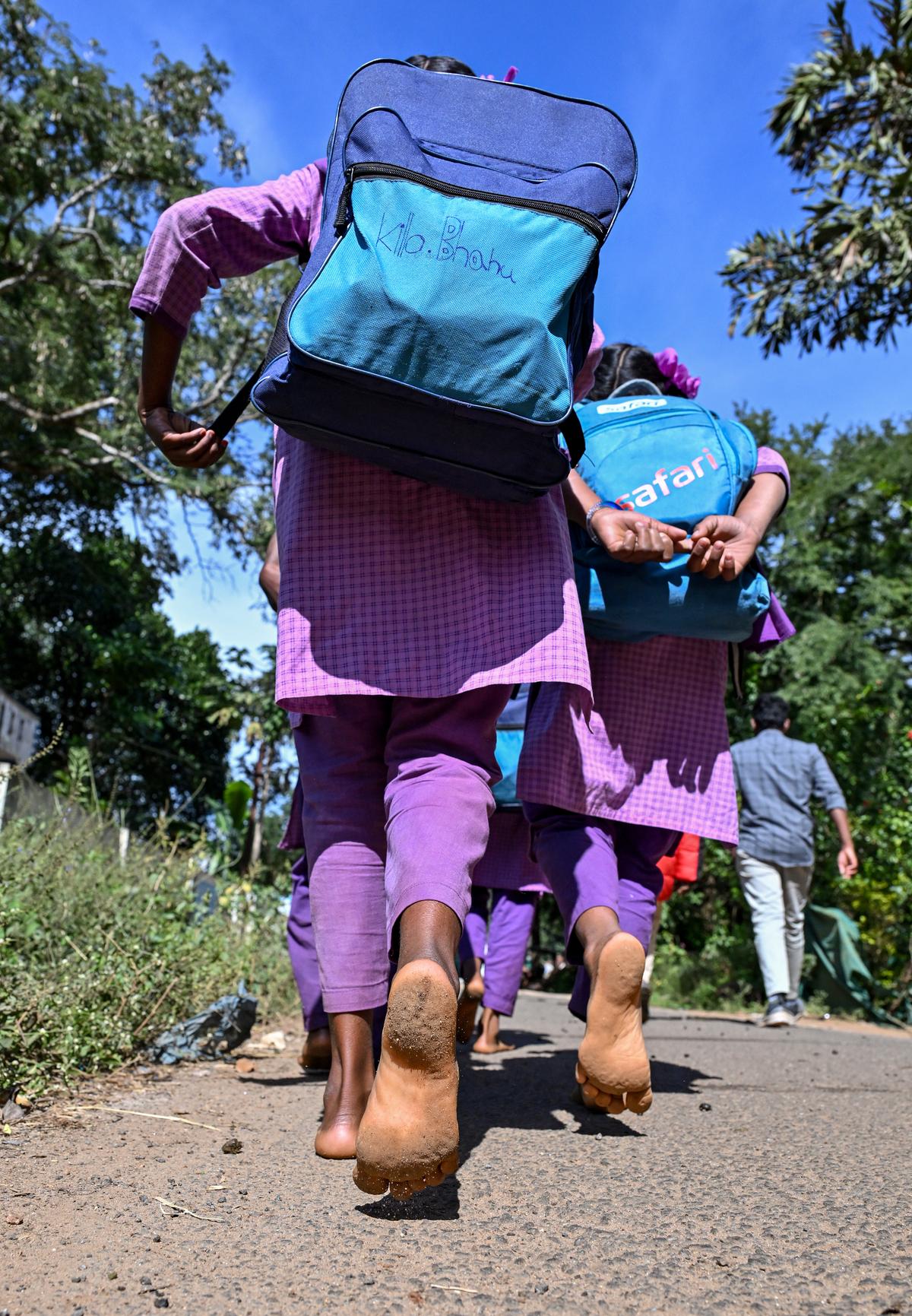
The previous government had provided a pair of shoes to each of these children. However, this practice was futile, as parents say the shoes did not last long in the muddy, mountainous terrain. , Photo Courtesy: KR Deepak
Another issue of concern about these children is that they walk barefoot on muddy roads even during the rainy season, putting them at risk of health problems. Srinivas says that parents do not insist on their children to wear shoes and slippers because they are not in the habit of wearing shoes and slippers at home.
The previous government had provided a pair of shoes to each of these children. However, this practice was futile, as the shoes did not last long in the muddy, mountainous terrain in which they trekked.
“While crossing rivers, their shoes would get wet and this would cause rashes on their feet. So he stopped wearing them. Students should have been provided with shoes similar to Crocs. ,school student’s parentsKidagari Village
“While crossing rivers, their shoes would get wet and this would cause rashes on their feet. So he stopped wearing them. “Students should have been provided shoes similar to Crocs,” says the parent of a Kindergarten student.
Meanwhile, J., 18 km away from Chintapalli mandal headquarters. 24 children from Chintalwada, Dabbagandi and Kondapalli study in another primary school run by the Tribal Welfare Department in Rallagadda village. To reach their school, children from Kondapalli have to walk a distance of 4 km, while children from Chintalwada have to cross a stream.
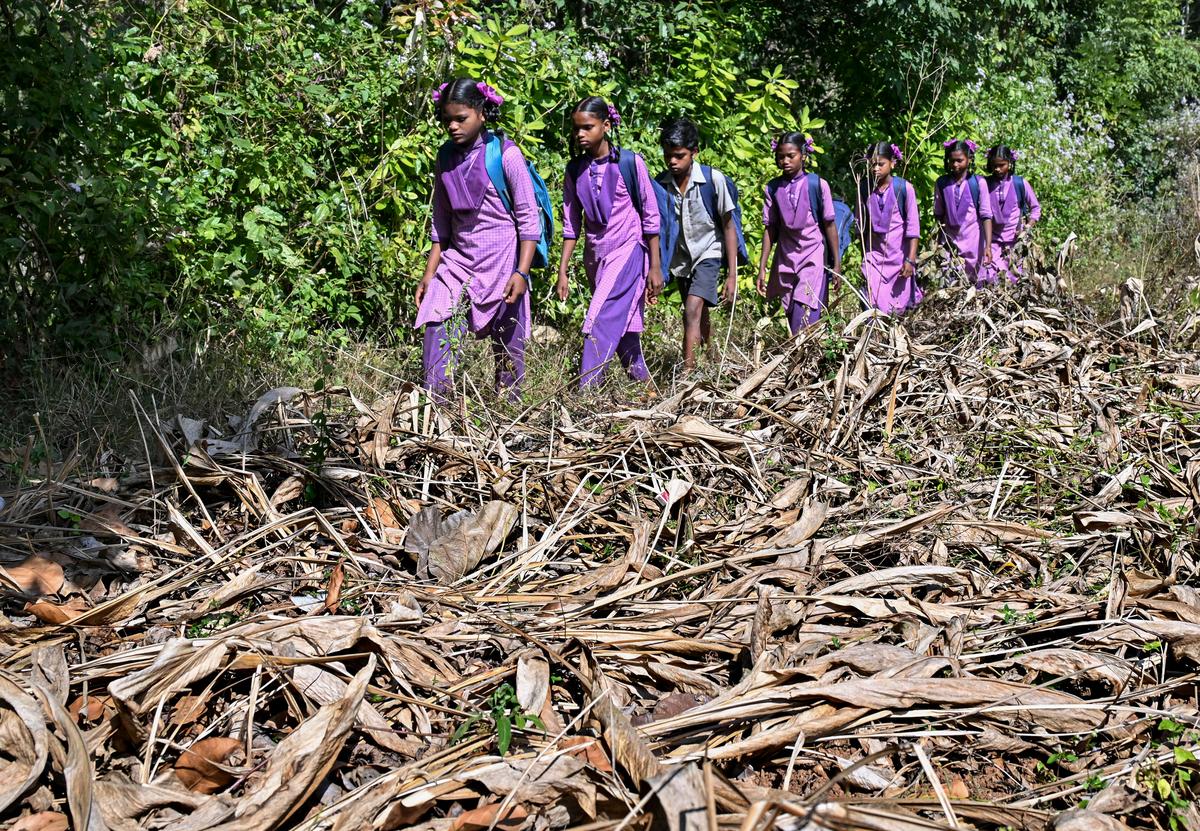
We collected ₹2 lakh from the villagers two years ago and built a kutcha road so that our children could reach school safely. But a villager in Kondapalli says it was washed away during the recent rains Photo courtesy: KR Deepak
“We collected ₹2 lakh from villagers two years ago and built a kutcha road so that our children could reach school safely. But it got washed away during the recent rains,” says a villager from Kondapalli. Some villagers say they have sent their children to their relatives’ homes in remote places where they have good road access to schools.
The lack of road access to schools is not limited to one or two panchayats or mandals in the district. Six students from Tertala, which falls under G Madugula gram panchayat, travel more than a kilometer on the hilly ghat roads of Killamkota to reach school. Korra Meghna, a Class 5 student of Killamkota school, says she has to cross a drain to reach her school.
According to an official of the Integrated Tribal Development Agency (ITDA), Paderu, 972 villages do not have road connectivity within their limits. In the entire ASR district, about 1,224 villages are without roads.
“Schools are located within two to three km of these villages, and going to school is a problem for children in these villages, especially when it rains. The rivers are flowing in full force, making it dangerous and difficult for them to cross,” says the official.
According to the official, the government plans to build roads to these interior villages under the Mahatma Gandhi National Rural Employment Guarantee Act (MNREGA) and other funds in the next three to four years.
Officials say there are about 120 ashram schools, 11 gurukul schools and 11 Eklavya model residential schools in the state, each constructed at a cost of ₹20 crore.
Vanthala Bhaskar Rao, a graduate from the Kondhu community, says there needs to be improvements in infrastructure and changes in the education system to give children from tribal areas a fair chance to compete with the mainstream world.
Shri Bhaskar Rao Ji is a volunteer of SR Sankaram Adivasi Sahay Kendram, a community-run service center to support tribals in accessing public services in ASR district, serving Madugula mandal. He made his efforts to extensively visit the tribal areas, to know the problems of the people there, to create awareness among the tribals about the facilities available in medical and health services in the government and to address their issues with the concerned authorities. Dedicated to.
“The tribals, especially the Kondhu community, have started making lifestyle changes and have shown impressive progress. Some of them are even pursuing higher education. Even though education for girls was taboo, they now encourage their girls to go to school,” says Mr. Bhaskar Rao.
Mr. Bhaskar Rao insists that teachers should remain at their workplace or at least in the nearby divisional headquarters so that they can teach till the last hour of the school day. Some teachers stay till Visakhapatnam and come to school on time as they have biometric attendance, but parents say they will not stay till the last term.
changing lifestyle
The Kondhu, belonging to the PVTG, are dependent on ‘Konda Podu’ (shift farming on the hills) and working in agricultural fields and coffee plantations. They sometimes hunt animals for their own consumption.
Once known for their infamous ‘demon marriage’ culture, where a man forcibly abducted a woman of his choice and married her, these tribes are also slowly adapting to the changing lifestyle. Villagers say that due to fear and awareness of the police case, such marriages are no longer taking place.
With the younger generation becoming educated and migrating in search of livelihood, children have also started showing interest in obtaining formal education. Residential schools have also made a huge contribution in providing education to these tribals. Youth, especially men, who have bachelor’s degrees started working in Madugula, Paderu and Visakhapatnam, says Mr. Bhaskar Rao.
However, Mr Srinivas says it is important to ensure a conducive environment in schools to retain and nurture their interest in academics. The teacher explains, “They are brought up in an environment where they roam freely in the open forest, and if we try to confine them to the classroom the whole day, they cannot stop coming to school. Therefore, we allow them to play during breaks and even while taking classes.
He says that people who see the school from outside feel that children keep playing all the time without studying, but it is not so.
published – December 27, 2024 12:34 am IST


