



In the shadow of the huge columns that surround St. Peter’s Square, Nancy Samai sells tickets to visitors to the Vatican Museums. A Roman Catholic, Ms. Samai arrived in Italy 22 years ago after fleeing civil war in her native Sierra Leone. As she works, she can look out the same window from which Pope Francis welcomes pilgrims on Sundays. Like many of them, she wonders if one day the face looking out that window might be black. She says, “If Barack Obama can become president in America, then surely the next Pope can be African.” “This is my dream. “This is what I am praying for.”
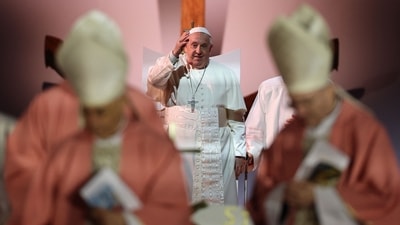
Similar thoughts may come to the minds of the 21 bishops whom Pope Francis will appoint as cardinals on December 8. Those under the age of 80 when he dies or retires will still be eligible to participate in the conclave, the assembly that selects the next pope. Francis has used his power of nomination to shift the geographic balance that, until recently, overwhelmingly favored the rich world, especially Italy. At the last conference in 2013, Europeans and North Americans cast 64% of the votes. In the election held immediately after the Consistory, they would have 52%.
The Pope now performs most of his duties from a wheelchair. But this is due to a defect in the right knee and not any life-threatening disease. In September Francis began his longest trip abroad to date, flying more than 30,000 km to visit Indonesia, Papua New Guinea, East Timor and Singapore. Yet, at the age of 87, the punitive demands of the Holy See will become increasingly burdensome and, as time goes on, the temptation to hand over power to a younger, more fit man will certainly increase.
As an Argentine, Francis is the first non-European to lead the church since 741 AD, when Gregory III, a Syrian, ended his rule. Now that the Church has broken with the structure that it held intact for nearly 13 centuries, there is inevitably speculation that its successor might come from Africa or Asia. Ghana’s Peter Turkson was widely nominated for the papacy at the last conclave, but his star has since waned.
According to the Vatican, the two continents accounted for 31% of the global Catholic population of about 1.4 billion at the end of 2022. But these figures underestimate the importance of continents because they do not include China, where there are perhaps an additional 12 million Catholics.
Furthermore, they record the number of baptized Catholics considered alive, but take no account of those who have since abandoned their faith: in Europe and North America, which nominally includes those around the world. The flock, comprising 27%, is disillusioned with secularization and clericalism. Abuse scandals have led large numbers of Catholics to renounce their faith or allegiance to Rome. The same is increasingly true of South and Central America, which accounts for 41% of the total. However, this is not true for Africa, the continent where the Catholic flock is growing fastest: between 2013 and 2022, it increased by 22% (see chart). The number of Catholics in Asia (except China) increased by 13% over the same period.
Of course, there is no scientific way to measure the intensity of collective faith. But some broadly drawn measures show that Africa is also where faith is strongest. The first is the level of adherence. In 2023, researchers at Georgetown University in Washington looked at mass attendance in 36 countries. Although only two Africans were included, they were ranked first and second: 94% of Catholics in Nigeria and 76% in Kenya said they went to mass at least once a week. The second measure, at least for men, is the number of people studying for the priesthood. Vatican figures show that in the ten years to the end of 2022, the number decreased on every continent except Africa, where it increased by 24%. Bigard Memorial Seminary in Enugu, Nigeria is considered the world’s largest training school for Catholic priests, with over 700 seminarians.
Other powerful arguments also strengthen the African pontiff’s case. But formidable obstacles also arise. The first, usually discussed in sotto voce, is “protecting”, a term that people in and around the Vatican prefer to “sexual abuse”. There are fears that the scandals that have already rocked the Church in Europe, North America and parts of South and Central America could begin to erupt in Africa during the next Pope’s tenure.
This is not the only such risk. On a continent where a man without a woman often faces social rejection, some priests take on a female partner early in their careers and sometimes even father children, only to be promoted. To abandon both partner and children. A pontiff whose elevation it was discovered that he was following that path would be a cause of great embarrassment to the Church.
All other factors relate to the character and structure of the next conference. After the upcoming union, there will be 140 so-called cardinal-electors. Of these, all but 30 would have been appointed by the ruling Pope, who has mostly favored similarly broad-minded men. African cardinals may be too conservative for them, although some will undoubtedly appeal to the more traditionalist cardinals in America’s deeply divided Catholic Church. In the 1990s, Pope St. John Paul II privately complained that African bishops were too reticent in dealing with him. Francis is unlikely to share that view: the two biggest challenges to his authority have come from African cardinals.
Robert Sara of Guinea, whom Francis had put in charge of the Vatican department that administers liturgy, mounted the first challenge. One of the most visible changes introduced by the reformed Second Vatican Council in the 1960s was requiring priests and bishops to speak at mass facing their congregations. But in 2016 Cardinal Sara told him he should return to the old practice of turning his back. Six days later, the Pope rebuked him and the Vatican issued a statement claiming his words had been “misinterpreted”.
The second rebellion was more broad-based and forced Francis to make a terrible U-turn. Last year, the Vatican’s chief theologian published a document authorizing the blessing of gay couples unless it was done as part of a religious ritual, let alone a gay marriage. This document caused an uproar in Africa. The head of the continent’s bishops, Congolese Cardinal Fridolin Ambongo Besungu, went to Rome and threatened Francis into supporting the opt-out for Africa. It was a rare, if not unprecedented, declaration that a sector of the hypothetically universal Church need not follow the Vatican’s guidance on a specific issue.
Another reason to doubt that the next Pope will come from Africa arises from Francis’s policy of choosing cardinals from unlikely places, often in countries where other religions are dominant, to show that his Church has a No part has been forgotten. He has provided the scarlet biretta, the four-pointed hat of cardinals, to the bishops of Ulaanbaatar in Mongolia, Ekwulobia in Nigeria, Huehuetenango in Guatemala, Tonga and Stockholm.
“The result is that at the next conclave very few cardinals will know each other – or who to vote for,” says Andrea Gagliarducci, an independent Vatican analyst. One Cardinal they all know is Pietro Parolin, the most senior Vatican official. In November bookmakers gave him the best odds to succeed Francis. But many view Cardinal Parolin with more fear than affection, and the unique character of the next conclave could also mean that a little-known cardinal with a magnetic personality could emerge as a serious candidate. Some cardinal-electors in Africa fall into that category. But there is one exception: Cristóbal López Romero, a cheerful, bearded Spaniard and member of the Salesian order who is archbishop of Rabat in Morocco. Like Francis, the second-generation son of Italian immigrants, Cardinal Lopez Romero, the white cardinal of an African archdiocese, has the advantage of strong ties to both the poor and the rich world. He lived in Latin America for more than 20 years.
Pope for the best
The final consideration is that although cardinal-electors do not always vote for papal candidates from their own neighbourhood, Africa’s representation at the next conclave will not reflect Africa’s importance. The continent’s Catholics number one-fifth of the total. Nevertheless, after the formation of the Union, Africa will have only 18 cardinal-electors able to cast 13% of the votes. In sharp contrast, Asia, where Catholics are barely half the number, will soon have a dominance of 18%. Largely because of Francis’ appointments, Latin America is likely to have a greater say in who becomes the next pope. A Vatican official said, “It seems as if he was pointing us in that direction.”
Until recently, the speculators’ favorite was Luis Antonio Tagle, a much-favored cardinal from the Philippines who headed the Vatican department responsible for most of the poor. But his prospects were damaged in 2022 when Francis removed him as president of Caritas Internationalis, the Catholic Church’s global charity, along with the organization’s entire leadership. The Vatican cited “failures of management and processes, seriously affecting team spirit and staff morale”.
Asia, like Africa, is a growth region for the Catholic Church. In Georgetown University’s mass attendance rankings, Lebanon (69%) and the Philippines (56%) rank third and fourth. Although the number of Asian candidates for the priesthood declined by 9% from 2013 to 2022, it was less than the steep 31% decline in Europe.
So could any surprises emerge from the east? The name sometimes mentioned is that of Cardinal Lazarus Yoo Heung-sik of South Korea, head of the Vatican’s department for the clergy. Like many Asian Catholics, he was baptized late, at age 16. Said to be theologically mainstream but active in denouncing social injustice and political authoritarianism, Cardinal Yu’s profile is not dissimilar to that of the late Pope, St. John Paul II, who stood for. A Catholic religion with some ifs and buts. Kim Whanyoung, a Korean writer on religion, says that the Cardinal has all the characteristics of the residents of his native region of Chungcheong: “They are kind and respectful, and when faced with disputes they often do not reveal what they are thinking. ” These would be useful qualities for any Pope.


