



The discovery was shocking – the lifeless body of a 55-year-old woman was lying in a dark corner of the basement of an old building, with multiple wounds on her head. A stone stained with blood lay ominously nearby, and a lock of hair clutched tightly in his fist suggested a desperate struggle. Her disheveled clothing raised suspicions of sexual assault.
It was June 14, 2023, when Pochampally police teams from Rachakonda Commissionerate reached an abandoned building in Pillaipalli village, about 40 km from Hyderabad. An empty 180 ml wine bottle looked like just another piece of garbage amid the scattered clues. Little did they know that this simple glass bottle would reveal the sinister identity of the killer.
Acting on a tip-off, the police caught Mohammed Anwar, a labourer, aged around 30, from Bihar, working in an under-construction building in the village. Under intense interrogation, Anwar confessed to his crime – having raped the woman after finding her alone in the basement in an inebriated condition and then silencing her with a fatal blow with a stone.
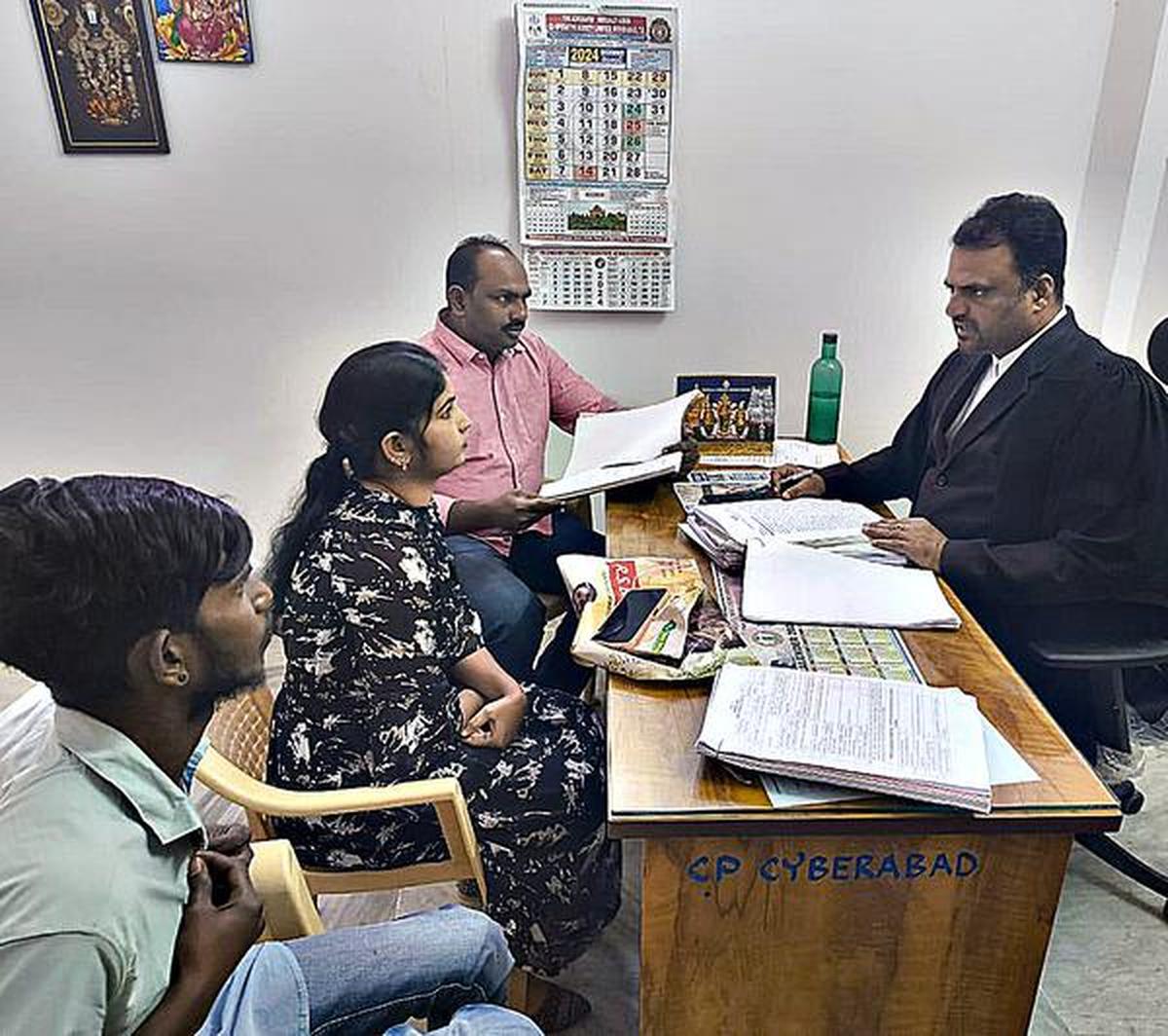
Police prosecutor talking to witnesses before the hearing of the case. Of the 30 convictions this year, 14 were related to POCSO cases. , Photo Credit: Special Arrangement
Although the confession brought immediate relief to the investigators and the case was solved within 48 hours, their ordeal was far from over. Ensuring a conviction was a much greater challenge, as confessions made to the police are inadmissible in court. Determined to build a strong case, the team carefully examines every piece of evidence collected from the crime scene.
Not much progress could be made. The first breakthrough came in the form of fingerprints lifted from an irrelevant liquor bottle found near the body. Of the two accidental prints recovered, one was unusable. But the second one exactly matched Anwar’s fingerprints collected during his arrest.
The evidence confirmed Anwar’s presence at the crime scene, but failed to conclusively prove that he had committed the murder, despite his confession and willingness to lead the police to the scene. Even his confession of sexually assaulting the victim was not enough to put an end to suspicion. The forensic doctor also mentioned ‘recent vaginal penetration’ in his autopsy report, but this left room for Anwar to claim that he might have tortured the woman but someone else might have committed the murder, thereby Get involved in this process.
Investigators were apparently close to solving the case, yet significant shortcomings remained. The breakthrough came from vaginal and cervical swabs of the victim collected during the autopsy. Forensic experts in their analysis conclusively linked Anwar to the crime, as the swabs matched his DNA profile, turning suspicion into certainty.
Forensic experts employed autosomal STR analysis – a DNA profiling technique that uses short tandem repeat markers on autosomal chromosomes to identify individuals – to match the DNA profile of the accused with samples collected from the crime scene . This technical evidence left no room for doubt, thereby conclusively establishing the arrestee’s involvement in the rape and murder.
In the courtroom, the First Additional District and Sessions Judge, Bhongir, said that “the prosecution has proved and established the guilt of the accused under sections 376 and 302 of the IPC beyond all reasonable doubt”. The judge sentenced him to 20 years’ rigorous imprisonment for rape and life imprisonment for murder, both sentences to run concurrently.
Rachakonda Police Commissioner G. Sudheer Babu says, “This case is an excellent example of how concerted efforts by investigators, forensic experts and prosecutors ensure that no criminal goes unpunished.” He is proud of not only the conviction in this case, but also the life imprisonment of 49 people in 30 cases this year alone.
Teamwork, technique and perseverance
Hailing it as a ‘remarkable achievement’ in the backdrop of a generally ‘low conviction rate’, the Rachakonda Police Commissioner attributed the success to teamwork and constant monitoring. A dedicated Court Monitoring Cell (CMC) was formed headed by Deputy Superintendent of Police-rank officers to oversee the hearing of important cases. Such specialized branches are now common in all police units.
Once the investigation is completed and the charge sheet is filed, the CMC examines every detail of the judicial process. When the trial schedule is announced, the cell ensures the presence of punches and eyewitnesses, forensic doctors and technical experts, leaving no one to chance.
Each case is closely monitored by two officers: a court duty officer from the local police station and a court monitoring officer from the CMC. This approach has led to convictions in 30 life imprisonment cases – 12 murders, two dowry deaths, one murder for profit and one murder-cum-POCSO Act case. Life imprisonment was reserved in the remaining 14 cases in which the POCSO (Protection of Children from Sexual Offenses) Act was invoked.
Some prosecutors believe that it is comparatively easier to ensure conviction in POCSO cases due to the stringent provisions of the special law. Unlike other crimes, POCSO places the burden of proof on the accused, who is presumed guilty unless proven otherwise – an advantage for law enforcement in achieving justice.
In the Pochampally murder case, it was up to the police and the prosecution to prove Anwar’s guilt. “Even POCSO cases present peculiar challenges. When the case comes up for hearing, victims and their parents sometimes refuse to testify as they often reach marriageable age by then,” says Jupalli Ramesh, an officer at the Commissionerate Crime Records Bureau.
In some cases, parents refuse to appear in court out of fear that the stigma of sexual assault may spoil the future of their children. They privately tell the police that they do not want to attract more attention by appearing in court and sharing evidence.
In one such POCSO case registered in 2020 and investigated by the Balapur police, the CMC noted that the testing schedule was disrupted several times. The trial involving the eight-year-old victim was repeatedly delayed as her parents stopped attending court after four years, worried the case would impact her future.
Respecting the sentiments of the parents, the Commissioner remained firm in providing justice. A team of women officers of various ranks met the family and reminded them that it was the headmaster of the girl’s school who had abused her. He told the parents, “The accused, Philip Joseph, who was ultimately removed from his post, should be punished to set an example and ensure that no other child suffers at the hands of such a predator. “
After several counseling sessions and persistent efforts by the authorities, the parents and the young girl agreed to appear in court. The attack took place on the afternoon of January 28, 2020, when the eight-year-old boy had gone to the school office to get drinking water. The accused headmaster lured her and took her to his office, where he assaulted her. He also threatened to kill me if I told anyone about this.
The next day, the girl’s mother noticed injuries on her while wearing her school uniform. The child, apparently afraid to tell about the attack, did not say anything when asked. The mother contacted the police only after the medical examination confirmed assault. “Such cases require more than prosecution and policing; They demand compassion and sensitivity,” says Sudheer Babu, reflecting on the case that led to the life imprisonment of the accused this year.
vigilance at every step
The murder of an elderly T. Ravinder by his own son in Adibhatla, on the outskirts of Hyderabad, in April this year is another example of how the CMC played a vital role in helping investigators. The charge sheet was filed, evidence was presented, and final arguments were underway, when the CMC official discovered a critical lapse by the Adibhatla police at the last moment.
Ravinder was at home when his 25-year-old son T. Anurag attacked him. Police said in the charge sheet that the youth, addicted to smoking ganja, was harassing his parents. On April 4, he poured petrol on his father and set him on fire. His mother was in the toilet and he locked the door from outside, ensuring that she could not interfere. Ravinder, engulfed in flames, ran outside screaming for help before he was injured.
According to police records, Anurag then chased his father and attacked him on the head with a stone, killing him instantly. He went to Vanasthalipuram police station around 10 pm and surrendered before the Station House Officer (SHO). However, while preparing for the trial, investigators had overlooked an important detail: they failed to produce the SHO’s statement in which Anurag had confessed.
By then, the trial had reached its final stages, with all the evidence and documents presented in the court. Since the defense counsel was likely to point out the lapses, the CMC advised the investigators to submit the statement of the SHO under Section 311 of the Code of Criminal Procedure. The judge accepted it after informing the defense counsel, closing the gap in the prosecution’s case.
This case is the only one to ensure a conviction in the same year it was reported. The murder took place on 4 April and the judge imposed a life sentence on 13 December.
with an eye on delivering justice
In contrast, most other cases were reported several years ago. The oldest of these cases involves the kidnapping and murder of car driver Mohammed Ilyas Ahmed, a 50-year-old man from Nizamabad. The crime, committed by a gang of four men – G.Srinivas, R.Mahesh, R.Gouraiya and G.Sridhar – was reported to the Bommalaramaram police station (Yadadri Bhuvanagiri district) in December 2014.
The quartet, hailing from Karimnagar district, hired Ahmed’s car on the pretext of visiting Vemulawada and Kondagattu temples. After reaching a secluded place on the outskirts of Kondagattu, they strangled Ahmed to death. The gang then drove for about 180 kilometers and dumped the body at a secluded place in Mariala village under Bommalaramaram police station limits and set it on fire.
Since the body was so charred that it was difficult to identify, the identity of the victim could not be ascertained initially.
Autopsy was conducted. The femur bone and viscera were sent to forensic experts for analysis. Through internal communication, the police learned that a man of similar age had gone missing from Nizamabad district. After examining the charred remains, Ahmed’s family identified the body and confirmed that it was their missing relative.
About a month later, investigators stopped a car and detained four people who were unable to provide valid vehicle documents or answer basic questions. During interrogation, the quartet confessed to kidnapping and killing Ahmed before stealing his car. Following due procedure, all scientific evidence was collected, and a charge sheet was filed. Later the accused were granted conditional bail and released from jail.
After several court adjournments, the gang was excused from attending the hearing, with the assurance that they would be present when the trial began. However, it took almost three years for the trial to begin and during that time, the accused stopped appearing in court altogether, disrupting the trial schedule. Non-bailable warrants were issued for their arrest, but when police went to their listed addresses, the accused were nowhere to be found, suggesting that they were trying to avoid trial.
Senior officials formed special teams to trace the first and fourth accused Srinivas and Sridhar respectively and produce them before the court. Since the other two suspects could not be located, the police divided the hearing into the case. Separate trials for Srinivas and Sridhar were completed and both were sentenced to life imprisonment for their involvement in the murder.
“We hope to ensure the presence of the other two persons. His punishment is also almost certain. Rachakonda police will endeavor to repeat this success of ensuring conviction in all cases,” Sudheer Babu says confidently.
published – December 27, 2024 08:57 AM IST


