




Bustling crowds at Bow Barracks in central Kolkata. The century-old Anglo-Indian hub has become a prime destination to celebrate Christmas in the city.
| Photo Credit:
DEBASISH BHADURI
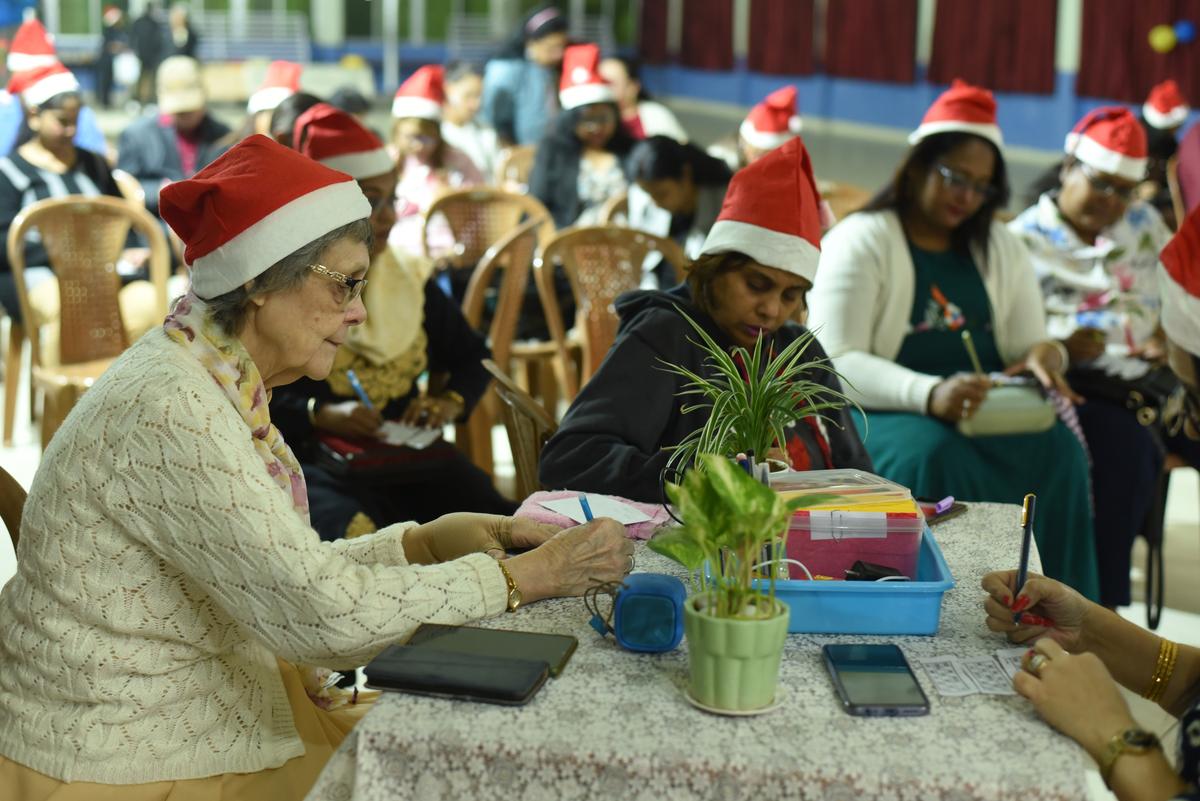
Sister Marisa at a reunion with her former Anglo-Indian students at Marian Co-Educational School in Kolkata’s Picnic Garden area.
| Photo Credit:
DEBASISH BHADURI
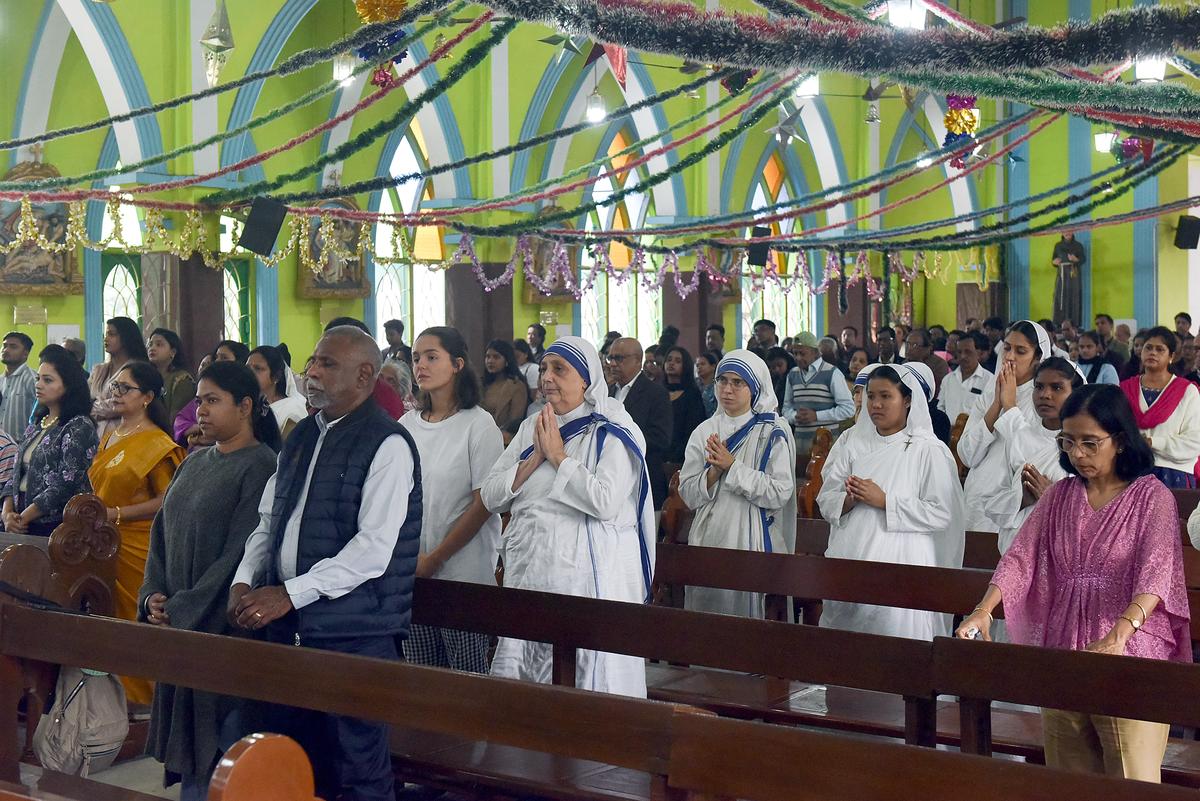
Morning mass at St. Teresa Church on Christmas.
| Photo Credit:
DEBASISH BHADURI
Guy Gomes, 54, feels that December 23 is the best day in the Christmas week to visit Bow Barracks in central Kolkata. Like every year, this year too, Guy found himself at the centre of the quadrangle in the area, guiding hundreds of visitors who thronged the century-old Anglo-Indian hub to soak in the Christmas festivities.
“So many people from around the city, especially the Anglo-Indians who moved away, come here every year for the musical night. The atmosphere is electric,” the travel industry professional says. Guy is one of the few Anglo-Indian residents who continued living at the brick-coloured, three-storey buildings at Bow Barracks, believed to have been a garrison’s mess for the Allied Forces during World War I.
A little north of Kolkata’s central business district, dotted with several colonial buildings, a narrow lane leads to these dilapidated red buildings with green windows. Over the past few years, Bow Barracks has become a prime destination to celebrate Christmas in the city.
Down the 500-metre lane at the festively decorated barracks, white-haired residents chat in circles as visitors enthusiastically photograph each other under glittering Christmas lights. Some groups revel in reuniting with family and community friends, sharing home-made wine.
“Many Anglo-Indians eventually moved out of here to different parts of the city, and many more moved out of the country for better prospects,” Guy says. “But the hype around visiting Bow Barracks during Christmas has only increased in the last decade. The crowd of visitors only gets bigger every year,” he says, smiling.
A day later, on Christmas eve, around 100 people dressed in finery — suits, dresses, ornate saris, and salwar kameezes — pour into St. Francis Xavier’s Church in Bowbazar, a stone’s throw from Bow Barracks. The church stands out in the densely populated neighbourhood in central Kolkata with pink and white columns and can be traced to the late 19th century.
Earlier, the church was the parish for most of the Roman Catholic Anglo-Indians who lived in Bow Barracks. However, as members of the community migrated out of the area and the country, the number of Anglo-Indians attending dwindled massively over the last decade.
The great exodus
Article 366(2) of the Constitution describes “Anglo-Indian” as “a person whose father” or “other male progenitors in the male line” is of European descent, living in India. While India’s last census in 2011 pegged the total number of Anglo-Indians at 296, members of the community believe the figure is a gross understatement.
“It is accepted that there are about 4 lakh Anglo-Indians in India today. That makes it not only a microscopic community when looked at in the context of a national population of 1.4 billion, but also a minority community in the respective States,” writes Barry O’Brien in his 2022 book, The Anglo-Indians: A Portrait of a Community.
Rianne Iona Selwyn relocated from Calcutta to Dubai for work. On December 23, she was among the many performers at the Bow Barracks Christmas Festival. “Every time I visit, the community seems to get smaller and smaller,” she says. “But at the same time, our community has blossomed and expanded beautifully as more and more people opened up to marriage with different communities,” she adds.
Selwyn recalls that when she was younger, she was always encouraged to find a “good Anglo-Indian boy” to marry. “Although like many, I moved abroad for job prospects, I believe one of the reasons most Anglo-Indians move out of the city is because our community can be a little cloistered and clannish,” she says.
John Eldrige, an elderly resident of Bow Barracks, recalls how he had always encouraged his sons to move abroad for better job prospects and quality of life. While his younger son still lives in India, his older son lives in Melbourne, Australia.
“In the 1960s, as a teenager, I had asked my father why we did not migrate back to the U.K. like most other Anglo-Indians. He was born in Sheffield. But he said life in Calcutta is better than anywhere else in the world, even the U.K.,” Eldrige says. He remembers his father fondly, a police officer in Calcutta, who was awarded two President’s medals for his work.
Other institutions like the Calcutta Rangers Club, originally known as the Calcutta Naval Volunteers’ Athletic Club, remind the city of the thriving Anglo-Indian population of some decades ago. “Established in 1896, this is the only exclusively Anglo-Indian club outside the British Isles. Only Anglo-Indian members and their families have voting rights,” Ernest Maxwell Dias, 73, a senior member of the club, says. He points out that emigration has “drastically reduced” club members to about 400-500.
In his book on the community, O’Brien highlights the various stages of the ‘Anglo-Indian exodus’ from India. “The first exodus was when thousands of Anglo-Indians set sail for ‘home’ in the 1940s and 1950s in England fearing the uncertainty and insecurity that comes with fitting into a new country with new rulers,” he writes.
Soon after, a second, equally massive exodus took place in the 1960s and 1970s, when Anglo-Indians in their 30s and 40s emigrated to various parts of the world in the hope of a better life. However, according to O’Brien, from the 1980s to date, the emigration of Anglo-Indians steadily declined but continued, mostly for reasons similar to that of other communities settling abroad.
Educating a community
Nearly a fortnight before Christmas this year, festivities had begun at Marian Co-Educational School in Kolkata’s Picnic Garden area. Around 50 middle-aged people of the city’s Anglo-Indian community gathered at the school’s assembly hall in the evening to ring in Christmas with Sister Marisa, the principal and respected member of the community.
“They are my children. I took them in and taught them when they got thrown out of schools for various reasons — if they could not pay the fees, keep up with studies, or did not know Hindi or Maths. The schools discriminated against them. But look at how far they have come,” Sister Marisa says, beaming at her jubilant former students playing the classic Anglo-Indian game of “housie”. ABBA songs played in the background.
Sister Marisa says she was born in Bombay in 1944 and became a nun very early. A close associate of St. Mother Teresa, she recalled how her mission brought her to Kolkata in July 1984 to teach. This was when she decided to start a school for school dropouts, especially Anglo-Indians, who could not complete their education due to economic or social challenges.
“When I briefly came to Calcutta in 1972 to do my BEd, I got a cultural shock. I realised how mistreated and miserable most Anglo-Indians were in this city, especially in the existing schools. I had come from Bombay, where our community did not have these issues,” Sister Marisa says, clad in a beige sari with a scarf around her neck.
Her office reflects the passionate educationist in her — books, school documents, and stationery coexisting with her love for her faith, manifested in the many paintings and sculptures of Jesus in the room.
She recalls coming across “tortured drug addicts, school dropouts, and distraught survivors of broken marriages and families” during her brief tryst with the community in the city. “I remember coming to Ripon Street for Mass and seeing these 30-something Anglo-Indians, as old as I was, sitting on the pavement, pulling the blues, their eyes all coloured,” she says. “That scene left a deep impact on me.”
Between 1985 and 2000, Sister Marisa educated nearly 3,000 school dropouts, mostly the city’s Anglo-Indians, teaching them basic maths, languages, elementary humanities, and the sciences through remedial classes at St. Mary’s School on Ripon Street. Her alumni include a now-retired tram loco pilot, teachers, entertainment professionals, and entrepreneurs.
Music and more
Among the many Anglo-Indian attendees at Sister Marisa’s student reunion was Linda Churm, formerly Thompson, who recalls her days as a musician in iconic cultural hotspots of the city. “I started as a gospel singer, my first love, and still is, at the Assembly of God church. I then progressed to singing pop music. I started at the Great Eastern Hotel, then Trincas for 12 years, and then finally the Oberoi Grand,” she says. “I know most of the Anglo-Indian bands in Kolkata. I sang with a few of them. Some went abroad and some are no longer with us.”
She gleefully adds how these venues would be hosting visitors from around the world between the 60s and 80s. “I met my husband 20 years ago. We said hi and bye for 15 years before that,” Churm says. “I also sang for Princess Anne (of the British royal family), and she danced to a few of my songs at the Oberoi.”
Anglo-Indians, especially in Calcutta, were at the forefront of the city’s cultural landscape, famously shaping its music, theatre, and fashion scene in the post-British era. Many consider the boom in contemporary English music in Calcutta between the 1960s and the 1980s as a contribution of the city’s Anglo-Indian community, which would famously perform rock ‘n’ roll, jazz, and blues in restaurants and bars across Park Street and central Kolkata.
After working so hard for all these years, Churm and her husband Ian now relax by travelling and looking after those less fortunate. “I feel the biggest struggles lie with the elderly members of the Anglo-Indian community. Most of them are lonely since their children migrated,” she says.
Actor and casting director for English-speaking foreigner roles in Tollywood, Mario Edmonds, 53, feels that one of the biggest crises of the current Anglo-Indian community is the gradual fading away of its age-old traditions. “Many of our traditions are in danger, be it culinary, cultural, or sociopolitical. Maybe in the next 10 to 20 years, they might completely die out, unless our youngsters actively hold on to it,” he says.
Like his teacher Sister Marisa, he also mentions the removal of the nomination of MPs and MLAs from the Anglo-Indian community in 2020 as one of the biggest losses the community faced in recent times.
Elvina Carr, 56, a corporate trainer for soft skills, feels the best way Anglo-Indians can help themselves and each other is through employment and financial independence. “Empowerment of any community lies in financial sustainability. Anglo-Indians have so many positive traits, they are fluent in English, enterprising, social, and well-groomed. Connecting them to opportunities and helping them hone their skills is my favourite way of contributing to the community,” she says.
This year, Anglo-Indian entrepreneur based in Kolkata and Elvina’s business partner, Craig Gomes, started AngloNet, a virtual professional and social networking platform for Anglo-Indians across the world.
Craig says untrue and negative stereotypes of Anglo-Indians being hedonistic or exclusionary in their ways have led to the community being distant from others, as well as from the city’s innovation and business circles.
“I think it was a vicious cycle of Anglo-Indians feeling like misfits, and consequently becoming more biased and clannish in their mindset. When I created AngloNet and met more and more Anglo-Indians, I realised even more strongly how vast our community is and how well we can help each other,” Craig says.
“AngloNet also helps Anglo-Indians in need access the support they need,” he says. When an elderly dialysis patient required financial support, members of AngloNet helped raise funds for him and connected him to a subsidised facility.
“A lot of friends and family who got disconnected for multiple decades also found each other on the platform,” Craig says. Elvina says it has even opened matrimonial propositions.
This year, Craig also started The Anglo, a monthly magazine that archives Anglo-Indian history, culture, recipes, and personal life stories of community members. Three digital and physical editions of the magazine have already been circulated worldwide. “My next aim is to bring to life the Global Anglo Business Council, where an advisory board of high-profile Anglo-Indians can create business opportunities for members of the community,” he adds.
Published – December 29, 2024 06:52 pm IST


