



Being a predominantly agricultural economy, India has great potential for research and technological innovation in agriculture. Yet, nearly $24 billion of innovation in the sector has barely scratched the surface given myriad challenges such as low market adoption, high customer acquisition costs, low investor interest, high infrastructure costs, and more.
Experts say compared to technology in other sectors, Indian agritech may need a different approach to turbocharge innovations in the sector. For example, IIIT-B takes an interdisciplinary approach and often considers developing solutions as digital public goods.
The institute is developing several AgriTech projects with a view to bring higher efficiency in agricultural processes. These include Autogrow – an autonomous greenhouse system for precision agriculture, smart greenhouses with secure long-distance connectivity, a remote compost monitoring system for sustainable agriculture and AgriSense (an IoT system with soil monitoring devices).
An India-specific problem
“Autogrow, which is an autonomous greenhouse system for precision agriculture, is an autonomous system for growing food. We are trying to solve a very India-specific problem,” says Ramesh Kestur, faculty at IIIT-B.
The system seamlessly integrates organic food production with an IoT/AI-based system and includes automated greenhouse control of climate conditions, irrigation, and supply of nutrients to plants. This can provide substantial benefits in increasing the efficiency of crop production while utilizing optimum resources and thereby reducing costs.
“If you look in the West, they lack resources like light and so they cannot grow throughout the year. Therefore, we should not copy their solutions. We have enough light, and we can grow 365 days a year. We just need to control whatever is important for our situation,” explains Kestur.
Given the abundance of sunlight and temperatures in the country, his team avoided including components like LED lights in the system, which helped reduce cost and complexity. After eliminating the unnecessary, the team looked at what needed to be controlled.
There was an input which was essentially water and nutrients. “We thought we would try to create a system and control those things. With this inspiration, we created systems for three configurations; One is hydroponic system. The second is what we call a vertical system where we can stack the growbag vertically. And the last one is the open field.”
“It is a non-linear control system where the inputs are continuously monitored, and the required amount of nutrition is administered. It is a control system realized with sensors and AI-ML algorithms,” says Kestur, adding that no sensors are placed in the soil as this can drain the battery quickly. Instead, temperature and moisture sensors are placed in the input tank where nutrient levels such as nitrogen, phosphorus and potassium are monitored.
This project has been done in collaboration with the Department of Biotechnology, IIHR, Bengaluru. Wick irrigation technology developed at IIHR has been incorporated in the system.
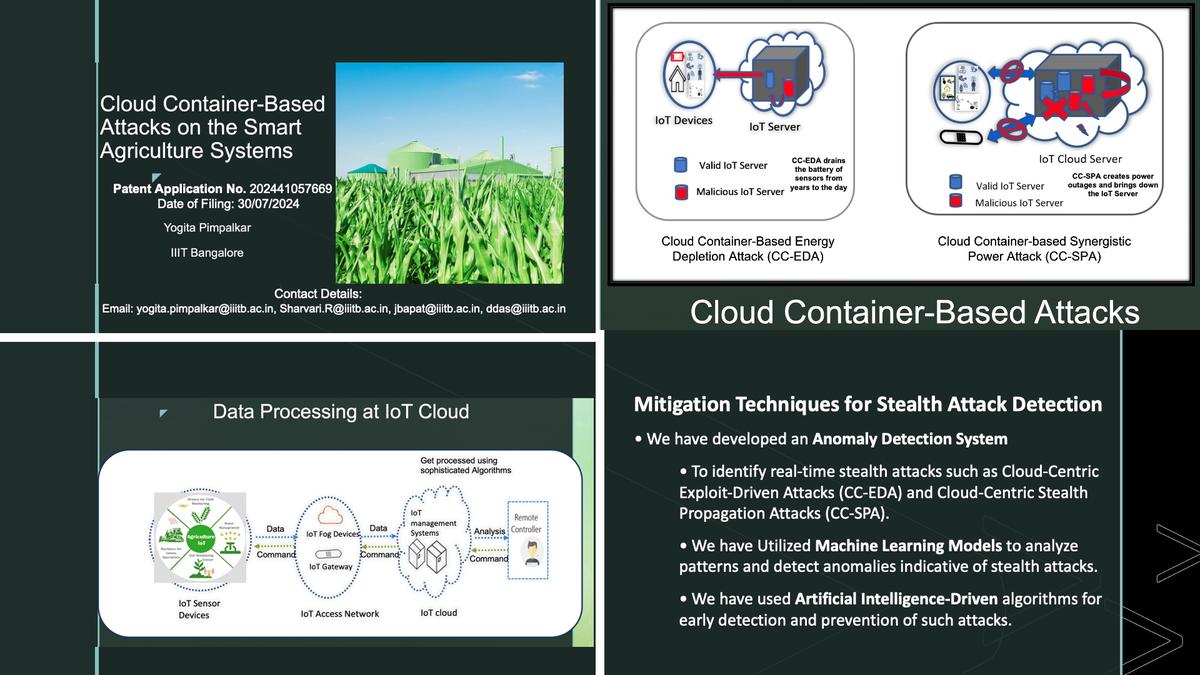
Cloud container-based attacks on smart agricultural systems. , Photo Credit: Special Arrangement
greenhouse monitoring
AgriSense and Smart Greenhouse Monitoring System is led by Professor Jyotsna Bapat at IIIT-B. Both are sponsored by the Government of Karnataka.
Smart greenhouse monitoring systems aim to transform greenhouse farming by leveraging IoT to improve crop health, automate environmental controls, and facilitate remote monitoring. The idea is to enable farmers to remotely monitor environmental conditions such as temperature, humidity, soil moisture and pH, providing real-time data for precise control over crop conditions.
The system sees features like real-time data monitoring using a network of sensors, automated controls based on sensor data, remote access to farmers through an app and data analysis, and alerts with the help of machine learning.
optimize input
Finding the optimum water level to ensure maximum production in agriculture has always been a problem. Another challenge is the deteriorating soil health due to excessive use of fertilizers. AgriSense, an IoT system developed by the institute to address these challenges, uses the Agri-Cone, a mushroom-shaped soil-monitoring device.
“We were initially looking at larger farms where we could help farmers ensure that irrigation is done correctly. By measuring the moisture content of the soil and looking at the predicted forecast, we can advise them about the irrigation that should be done,” explains Bapat.
“The other aspect is the soil content and we measure carbon dioxide and ammonia in it. If the soil is of good quality then the amount of carbon dioxide will be relatively high. If there is too much urea or any other fertilizer, the amount of ammonia released will be high. Therefore, we can give them advice based on these also.”
Inside the Agri-Cone, a coin battery powers various sensors to monitor soil moisture and temperature. The sensors detect gases like CO₂ and ammonia. Humidity sensors track the moisture level of the air around plants, helping prevent diseases and promote healthy growth.
“Right now, we have installed a small battery. But the goal is to put a solar surface on top of the mushroom so that it becomes completely sustainable,” says Bapat.
“Right now, we only use Wi-Fi. But the other solution is something called LoRA. It is used a lot for IoT in Europe and the Netherlands, their entire IoT network is on LoRA. It is more energy efficient and also has a greater range, making it suitable for a vast area,” says Bapat.
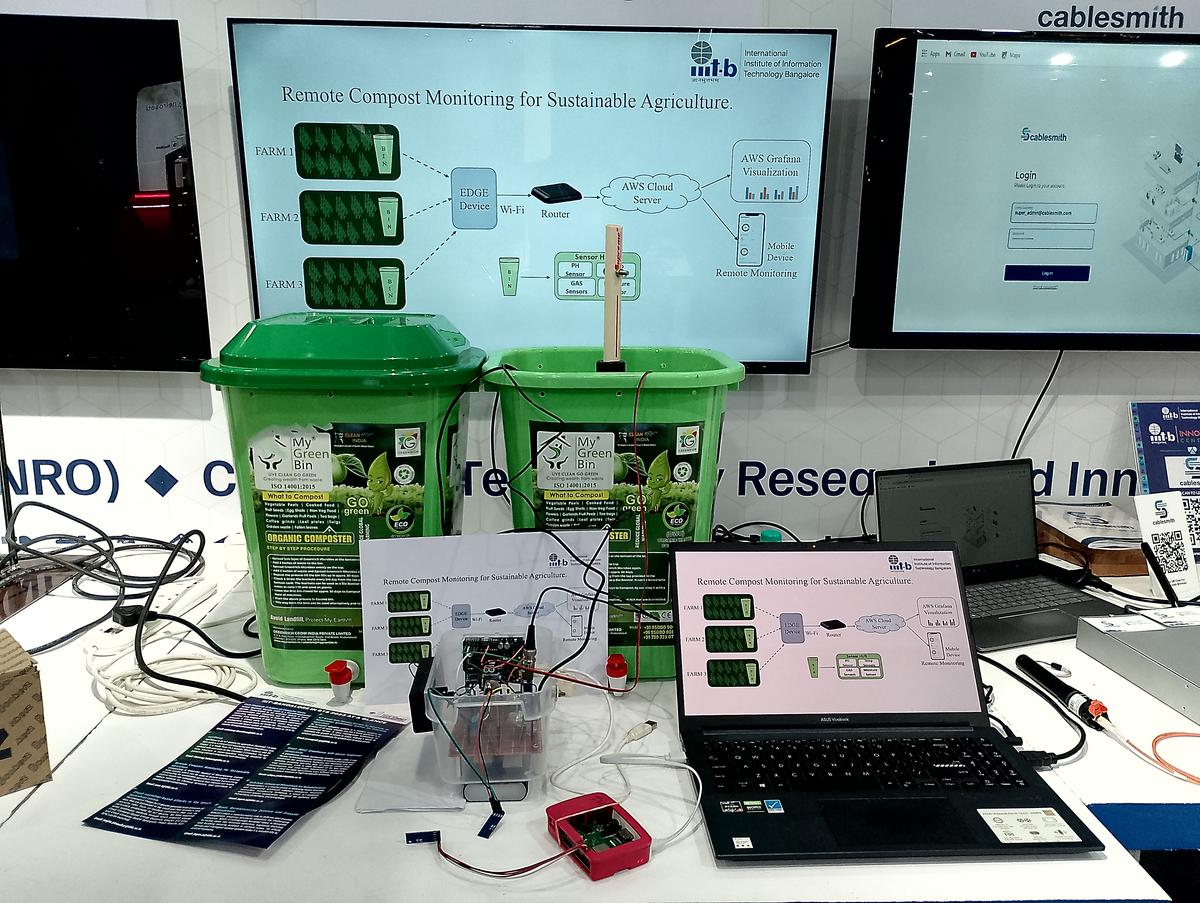
Remote compost monitoring for sustainable agriculture. , Photo Credit: Special Arrangement
Manure monitoring
The team led by Bapat is also working on a remote compost monitoring system. The idea was to create a prototype for an intelligent IoT system that remotely monitors and manages manure which can then be used as fertilizer.
Bapat explains that the system he developed can help properly compost Bengaluru’s garbage dumps, which contain a lot of food waste, while avoiding odor.
The solution developed by the team comes with a sensor hub attached to each bin that monitors the pH value, temperature, humidity and CO2 level of the compost inside them. It also allows remote monitoring of these values using a mobile phone and generating alerts.
Bapat says this solution also helps avoid manual labor in which a person checks and stirs the manure.
market welcome
While many such initiatives are being prepared, market adoption of agri-tech solutions is always a challenge. Bapat thinks urban people with backyard vegetable gardens could be the initial customers for solutions like AgriSense. “Although it is primarily designed for farmers, if we can see some urbanites as early adopters, that would be useful,” she says.
Regarding Autogrow, Kestur noted that a proof of concept has been done and a patent has been filed. The next step will be to partner it with a start-up through the institute’s innovation cell to scale up the solution.
According to him, AI has the potential to bring immense efficiency in agriculture and it is important to create India-specific solutions with it. “Being an agricultural economy, this is an opportunity for us. Many things are unfolding before us. “A lot remains to be done in agriculture in terms of making farmers highly skilled.”
funding issues
While he acknowledges that a lack of funding in agritech poses challenges in scaling up and deploying, Kestur says his team is trying to address the problem in a different way.
“It will be difficult to reach farmers as end users are very fragmented. Therefore, we are working with Farmer Producer Organizations (FPOs). We have conducted some workshops where we have talked to farmers and received problem related details from them. We are considering start-ups in this area and trying to do the work of providing facilities. We are trying to connect those start-ups with the problems faced by FPOs,” he says.
Kestur also notes that agri-tech needs to be looked at differently than consumer tech or other sectors that attract larger funding.
public digital infrastructure
“Agriculture is a use case where solutions should be developed as public digital infrastructure. Take the case of Aadhaar. It has been successful. If it had been developed by a big company, they would have been able to earn billions of dollars. But it is open source for the public good. We should have its equivalent in agriculture too,” he says.
Kestur also emphasizes the need for interdisciplinary research. “Now we have agricultural universities. Then there are also technological universities like ours. Therefore, there is a need to conduct interdisciplinary research. Auto Grow is a small step in this direction. They (IIHR) bring domain expertise and we bring technology.”
published – December 30, 2024 09:00 AM IST


