



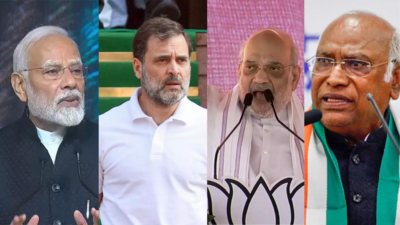
New Delhi: In the 2024 election season, political slogans become more than just catchy phrases; They were powerful tools for influencing public opinion, organizing voters, and shaping the narratives of various campaigns. Slogans, often short but powerful, encapsulated the core messages of political parties and provided a sense of direction to their supporters. These slogans reflected both the optimism and concerns of voters and played an important role in the electoral battle.
One of the most talked about and divisive slogans was the one that echoed across Maharashtra, where Uttar Pradesh Chief Minister Yogi Adityanath’s statement, “Batoge to katoge” took center stage. The slogan immediately attracted attention and prompted both criticism and appeasement from various political circles. When Bharatiya Janata Party ,BJP) did not officially endorse it, nor deny its implications. Prime Minister Narendra Modi avoided using the controversial phrase in his speeches, but subtly adapted it, turning it into a more catchy version: “Ek hai to surakshit hai” (If united, then safe). The message was clear – unity, especially within the Hindu vote bank, was essential to maintain political strength.
The 2024 elections saw a fierce battle not only for seats but also for narrative dominance and slogans played an important role in this contest. From aggressive campaign messages to appeals for unity, political parties devised slogans that were designed to influence different sections of society, often invoking deep concerns, cultural identities and aspirations.
Here is a look at some of the most influential slogans that shaped the 2024 election landscape.
BJP’s “this time it has crossed 400”
The BJP, led by Prime Minister Narendra Modi, continued its ambitious quest to win majority in the Lok Sabha with the slogan “Abki Baar 400 Paar” (This time, more than 400 seats). Building on the success of their 2019 campaign slogan, “Abki Baar 300 Paar”, this slogan strengthened the party’s confidence in expanding its political reach and dominance while also strengthening the fear that it might lose seats. Can. With the promise of securing more than 400 seats, the BJP aimed to project an image of invincible strength and political dominance. The slogan was not only about achieving victory but also about setting an optimistic atmosphere for the party’s future rule.
“If we divide we will be divided” and “If we are united then we are safe”
In Maharashtra where BJP faced competition from both the regional parties CongressTwo slogans emerged: “Batenge to katenge” and “Ek hain to sukhar hain.” The first, “Batenge to Katenge”, was aimed at unifying the Hindu voter base by warning against fragmentation and division. The second, “Ek hain to surakshit hain” (If united, then safe), was intended to promote unity within the Hindu community as a protection against political opponents. These slogans were particularly important in Maharashtra, a state with a large number of constituencies and a complex political landscape. He sought to consolidate Hindu votes and strengthen the BJP’s position at both the state and national levels.
“If Eknath is there then he is safe”
In an effort to ensure Enath Shinde’s dominance in the Maharashtra elections, Shiv Sena changed Prime Minister Modi’s slogan “If there is one, it is safe” to “If there is one (Nath), it is safe”, and Eknath Shinde was elected Chief Minister of Maharashtra. Advocated to remain. This change has come after the strong performance of the Mahayuti alliance in the recent assembly elections.
PM Modi had earlier used the original slogan to promote unity and called it the “maha-mantra” of the country. Drawing comparisons to Bihar, where Nitish Kumar remains the CM despite his party’s low number of seats, the Sena argued that Shinde should retain his role.
Congress’s “If you police, you will kill”
In an attempt to counter the BJP’s “Batenge” slogan, the Congress party led by Rahul Gandhi introduced the slogan “Daroge to maroge” (If you are afraid, you will die) during the elections. The slogan sought to empower the public to oppose what the Congress described as the BJP’s authoritarian tactics and “climate of fear”. It was inspired by Gandhi’s recent comments, encouraging people to overcome fear and challenge the dominance of the BJP.
Congress leader Mallikarjun Kharge popularized this slogan in Jharkhand, accusing the BJP of divisive politics and spreading fear. He compared the BJP’s aggressive rhetoric, exemplified by Uttar Pradesh Chief Minister Yogi Adityanath’s “batoge to katoge” (if you speak, you will suffer), with the Congress’s message of resistance and courage.
“The Constitution is in danger”
In a bold campaign strategy, the Congress raised concerns about the future of India’s Constitution with the slogan “Samvidhan Khatar Mein Hai” (The Constitution is in danger). The Congress leadership, especially Rahul Gandhi, tried to exploit public fears about the erosion of democratic principles and the possible weakening of the Constitution. The party described the BJP as a threat to the constitutional integrity of the country and portrayed the saffron party as willing to destroy or alter the founding document of the republic. The slogan resonated among a significant section of voters who were concerned about the BJP’s increasing centralization of power and efforts to modify the constitutional framework. Despite the BJP’s denial, the Congress managed to keep the issue on the agenda, and ensured that it remained in the public discussion.
Congress’s “Jal Jungle Zameen” vs BJP’s “Roti, Beti, Aur Mati”
In Jharkhand, the Congress targeted tribal voters with the slogan “Jal Jungle Zameen” (Water, Land, Forest), which was deeply connected to the concerns of indigenous communities in the region. The Congress tried to portray itself as a defender of tribal rights, focusing on issues of land, water and forest resources, which directly affected the livelihoods of tribal communities. In response, the BJP came up with its slogan, “Roti, Beti, aur Maati” (Food, Daughters, and Land), which aimed to address broader issues of livelihood, women’s safety, and land rights. While the Congress emphasized environmental and tribal concerns, the BJP focused on economic empowerment and social security in the hope of attracting a broader section of voters.
RSS’s “Be alert”
BJP’s ideological parent Rashtriya Swayamsevak Sangh (RSS) played an important behind-the-scenes role in the elections and mobilized its vast network of workers in support of the BJP. The RSS slogan, “Sajag Raho” (Be alert), calls on its members to remain alert and protect the country from external and internal threats. The slogan was central to the Sangh’s strategy to garner support for the BJP through its wide grassroots network, especially in rural and semi-urban areas. By emphasizing vigilance, the RSS tried to create a sense of urgency and responsibility among voters, and urged them to protect India’s cultural and political identity.
“Knock, knock, knock”
Congress leader Rahul Gandhi said during his rally in Rajasthan as a symbol of the rapid progress and development made by his party that “1 lakh will come to your account “Khatkhat Khatkhat”. The phrase “Khatkhat Khatkhat” means quick and immediate. The idea was to take action in poverty alleviation, with the promise of transferring Rs 1 lakh annually to women from below poverty line families, this slogan raised the aspirations of the voters. And to portray the Congress as a party focused on rapid growth, Prime Minister Modi mocked the slogan, predicting that Congress leaders would win after the elections in the summer. Will flee the country for the holidays, a jibe aimed at portraying Rahul Gandhi and his allies as detached from the struggles of common citizens.
The 2024 election season was the year of slogan wars in shaping political discourse and influencing voter behavior. These slogans were not merely political tools but encapsulated the aspirations, fears and concerns of voters. From the BJP’s strong appeal for unity and political dominance to the Congress’ appeal for constitutional protection and empowerment, these catchphrases captured the essence of the political battle.
Whether promoting unity, addressing core issues such as land and livelihoods, or warning against perceived threats to democracy, slogans have proven to be a vital element in the success of political campaigns. His ability to encapsulate complex political messages into a simple, memorable phrase made him indispensable to both parties and leaders. In a country as diverse and complex as India, where political campaigns are often dictated by policy as well as emotional appeals, slogans remain an important tool to shape the narrative and win the hearts and minds of voters.


