



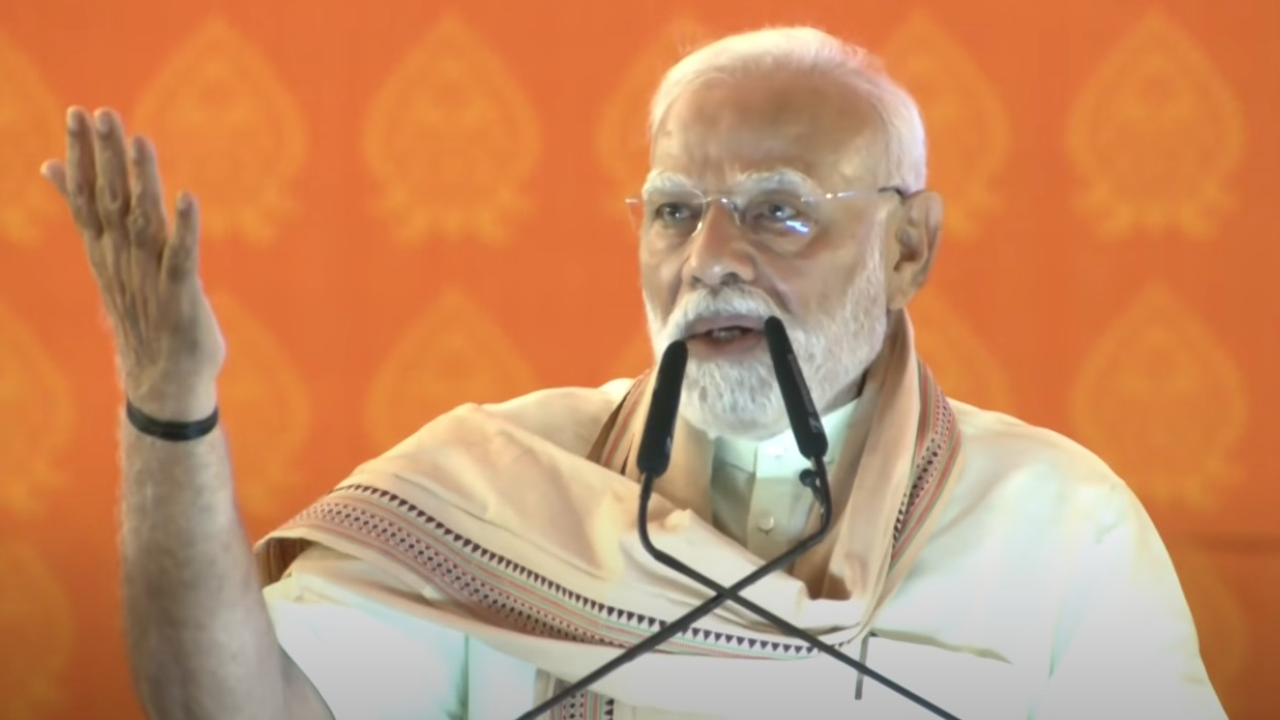
New Delhi: As Bihar moves from its inner political center to its outer border belt for Phase 2 voting, the Bharatiya Janata Party has chosen its primary talking point – “infiltration”.Prime Minister Narendra Modi, while addressing rallies in Araria and Bhagalpur on Thursday, hit out at alleged illegal immigrants and accused the opposition of protecting “infiltrators” for vote bank gains.The second phase of voting includes districts of the Seemanchal region bordering West Bengal and Nepal. The Prime Minister’s comments appear to have set the tone for the next phase of the BJP’s campaign, where national security and demographic change are expected to dominate the discussion.
PM Modi’s message – Infiltration a ‘national challenge’
In Araria, the Prime Minister made one of his sharpest attacks of the campaign, saying infiltration has become a major hurdle for governance.PM Modi said, “There is a big challenge facing these efforts of ours. That challenge is of the infiltrators. The NDA government is sincerely engaged in identifying each and every infiltrator and taking them out of the country. But these people of RJD and Congress are engaged in saving the infiltrators. To save these infiltrators, they spread all kinds of lies and organize political tours to mislead the people.”He continued the topic by linking infiltration with law and order in Purnia also. The Prime Minister said, “Vote bank politics is such that Congress, RJD and their entire machinery are busy protecting and saving foreign infiltrators. They have become so shameless that they are raising slogans and taking out yatras in support of foreign infiltrators.”He said, “Listen carefully to what I am saying. Every infiltrator will have to go. It is the firm responsibility of the NDA to stop infiltration. The law of the country will prevail in India, not the whims of the infiltrators. This is Modi’s guarantee – action will be taken and the country will see positive results.”The back-to-back rallies in Araria and Bhagalpur, located in the eastern border region of Bihar, marked the Prime Minister’s shift from Phase 1 themes of development and governance to the more emotive concerns of outer ring identity and security.
From governance to demography: BJP’s campaign change
The Election Commission’s phase-wise voting plan has effectively divided Bihar into two geographical regions: an inner circuit of constituencies where voting took place in Phase 1 and an outer circuit along the state’s borders with Nepal and West Bengal that will vote in Phase 2.Phase 1, comprising 121 seats, mainly focuses on welfare, infrastructure and governance issues. Phase 2 – covering border districts like Purnia, Araria, Kishanganj and Katihar – is now set to be dominated by debates around migration, infiltration and demographic change.According to the 2011 census, the Seemanchal region has a 47% Muslim population, compared to the state average of 17.7%. The RJD-Congress alliance has traditionally enjoyed strong support here, with AIMIM also making gains after winning five seats in 2020, splitting the votes and indirectly aiding the BJP’s performance in the region.The BJP’s renewed emphasis on infiltration seeks to turn the region’s border geography into a central campaign issue, a strategy the party has previously used in Assam and West Bengal.
Boundless Shah enhances PM’s point
Union Home Minister Amit Shah reinforced Modi’s message with a series of attacks on the Congress-RJD alliance while campaigning across north Bihar. He accused Lalu Prasad Yadav and Rahul Gandhi “Welcoming infiltrators” and claimed that a vote for the opposition would mean the return of “Jungle Raj”.“Should infiltrators be removed from Bihar’s voter list or not? Lalu and Rahul say, ‘Infiltrators are welcome’.” Lalu’s son (RJD leader) to save him Tejashwi Yadav) and Rahul goes on a trip. Lalu and Rahul, listen carefully, the BJP and NDA government will not only drive out the infiltrators from Benipatti and Madhubani, but will also uproot them from the entire country.He also criticized Rahul Gandhi for his comments on the armed forces. He said, “Rahul Gandhi should be ashamed to know about the caste and religion of army personnel. We do not discriminate among military personnel on the basis of caste or creed.”Shah used the platform to highlight PM Modi’s “decisive action” on national security. “During the Congress rule, Pakistani terrorists used to come, explode bombs and leave. No action will be taken against them. Instead, they were fed biryani. Recently our people were killed in Pahalgam. PM Modi launched Operation Sindoor in just 20 days, in which we entered Pakistan’s homeland and eliminated the terrorists.
a map within a map
The phase-wise voting map released by the Election Commission reveals a different geographical structure. Phase 1 will cover constituencies located within Bihar, forming a tightly knit cluster in the center of the state. These are almost entirely surrounded by Phase 2 constituencies, which are located on the periphery.Phase 2 extends to the borders of Bihar with Nepal and parts of West Bengal, forming a ring-like belt that includes the Seemanchal region. This split sets up two contrasting campaign arenas – the interior seats of Phase 1 are expected to focus on development, caste equation and governance, while migration, security and demographic change are likely to dominate the political debate in the border constituencies of Phase 2.
Seemanchal in the center of phase 2
The Seemanchal region, comprising four districts and 24 assembly seats, is emerging as the most politically active region of the Bihar elections. Its strategic location, demographic structure and voter density make it an important determinant of the results of Phase 2.The Election Commission’s schedule includes these constituencies going to the polls in November, giving the BJP a clear opportunity to shape negotiations in the intervening weeks.Party leaders say the government’s Summary Inclusion and Revision (SIR) process – the administrative review of voter lists – has already identified irregularities in Seemanchal districts.BJP Bihar vice-president Santosh Pathak said, “Even though this matter comes under the Union list, at the local level Aadhaar cards are easily provided to people coming from Bangladesh.” “The SIR has been completed, and so far, no objections have been filed by those excluded from the process, which shows that there are indeed infiltrators in the Seemanchal districts,” he said.According to Pathak, while development is a major campaign issue, the issue of infiltration will have “political weight” in the second phase.
Step 1: Record voting, smooth voting
Chief Electoral Officer Vinod Singh Gunjiyal said a provisional turnout of 64.46% was recorded in Phase 1. A total of 3.75 crore voters were eligible to decide the fate of 1,314 candidates in 121 constituencies. Voting took place at 45,341 stations, of which 36,733 were in rural areas. “Barring a few minor clashes, voting passed off peacefully,” Gunjiyal said.BJP leaders say the heavy turnout in the first phase indicates positive voter sentiment and sets the stage for the second phase, where border districts will dominate the political narrative.
Story of infiltration and previous strategy of BJP
The BJP’s use of the “infiltrator” narrative is not new. The issue of illegal migration has figured prominently in earlier state campaigns in Assam, West Bengal, Jharkhand and Delhi. For example, in Jharkhand, PM Modi and Shah repeatedly accused the Hemant Soren-led government of turning the state into a “dharamshala for infiltrators”, while in Delhi, the BJP clashed with the AAP over the alleged settlement of Rohingyas and Bangladeshis.In Bihar, the issue has gained renewed prominence due to the state’s geographical vulnerability and high migration flows. Seemanchal’s proximity to the Bangladesh border through West Bengal, coupled with its economic dependence on remittances, makes it a unique frontier for both development and identity politics.During his Independence Day address earlier this year, PM Modi had warned of a “pre-planned conspiracy” to change the demography of the country through illegal immigration. The Prime Minister said, “I want to warn the country about a concern which is emerging as a crisis. Under a well-planned conspiracy, the demography of the country is being changed. The seeds of a new crisis are being sown.”“These infiltrators are snatching away the bread and butter of our youth. These infiltrators are targeting the daughters and sisters of our country. It won’t be tolerated.”
Modi said, heavy voting is proof of confidence in NDA’s track record.
Meanwhile, PM Modi on Friday said the record turnout in the first phase of Bihar assembly elections reflects the public’s faith in the governance model of the National Democratic Alliance (NDA) and its performance over the years. Addressing rallies in Aurangabad and Bhabhua ahead of the second phase of voting, the Prime Minister said the enthusiasm seen in the first round of voting was a “clear indication” that people wanted continuity and stability under the NDA. Referring to the Election Commission’s provisional polling data, Modi said, “Yesterday the voters of Bihar broke all records. There has never been such a high voting percentage in the history of the state. Much of the credit for this goes to the mothers and sisters, the mother power, who came to vote in large numbers and took the voting percentage to almost 65 per cent. It is clear that they all have faith in the track record of Narendra-Nitish.” The Prime Minister said the people of Bihar had voted to ensure that “good governance” continued in the state. “They have not fallen for the false promises of the RJD-led opposition. Even the Congress, despite being an ally, is not trusting the promises made in the RJD manifesto,” he said. Citing examples of construction of Ram temple, abrogation of Article 370 and Operation Sindoor, Modi told the crowd that he stood by his words. “I deliver what I promise,” he said, adding that people’s faith lies in the NDA’s “delivery record”. The Prime Minister also praised the Election Commission for smoothly conducting voting in 121 constituencies in the first phase and said the voting was “a message of confidence from the people of Bihar”. “The high participation of women and youth shows that people believe in the development journey of Bihar. They do not want the return of jungle raj, which has brought fear and stagnation to this state,” Modi said. According to the Election Commission, 64.46 percent voting took place in the first phase in Bihar, which is the highest ever in the electoral history of the state. Voting was held at 45,341 polling stations in 18 districts, deciding the fate of 1,314 candidates.
What does Phase 2 mean for BJP?
With the Seemanchal region becoming the outer ring of Bihar’s electoral map, BJP leaders are expected to keep their focus on infiltration and demographic issues in the coming weeks. The thematic change of the campaign from development in the interior to border security in the periphery reflects the phase-wise voting design.By promoting the “infiltrator” narrative in Seemanchal, the BJP aims to strengthen its national security pitch in the region where local caste equations and religious demography traditionally favor the opposition. The phase map with its concentric structure gives the party a natural axis: inner seats are contested on governance, and outer seats are contested on security.As the Prime Minister said in Purnia, “It is the firm responsibility of the NDA to stop infiltration…this is Modi’s guarantee.”The second phase, covering the outer circuits of Bihar, will determine whether the message resonates among voters beyond rhetoric and whether the infiltration narrative becomes the defining pivot of Bihar’s 2025 elections.


