



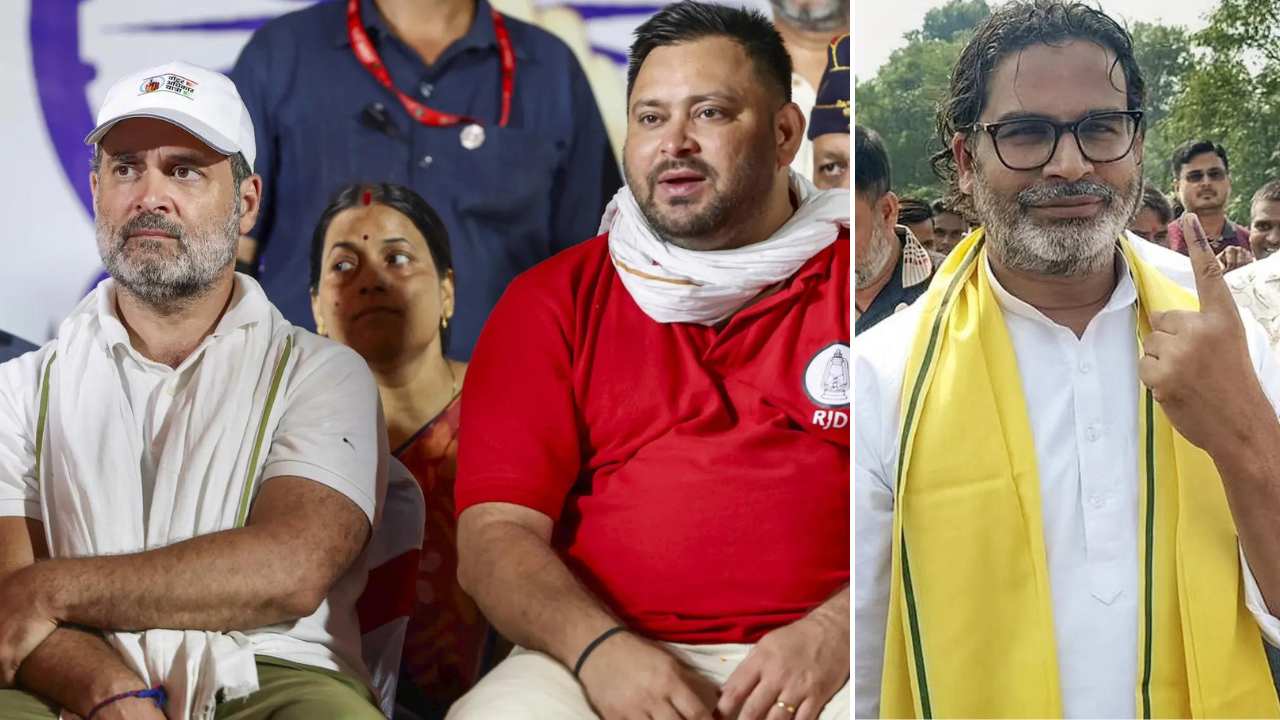
In the lead up to Bihar assembly elections, three major marches: Rahul Gandhi’s Voters’ Rights March, Majestic It was expected that Yadav’s Bihar Adhikar Yatra and Prashant Kishor’s Jan Suraj Padyatra would energize the opposition and reshape the election story. All three drew big crowds and a lot of attention.
Yet, when the votes were counted, none of these lavish visits translated into electoral gains. The BJP-led NDA handed a crushing defeat to the Congress and its allies by winning more than 202 seats out of 243. India Bloc’s ambitious marches proved ineffective: Rahul Gandhi’s voter rights march did not prove to be a trump card, and his message of “vote theft” remained largely irrelevant in Bihar politics.
Similarly, Tejashwi Yadav’s tour failed to expand his party’s base, and Kishor’s two-year-long tour ended without the victory of a single Jan Suraj. In short, symbolism cannot be an alternative to organization in the difficult electoral terrain of Bihar.
Yatras: A time-honoured tool of Indian politics
Pan-India “padayatras” have long been a favorite strategy for politicians looking to connect with voters. And they have suddenly become very popular in politics, with leaders from different parties taking to the streets with dramatic, high-octane visits. Rahul Gandhi helped revive the trend with his Bharat Jodo Yatra in 2022-23, walking nearly 4,000 km from Kanyakumari to Srinagar, followed by the longer Bharat Jodo Nyaya Yatra earlier this year. On his heels came Tamil Nadu BJP chief K Annamalai, whose En Mana, En Makkal journey crossed 10,000 km and ended with a grand finale in the presence of the Prime Minister. TDP’s Nara Lokesh completed his youth-centric Yuva Galam, insisting that it is more about listening than winning.Such trips can energize party workers and highlight campaign themes. The trips can be said to be “sanjivani” (life-giving) to the parties, refreshing the organization and giving a solid foundation to the campaigns.In Bihar, where rural networks and caste relations are important, parties often organize trips to visit remote villages and rural groups. A well-timed visit can create momentum by showing unity and giving a sense of participation to voters. Yet this year, show-off without facts was no match for the NDA’s disciplined strategy. Despite the grand fanfare of these three yatras, the voters of Bihar delivered a very different verdict.
Rahul Gandhi’s voter rights journey
Rahul Gandhi’s Voter Adhikar Yatra (August–September) was promoted as a campaign to protect voter rights. Covering over 1,300 km across 25 districts and over 100 constituencies, Rahul flaunted Bihar’s cultural symbols, wore Gamchha scarves, caps and attacked alleged “vote chori” (vote theft) and the state’s special intensive voter list. The march began with impressive crowds, especially in Sasaram, and anticipated the return of Congress to the rural areas.However, it was clear from the beginning that public enthusiasm would not last. In the following weeks, energy declined rapidly. The Yatra started with huge crowds, but as the campaign progressed, the initial spark faded. The Congress relied heavily on the symbolism of the Yatra but failed to build an effective grassroots organisation. Apart from a few big rallies, senior Congress leaders were largely absent, and booth-level mobilization was weak. Rahul’s strategy focused obsessively on national issues like voter lists, which did not appeal to most Biharis. Ordinary voters were more concerned about jobs, inflation and local governance than allegations of “voter theft”.
Rahul’s campaign wasted precious time attacking the Election Commission and this change backfired. After rallying around the national narrative, the Congress’s message was overshadowed by local realities that it failed to read. By election day, the Congress had won only 6 out of 61 seats contested: a success rate of a pitiful 10%. Rural crowd did not translate into rural votes. Internal alliance tensions also did not help: Rahul maintained distance after the visit and resurfaced only weeks later, and the absence of sustained leadership further weakened the Congress.Meanwhile, Bihar’s ruling BJP and JDU happily termed Rahul’s march as a flop show. Their taunts reflected the reality on the ground: for all its high production values, the Voters’ Rights Yatra failed to translate into votes for the Congress, leading the party to suffer one of its worst-ever results in Bihar. In short, Rahul’s “vote theft” narrative and his focus on fighting SIR proved largely irrelevant to Bihar voters. His journey did not prove to be a trump card.
Tejashwi Yadav’s Bihar Adhikar Yatra
Tejashwi Yadav’s Bihar Adhikar Yatra was launched on September 16, almost immediately after Rahul’s visit. Emerging from Jehanabad, Tejashwi promised to challenge the Nitish Kumar government on unemployment, crime and local grievances. The march was presented partly as a way to fill the void left by Rahul’s march; RJD officials openly said that they have covered the districts left out by the Voters Adhikar Yatra. By highlighting issues in RJD strongholds Jehanabad, Nalanda, Supaul, Saharsa and others. Tejashwi’s aim was to consolidate his party’s core vote and signal that RJD is the main force in the Bharat block. He also used the visit to assert himself: earlier, he had announced that he would contest all 243 seats, underscoring his claim to be the undisputed leader of the alliance.In theory, Tejashwi’s concentrated effort should have strengthened his social coalition and countered the anti-incumbency wave. In practice, it barely made a dent outside his base. By election day, the RJD had outperformed the Congress, but only marginally: the party was on about 25 seats, down significantly from 75 in 2020.Tejashwi failed to convert the momentum and anti-incumbency wave into actual votes against Nitish Kumar, leading to RJD’s second-worst tally so far. The much-touted Yatra vision of reaching every village did little to overcome the RJD’s narrow caste profile. Most communities beyond the Muslim-Yadav base remained unconvinced, and even within the RJD, the ticket distribution sparked resentment. Seat-sharing disputes led to friendly fights, where the opposition partners split the anti-NDA votes.In the end, Tejashwi’s personal crusade could not overcome these structural flaws. RJD retained its support base but did not expand beyond its traditional base. The youth-versus-experience narrative he had propagated collapsed due to Nitish Kumar’s intact governance credentials and the shadow of “Jungle Raj”.
Prashant Kishor’s Jan Suraj Padayatra
Prashant Kishor enters the fray with arguably the grandest foot march: The 3,500-km Jan Suraj Padyatra launched on Gandhi Jayanti 2023. Kishor, a renowned election strategist turned candidate, promised a mass movement – reaching every panchayat, listening to voters and preparing a vision document on education, health and agriculture. He roamed remote Bihar for months, attracting media attention and presenting himself as an alternative to both the NDA and the Grand Alliance.
Yet the results on November 14 exposed the folly of that effort. Jan Suraj Party failed to register even a single election victory. Most of its candidates lost their deposits, indicating minimal vote share. Kishor entered the Bihar elections as a political candidate and walked out as the biggest loser. Despite all the media hype, his technocratic, governance-centric message could not resonate in a polarized contest dominated by clear caste and welfare narratives. Voters showed little interest in this new kind of politics.Kishor had gambled that his nationwide profile and long journey would translate into votes; Instead, it exposed the disconnect. The Jan Suraj experiment demonstrated that mere visibility cannot replace ground level machinery. His late decision to withdraw candidates from some constituencies reinforced the perception of organizational chaos.
Structure takes a toll on travel
While the opposition’s three marches failed, the NDA conducted a far more disciplined and targeted campaign. The alliance maintained unity and a clear message throughout. BJP left some seats to allies to consolidate OBC and Dalit votes. The caste calculation was successful and the welfare-centric agenda of the alliance resonated strongly. The record female turnout of over 71% tilted the mandate towards the NDA, boosted by schemes like women entrepreneurship subsidy.The NDA ran on a combination of Nitish Kumar’s governance brand and the organizational strength of the BJP. Nitish (JD(U)) carried the narrative, focusing on law and order and welfare. He introduced a series of high-profile welfare schemes for women, the elderly and the poor: for example, deposits of Rs 10,000 in women’s accounts, free electricity up to 125 units and higher pensions.
In contrast, the Grand Alliance’s strategy was a mess. Seat-sharing remained an open wound: even on the eve of voting, the partners had not finalized the allocation, leading to several cases where the partners fielded candidates against each other. This confusion ruined whatever goodwill had been generated by Rahul’s visit. The Indian camp lacked a coherent narrative. Issues like special intensive revision failed to motivate voters, while the NDA’s focus on good governance and economic gains rang true at the booth level. The opposition entered the elections divided, full of disputes and with no unified strategy, while the NDA’s welfare-centric message proved to be much stronger.Grand marches may generate enthusiasm, but they cannot be a substitute for solid organization and clear leadership in Bihar. Rahul Gandhi’s 1,300-km journey stunned onlookers, but Congress’ vote share fell to its lowest ever level. Tejashwi Yadav’s bid for prominence strengthened the RJD’s base but did not expand it. And Prashant Kishor’s huge padyatra proved that even two years of padyatra cannot lead to immediate vote ban.


