



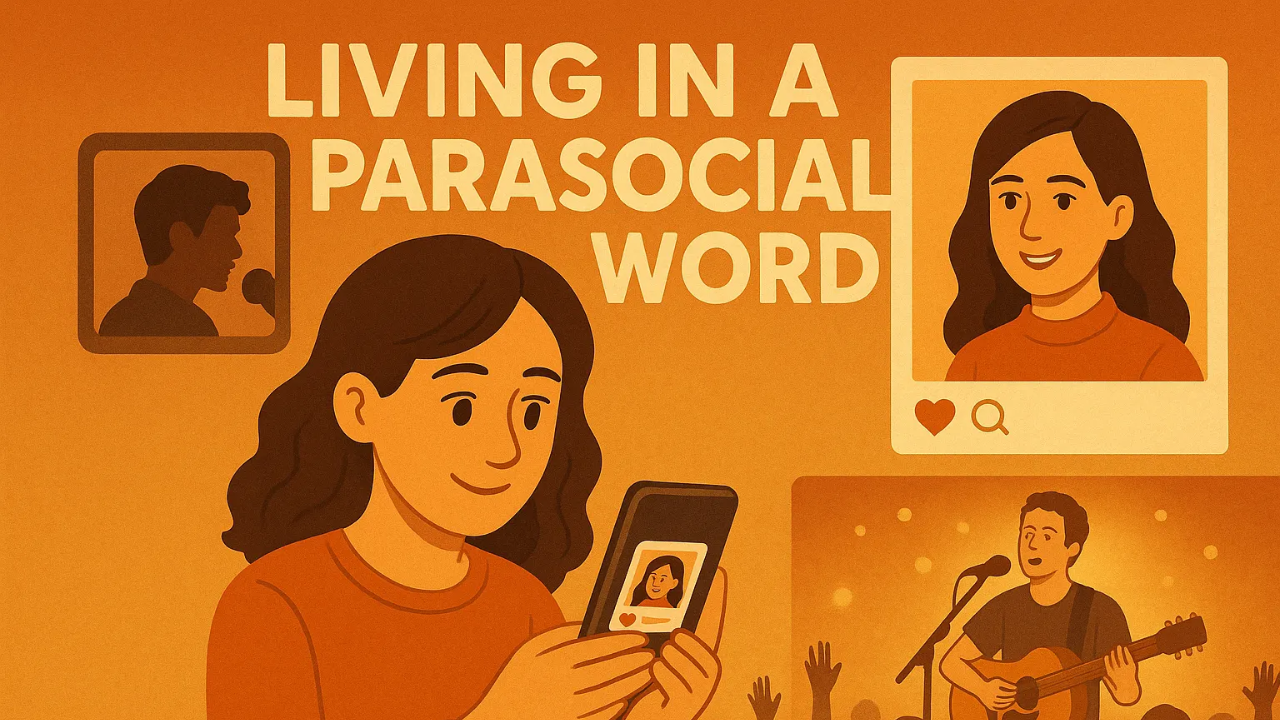
In 2025, parasocial became the Cambridge Dictionary’s word of the year – and honestly, could there be a more appropriate choice? We now live in a world where emotional closeness is fluid, intimacy is performed, and connection is encapsulated in square tiles on our screens. The distance between us and the people we admire has shrunk so dramatically that for many, these are no longer public figures – they feel like friends. Confidant. Extension of self.The term itself describes a one-sided emotional bond formed with someone we don’t know – a celebrity, influencer, dreamer, or even a fictional character. But today, parasocial barely seems to be an academic term. It feels like it’s a daily lived reality.Instagram is no longer ‘just an app’; This is the new Netflix, giving us episodic glimpses into people’s lives, complete with cliffhangers, plot twists, soft-launches and heartbreak arcs. Our idols aren’t just entertainers — they’re the heroes of never-ending reality shows, which we watch with the devotion we once reserved for scripted television.pretend to be realOnce upon a time, celebrity culture was mysterious, aspirational, firmly rooted behind velvet ropes and PR filters. Today, the doors are open.Everyone – from A-list stars to teenagers with ring lights – is telling their story online.And the more people share, the closer we feel. Or at least, we feel closer than we think.Livestreams, photo dumps, Notes-app confessions, ‘get ready with me’ videos, chaotic vlogs, 2 a.m. heartbreak stories, Pilates classes, pet updates, skin-care routines — everyday life has become dramatic. And we, the audience, become emotionally entangled in narratives that are not ours.You may have never met the influencer you see every day. You may have never spoken to the actor whose divorce devastated you or the singer whose esoteric lyrics you analyze for hidden truths. But our brains don’t always distinguish between genuine closeness and repeated, intimate contact.The more we see someone, the more we feel we know them. The more they ‘share’, the more we believe that access = intimacy.The parasocial world thrives on the illusion that
‘I screamed like my best friend got engaged’: Swifty Syndrome
It is a ‘delicate’ ‘love story’.
For some people this bond becomes an identity.“I’m such a Swiftie that when Taylor announced her engagement, I screamed like my real best friend was getting married. I’ve watched her fight for her music, reinvent entire eras, and drop breakup songs that can revive a dead party. Now my entire feed is nothing but Taylor Easter eggs and Opalite reels. She has no idea I exist, but I’m as emotionally invested as we are a Grew up together,” said Priyanka Mukherjee, demonstrating social bonding at its finest.What’s interesting is how common this sentiment is – not shameful, not marginalized, but culturally influential. Entire communities are built around these shared emotional investments. Similarly, Shamin Alauddin has been invested in Nina Dobrev’s life for almost 15 years. “Nina Dobrev is one of those celebrities who has quietly been in my life for about 15 years. It’s like Dobrev became someone I rooted for without even realizing it was happening; I’m not keeping track of every little thing she does, but it’s her personality that keeps me invested.”Celebrity culture used to be a conversation between fan magazines and fans. Now this is a relationship. Or at least, the illusion of one.When your hero wins, you win too
It’s a messed up love affair.
Parasocial bonding isn’t limited to pop stars — athletes ignite it just as intensely. Watching sports has always been full of emotion, but in our hyper-connected world, fans often feel as bonded to the players as if they were family.“The first whole season I watched Messi go through defenders, I really believed that magic existed and here was a man who made me believe in it. His greatest moments felt personal: his departure from Barcelona felt like uprooting from home, and his World Cup win gave me such deep joy that it lingers in my chest even years later,” said a starry-eyed Nakul Jain, who physically lives in Bengaluru but believes he is Argentinian.He said, “The way he carries himself, his humility and quiet strength, dictates how I move forward in life. And every time he wins, it feels like I win too… because fighting for him, loving him and believing in him feels like protecting the part of me that still believes in magic.”This is the power of parasocial attachment – it’s not ‘just fans’. It becomes a mirror of our own emotional life.Their battles seem like metaphors for our battles. Their victory heals wounds we didn’t know were open. Their losses feel like personal tragedies.Concert: When the Screen Comes Alive
Ed Sheeran, Coldplay, Maroon 5 and Akon perform in India!
And then comes that moment when the story you’re watching on the screen suddenly appears in 4K reality – concerts.There’s nothing like standing in a stadium, surrounded by thousands of people sharing your emotional vocabulary, waiting for the person whose voice spoke about your life. The light dimmed. The strings are played first. And suddenly, your parasocial connection makes your heart skip a beat.I attended a few concerts recently – Ed Sheeran, Coldplay, Maroon 5, Akon – and the experience was amazing. It was a collision of worlds: the digital, curated presence I’d consumed for years and the embodied, breathing version standing right there on the stage.When Chris Martin joined ‘Fix You’, it felt like group therapy.When Sheeran looped his guitar and created a song from scratch, it felt intimate, like he was doing it just for us.When Adam Levine walked onto the stage waving, the entire stadium started screaming as if they had been waiting for that moment their whole lives.This is the strange beauty of parasocial experiences – your idol doesn’t know your name, but you know their body language, their smile, their on-stage banter, just the way their voice bursts on a high note. Seeing him in person felt as if you were meeting an acquaintance, someone whose existence is embedded in your memories.These concerts emptied my wallet but filled my heart. And this is exactly what parasocial pleasure feels like – irrational, extraordinary, but deeply, deeply human.The grief of losing someone who never knew youParasocial bonds don’t just bring us happiness – they also bring us sadness.When beloved public figures die, the world mourns collectively, but also privately. It is a pain that may feel incomprehensible but it is not. We mourn not only the man, but also the era he represented.When Satish Shah passed away recently – especially for Sarabhai vs Sarabhai fans – it felt as if we lost a piece of our childhood living room. Indravardhan Sarabhai was more than a character; He was a personality embedded in our nostalgia, our humor, our shared pop culture shorthand.Matthew Perry’s death seemed even more tragic. Chandler Bing was our living room friend for ten seasons, the voice in the background during college, the comfort show after a breakup. The man behind the character had battled demons that we would later understand, and his demise felt heartbreakingly personal.maggie smithWhose characters have shaped generations – from Professor McGonagall to Violet Crawley – represent knowledge, wisdom and authority. His death felt like the world had lost a certain kind of dignity.“I felt something similar when Liam Payne died. I went back into that old One Direction fan mode without any plan – re-watching the performances, scrolling through the timeline, trying to pick up the news. It wasn’t about being connected to them as a person, but about my teenage memories of being a fan of that boy band. When one of them suddenly left, I realized that even when you don’t actively think of yourself as a ‘stan,’ the version of you that once was can come back,” Shameen said.These people never knew us. But we knew them – or at least, a version of them. And loss feels real because relationships feel real.The parasocial economy: when intimacy becomes a currencyToday, influencers are not just creators; They are brands built on relativity. Their value comes from their ability to maintain the illusion that you are part of their inner circle.This means:– Sharing personal struggles– Talking openly about mental health– Soft-Launching Partners– crying on camera– exposing childhood traumas– Letting the audience ‘get ready’ with them– Inviting the audience to vote on their outfit, hairstyle, breakfast, life choicesThis is intimacy as strategy. Vulnerability as content. Connection as a business model.Even though it’s designed, we’re still attracted to it – because humans are wired for connection. If someone looks into the camera as if they’re talking to you, your brain often defaults to trusting them.Why parasocial bonds seem so good and so dangerousParasocial relationships give us:✔ Relax✔ stability✔ Emotional release✔ Community✔Illusion of stability✔ A safe getawayBut they also blur the lines between fantasy and reality. They also give us:– expectation of emotional reciprocity – Comparison of our lives with the narratives compiled by others– Attachments based on edited previews– Guilt, jealousy, loyalty and heartbreak towards people we have never metwe are all parasocialIf we peel back the layers, parasocial attachment is not an anomaly – it is a feature of our age.And because everyone is online now – not just celebrities – parasocial mobility exists even among ordinary people. We follow acquaintances, coworkers, strangers, creators, and micro-influencers and form internal impressions of their lives, personalities, and travels without actually knowing them.We all deserve each other’s feed. We’re all making one-sided acquaintances with people who barely think about us. We are all simultaneously both the seer and the seen.This is the new human condition – intimate yet lonely, connected yet organized, expressive yet isolated.So is this good or bad?Honestly – it’s both.Parasocial relationships can bring joy, inspiration, healing, motivation, creativity, and community. They can also bring heartbreak, comparison, obsession, and confusion.The key is awareness – loving art without believing the artist owns it, enjoying the relationship without mistaking it as a relationship, cherishing comfort without falling into dependency, appreciating someone without getting absorbed in their narrative.ultimate truthWe may live in an anti-social world, but that’s not inherently sad. It’s simply a new kind of human connection – born of the technology we create, shaped by the feelings we’ve always had.Because at the end of the day, whether it’s Taylor, Messi, Ed Sheeran, Satish Shah, Matthew Perry, or Maggie Smith… parasocial love is still love. Real or imagined, it tells us certain truths about ourselves – what we value, what we desire, what we mourn, what we hope for. And perhaps the most human thing is to care deeply about people who may never know our names.


