



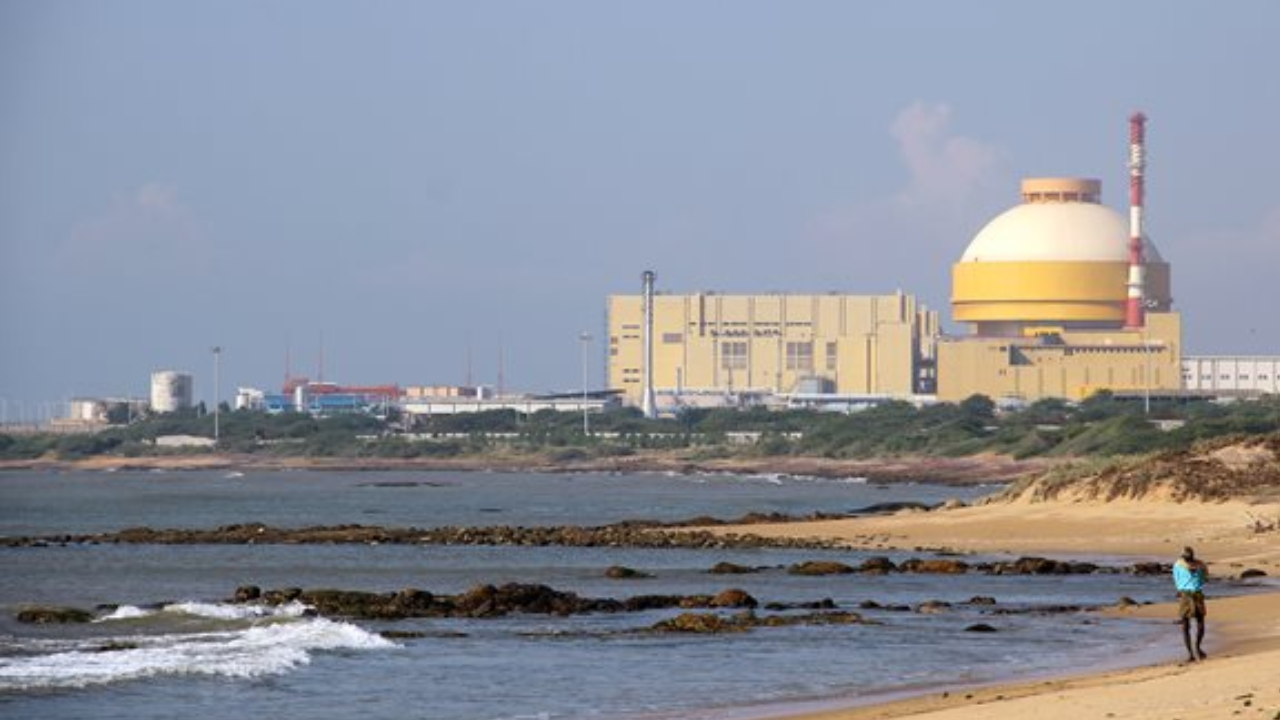
TL;DR: running the news
Parliament on Thursday passed the Sustainable Harnessing and Advancement of Nuclear Energy for Transforming India (Peace) Bill, 2025, a landmark legislation that opens the country’s tightly controlled civil nuclear sector to private and foreign investment for the first time since independence.Rajya Sabha approved the bill by voice vote, rejecting the opposition’s demand to send it to the standing committee. The Lok Sabha had passed it a day earlier. The bill becomes law as soon as it receives the assent of the President.
“This marks a transformative moment for our technology landscape,” he said Prime Minister Narendra ModiThe bill is linked to India’s clean energy ambitions and global leadership in AI and green manufacturing.PM Modi, in his post on Twitter, said: “My gratitude to the MPs who have supported its passage. From safely empowering AI to enabling green manufacturing, it provides a decisive boost to a clean-energy future for the country and the world. It also opens up numerous opportunities for the private sector and our youth. This is the ideal time to invest, innovate and build in India!”
why it matters
The PEACE bill aims to supercharge India’s clean energy transition. This would enable India to grow from 8.9 GW nuclear capacity to 100 GW by 2047, which would require an investment of ₹19.3 trillion ($214 billion), Bloomberg reports.Minister of State for Atomic Energy Jitendra Singh defended the bill in Parliament, saying, “It (nuclear energy) will be the most reliable, stable 24×7 source of energy, unlike some other renewable sources.”
At a time when demand for electricity is increasing due to industrial growth, data centers and urban expansion, the bill aims to ensure a robust, carbon-free power source, unlike solar or wind, which is intermittent.
Zoom in: what the peace bill actually does
It is not just about inviting private capital. The bill changes the entire nuclear governance architecture by combining safety, licensing, regulation, liability and dispute resolution into a single law.
Main changes:
Private sector participation is now a reality: Indian private firms are now allowed to build, own and manage civilian nuclear facilities. Foreign entities may also be involved through partnerships or joint ventures.out with the old: Both the Atomic Energy Act of 1962 and the Civil Liability for Nuclear Damage (CLND) Act of 2010 are being repealed, paving the way for a single, updated regulatory framework.Responsibility is being redefined: Operators’ liability is capped (for example, Rs 3,000 crore for large reactors), and the government can set up a nuclear liability fund to cover any claims in excess of this limit. Suppliers are generally protected from liability, unless otherwise specified in their contracts.The Atomic Energy Regulatory Board (AERB) is now a statutory body, gaining legal independence as a safety regulator. This gives it the power to inspect, pause or even shut down operations.Dual authorization system is being implemented. Nuclear plants will require both an operating license and a safety authorization. Every action, from building construction to waste management, will require official approval.“The standard operating procedure clearly says: ‘Safety first, then production,'” Singh said, emphasizing that India’s safety protocols are firmly based on the Nehru-era approach.Dual Authorization Model: Plants will now require two approvals – a license to operate and a safety authorisation. Every activity, from construction to waste storage, requires approval.“The SOP clearly mentions: ‘Safety first, production second’,” Singh said. He said India’s security standards are still rooted in the Nehru-era framework.
between the lines
This bill is not just about clean energy – it is about opening up stalled mega projects and repositioning India geopolitically.India’s 2010 liability law spooked global suppliers. Companies like GE, Westinghouse and EDF halted projects worth billions of rupees due to Section 17(B) of the CLND Act, which allows victims to sue suppliers in case of a nuclear accident.He is gone now.Shanti removes this legal risk, aligns India with global conventions like the Convention on Supplementary Compensation (CSC) and signals to Washington, Paris and Tokyo that India is open for business.
what are they saying
Meanwhile, opposition MPs in the Rajya Sabha raised concerns over the Centre’s decision to allow private players in the nuclear sector and warned that it could affect the country’s sovereignty.“We are seeing privatization of profits and socialization of risks,” warned Rashtriya Janata Dal’s Manoj Kumar Jha, referring to the taxpayer-backed safety net for private players.“The bill dismantles the liability framework established after the Bhopal gas tragedy,” said Haris Biran of IUML. “The coming generations will judge us very badly,” he said.Congress’s Jairam Ramesh accused the BJP of rewriting history and ignoring contributions made before 2014, saying, “The government first comes up with an acronym and then a policy.”“This is a milestone. We are now a first-line nation, not a follower,” Jitendra Singh said in the Rajya Sabha. He said that there has been a lot of change in India’s global role in energy and climate.Participating in the debate, Trinamool Congress MP Sagarika Ghosh described the Sustainable Use and Advancement of Atomic Energy to Transform India (Peace) Bill as not only flawed but “fundamentally dangerous”.He said, “This bill brings neither peace nor security… We are not debating whether India should pursue nuclear energy or not, India has always pursued nuclear energy responsibly for decades…”“But as a country, are we now ready to abdicate our sovereign responsibility, jeopardize public safety, and put one of the most sensitive sectors of the country at the mercy of crony capitalism and government-friendly oligarchs, as well as foreign pressure?”He said, “This bill is not reform, it is negligence. This bill is not for the public, it is for profit.”DMK MP P Wilson said the bill is a “nuclear bomb that is a threat to the peace and security of the country”. He also demanded to send this bill to the Select Committee of Parliament.AAP MP Sandeep Pathak questioned the BJP-led Center and pointed out that the saffron party had opposed the India-US civil nuclear deal because of foreign involvement.“Do you accept that the protest at that time was political, not ideological? If it was ideological, do you accept that you have changed your ideology?” He said.“Is it for the money? Or do you think they will bring the technology? We are importing a foreign model without importing their regulatory backbone,” he said.
big picture
India is betting on nuclear energy even as the world is rediscovering it as a climate-friendly baseload energy source.Global nuclear capacity could potentially exceed 860 GW by 2050, it estimates, with an emphasis on AI, data centers and clean technology, as highlighted by Morgan Stanley Research in August.
Nations such as China, South Korea, and Japan are actively expanding their nuclear power capabilities. The US and EU are also showing interest in small modular reactors (SMRs), the Peace Bill supports this trend.India’s plans are in line with this global shift:
- 100 GW by 2047
- Energy independence by 2047
- Net-zero by 2070
The Department of Atomic Energy reports that India’s nuclear power budget has seen a significant increase, almost tripling from Rs 13,879 crore in 2014 to Rs 37,483 crore in 2025.The issue of security responsibility remains a matter of controversy.Critics argue that peace weakens accountability standards.No strict criminal liability for suppliers.Operators face limited compensation.The victims have limited resources.Anti-nuclear activist G Sundararajan told the AP that the bill “takes away essential safeguards”, making it “almost impossible” for radiation victims to seek legal redress.“This provides little recourse for any Indian citizen to claim damages from nuclear companies,” he said.However, Union Minister Singh refuted those concerns, saying, “Extensive discussions were held with industry leaders, scientific experts, startups and ministries.”“It took us more than a year to draft the bill keeping in mind security and global standards.”
Implications: Enter the SMR era
Shanti’s strategic vision rests on Small Modular Reactors (SMRs). These compact, factory-assembled reactors, each less than 300 megawatts, are designed to power industrial centers or remote areas.Consider these possibilities:
- A steel mill in Odisha is generating its own electricity
- A data center in Hyderabad, complete with its own mini nuclear facility
- Green hydrogen plants are working continuously
The legal framework allows private ownership, licensing and safety approvals for these installations, providing a competitive advantage in clean energy for heavy industries.According to Bloomberg, L&T is already exploring SMR technology.The geopolitical implications are significant.The Peace Bill extends beyond energy; It is also an instrument of foreign policy.By adhering to global standards for liability and security, India is:To revive the Westinghouse project in Andhra Pradesh, which was earlier stalled.Re-entering into agreements with EDF, GE and Rosatom.Strengthening strategic relations with the United States, France and Japan.It also positions India as a climate-conscious global leader, especially in the lead up to the G20 follow-up meetings and COP summits.
looking ahead:
How quickly are licenses granted? What are the specific security requirements? Who will be the first to apply – Tata? Adani?Insurance: Who will take the nuclear risk? And are the premiums even realistic?Liability Fund: How does funding work? What is the payment process?Autonomy of AERB: Will it actually enforce the rules, or will it succumb to political influence?Local opposition: Protests have been seen in places like Kudankulam. Could land acquisition and health concerns lead to new conflicts?(with contributions from various sources)


