



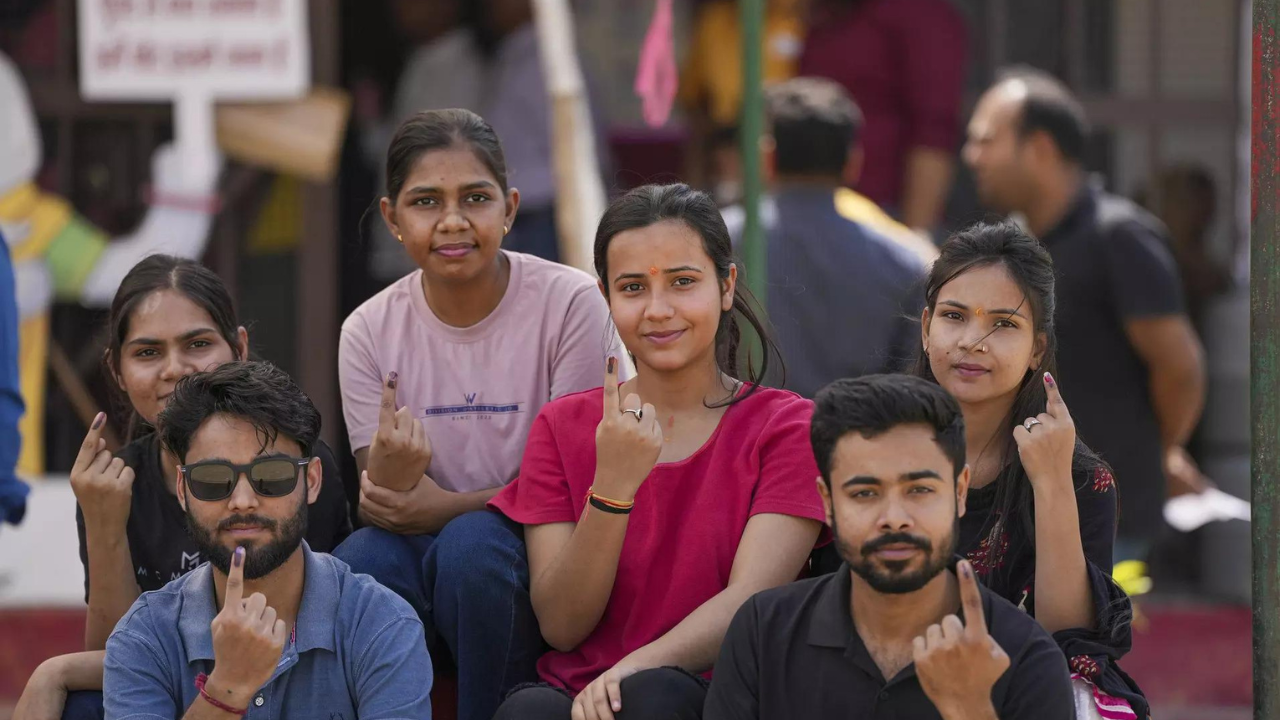
New Delhi: On this day in 1988, India lowered the voting age from 21 to 18, expanding voter participation and cementing universal adult franchise in the world’s largest democracy. The 61st Constitutional Amendment enacted under Article 326 brought millions of young citizens into the democratic process.Introduced by the government led by the then Prime Minister Rajiv GandhiThe 61st Amendment is considered a historic reform in the Parliament, which has provided fundamental democratic rights to millions of people in India.Universal suffrage ensures that every eligible citizen can directly participate in the process of electing their representatives, be it for the Lok Sabha, state assemblies, or local bodies in urban and rural India.
What is Article 326?
Elections to the Lok Sabha and state assemblies are to be conducted on the basis of adult franchise. It clarifies that every Indian citizen who is at least 18 years of age on a date specified by law, and who is not disqualified under the Constitution or any law by reason of non-residence, mental unsoundness of mind, criminal conviction, or corrupt or illegal practices, is entitled to be registered as a voter at such elections.key points –
- scope -Applies to both Lok Sabha and State Assemblies
- Base – Adult franchise, every citizen who meets the age and legal criteria has the right to vote.
- minimum age – 18 years (set by law in 1989)
grounds of disqualificationThe right to vote may be deprived of –
- non resident
- mental illness
- criminal conviction
- corrupted by illegal conduct
- Registration – Eligible citizens must be registered to vote in elections
Lowering the voting age was more than a legal reform; It was part of India’s broader effort to broaden political participation and shape an electorate that reflects the country’s diverse and growing youth population.
Reversing the colonial legacy
In the years before independence, voting was a limited privilege in India under British rule. Under colonial rule, barely 13 percent of Indians were eligible to vote, with the franchise restricted by property, education and income qualifications. Large sections of the society, workers, farmers, women and youth, remained out of the electoral process. As most Indians experienced, democracy was distant and exclusionary.
PTI file photo
Independent India tried to reverse this legacy from the very beginning. One of the most important decisions taken by the framers of the Constitution was the adoption of universal adult suffrage. At a time when many newly independent nations were hesitant in granting full voting rights to their citizens, India chose to trust its people. Every adult was given an equal vote regardless of gender, caste, wealth or education.India’s approach to women’s voting rights was particularly noteworthy. Unlike many parts of the world where women had to fight a long and sustained political battle to gain suffrage, Indian women gained the right to vote from the beginning of the Republic. This made India one of the first countries to grant full electoral rights to women, well ahead of many established democracies. Yet, even as universal adult suffrage took shape, the minimum voting age remained at 21 for decades. By the 1980s, this limit increasingly did not correspond to social realities. Young Indians were entering higher education, joining the workforce, and becoming actively involved in political and social issues, yet many had no formal voice in choosing their representatives.This changed with the 61st Constitutional Amendment Act, passed in the Rajya Sabha on December 20, 1988, and enacted on March 28, 1989 by amending Article 326. The amendment lowered the voting age to 18 years, signaling confidence in the political maturity of India’s youth.It acknowledged that democracy must grow with its people, especially in a country where youth constitute a significant portion of the citizen population.
What is universal adult franchise?
From the very beginning, the framers of India’s Constitution made a bold and deliberate decision: democracy in independent India would be based on universal adult suffrage. This meant that every adult citizen would have one vote, and each vote would have the same value. There will be no discrimination on the basis of caste, creed, religion, sex, education, income or social status. The word “universal” perfectly encapsulates this promise: political equality for all.This principle became the cornerstone of Indian democracy. Elections to the Lok Sabha, state and union territory assemblies and local bodies in villages and cities were all based on this idea. This is clearly enshrined in Article 326 of the Constitution, affirming that elections shall be based on adult franchise and voting is an individual right, no one can vote on behalf of another.This decision marked a decisive break with the colonial past. Under British rule, voting rights were limited and highly exclusionary. Laws such as the Government of India Acts of 1919 and 1935 limited the franchise to those who met specific property, income or educational qualifications. As a result, only 3 to 10 percent of Indians were eligible to vote. For the vast majority, political participation remained out of reach.This long history of exclusion made the demand for universal suffrage central to India’s national aspirations. This idea emerged early in constitutional thinking. The Indian Constitution Bill of 1895 stated that “Every citizen shall have the right to cast one vote.” Over the next decades, demand developed and strengthened. The Lucknow Agreement of 1916 spoke cautiously of creating “as wide a franchise as possible”, while later proposals, such as the Indian Commonwealth Bill of 1925, still retained restrictions based on property and education.However, by the late 1920s the direction had become clear. The Nehru Report of 1928, prepared under the leadership of Motilal Nehru, declared that every person who has attained the age of 21 years shall be entitled to vote, unless disqualified by law. This commitment was reinforced by the Karachi Resolution of 1931, which resolved that any future Indian constitution should be based on adult suffrage.This demand became clear in the 1940s. Influential documents such as the Sapru Report (1945), BR Ambedkar’s States and Minorities (1945), and the Gandhian Constitution of Independent India (1946) provided universal adult suffrage. Even the Cabinet Mission Plan of 1946 accepted adult franchise as a democratic ideal, citing practical difficulties in immediately implementing the principle.
PTI file photo
By the time the Constituent Assembly began its work in December 1946, the matter was resolved. Universal adult suffrage was recommended as a non-negotiable feature of a future constitution. Although one member briefly opposed the idea on principled grounds, the assembly leadership made it clear that the decision had already been taken. The debate ended rapidly, reflecting broad consensus in favor of political equality.Article 326 of the Constitution formally sealed that commitment. When the first general elections were held in India in 1951–52, approximately 173 million citizens registered to vote, an unprecedented democratic process, as cited by ConstitutionofIndia.net. Many elections have followed, but the principle remains unchanged: In India, democracy begins with the simple, powerful act of one person, one vote.
When India moved ahead of the world and chose universal suffrage
It is often assumed that Western democracies, with their long history of representative government, were the early champions of universal adult suffrage. However, the record tells a more complex story. In many of these countries, the right to vote for all adults emerged only after a long struggle, and often much later than popular belief.World War I (1914–18) was fought to make, in the words of the Allied Powers, “the world safe for democracy”. Yet, even though democracy was implemented as a moral objective, many of these countries had not yet given the vote to all of their citizens. The irony is that Germany, which had included universal adult suffrage in its constitution in 1919, had to face defeat.Great Britain, despite its long parliamentary tradition, took almost a decade longer to overcome voting disparities. In 1918, it expanded suffrage to all adult males aged 21 and over, but gave women limited rights to vote, and only if they were over 30. Full voting equality between men and women came only in 1928, when this discrimination was finally abolished.France, a country associated with the powerful ideals of liberty, equality and fraternity, introduced universal adult suffrage even later. French women gained the right to vote in 1945, after the end of World War II. Switzerland also provides an equally wonderful example. Often cited as the home of direct democracy, it denied women the right to vote at the national level until the early 1970s.In this global backdrop, India’s decision is noteworthy. When the Constitution was adopted in 1949 and implemented on 26 January 1950, the country adopted universal adult suffrage in a decisive step. Every adult citizen, male or female, was given the right to vote, without discrimination on the basis of education, wealth or social status. For a newly independent nation emerging from colonial rule, this was an extraordinary act of democratic faith.The voting age also varies widely across countries. In some countries, adulthood at the ballot box came much later. For example, Denmark and Japan once set the voting age at 25, while Norway set it at 23. In contrast, countries such as Great Britain, the United States, Russia, and Türkiye eventually set the voting limit at age 18.India’s own journey later aligned with this global change when it lowered the voting age to 18 in 1989. Along with the early adoption of universal adult suffrage, this move reinforced a defining principle of Indian democracy: political participation is not a privilege reserved for the few, but a right for all adult citizens.


