



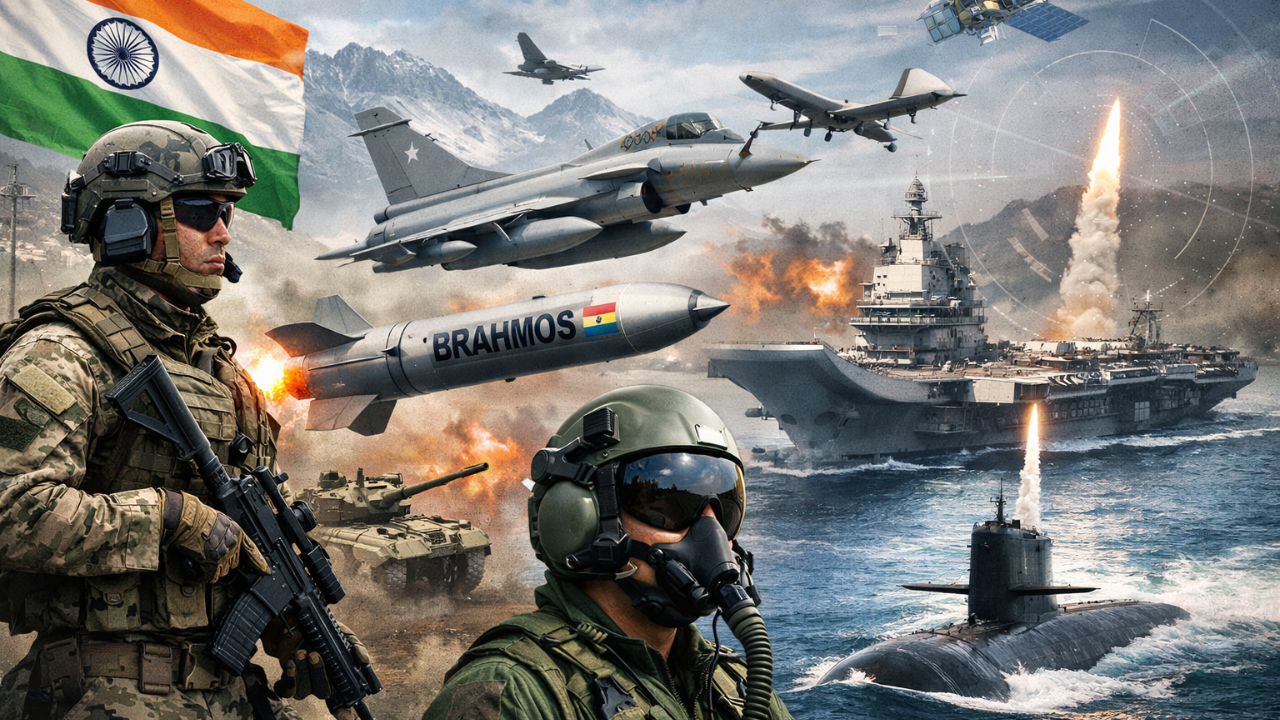
NEW DELHI: India’s military might stood unmistakably on display in 2025. The year was defined by armed forces’s decisive response to the Pahalgam attack through Operation Sindoor – a signal moment that underlined both resolve and capability. Beyond this, 2025 unfolded as a year of preparedness, projection and purpose.From the icy reaches of Alaska to the warm waters off Guam, from desert manoeuvres near the western border to anti-piracy patrols in the Indian Ocean, the armed forces operated with a clarity of intent shaped by experience, threat perception and a steadily expanding strategic vision.The year began with the government declaring 2025 the “Year of Reforms” for the defence sector, signalling that jointness, indigenisation and technological adaptation would no longer be incremental goals but central pillars of military planning. That intent was backed by numbers. The defence budget rose to Rs 6.81 lakh crore in 2025–26, nearly tripling from a decade earlier, underlining a long-term commitment to readiness across land, air and sea.Operational realities, however, gave urgency to that vision. In May, following the terror attack in Pahalgam, India launched Operation Sindoor, a calibrated military response that brought renewed focus on air defence, precision strike, electronic warfare and the growing role of drones. While details remained closely held, the episode reinforced lessons from recent conflicts: modern warfare is compressed, technology-driven and unforgiving of gaps in surveillance or response time. Those lessons echoed through the rest of the year in exercises, acquisitions and doctrinal conversations. By the end of the year, that assessment was articulated publicly by chief of defence staff General Anil Chauhan, who cautioned that India must be prepared for “short-duration, high-intensity conflicts” as well as longer wars, given unresolved territorial disputes and the changing character of warfare. His remarks captured the strategic undercurrent running through 2025 — a recognition that future conflicts may escalate rapidly, across domains, and demand seamless coordination among the services.On the borders, India sharpened its preparedness for short, high-intensity conflicts, testing tri-service integration and counter-drone capabilities. At sea, the Indian Navy sustained an unusually high operational tempo, escorting merchant vessels, deterring piracy and expanding its footprint from the Gulf of Aden to the western Pacific. Simultaneously, India commissioned frontline warships and submarines, signed major defence pacts, and pushed indigenous platforms—from helicopters and artillery guns to missiles and next-generation aircraft—closer to induction.By December, the picture was clear. India’s military year in 2025 was not defined by symbolism alone, but by the steady alignment of capability, industry and diplomacy. From borders to sea lanes, New Delhi sought to demonstrate that its defence posture is no longer reactive, but designed to endure, adapt and project strength in an increasingly uncertain strategic environment.
From Pahalgam to Operation Sindoor and the drone turn
Operation Sindoor emerged as India’s calibrated military response to an evolving pattern of asymmetric warfare that increasingly targets civilians alongside security forces. The terror attack on tourists in Pahalgam in April 2025 marked a grim inflection point, prompting New Delhi to launch a swift, technology-heavy operation designed to punish perpetrators without triggering a wider conventional conflict.India’s response was deliberate and precise. Without crossing the Line of Control or the international boundary, Indian forces struck identified terrorist infrastructure and supporting nodes, relying on stand-off weapons, drones and electronic warfare rather than ground manoeuvres. The emphasis was on speed, accuracy and escalation control.
At the offensive end, the Indian Air Force employed a mix of air-launched precision weapons. These included the BrahMos supersonic cruise missile, integrated with Su-30MKI fighters, and the SCALP long-range cruise missile fired from Rafale jets for deep, precision strikes. HAMMER precision-guided munitions were used against relocatable and hardened targets, while indigenous loitering munitions such as Nagastra-1 carried out surveillance and precision attacks on high-value assets, including radar and missile sites. Key Pakistani airbases, including Noor Khan and Rahimyar Khan, were targeted with loitering munitions, destroying air defence and surveillance infrastructure.Also read: ‘Hammer’: Used in Op Sindoor to crush Pakistan; India inks pact with France for homegrown hellfire – why the deal mattersEqually critical was air defence dominance. On the night of May 7–8, Pakistan attempted retaliatory strikes using drones and missiles against multiple military targets across northern and western India. These were neutralised by India’s Integrated Counter-UAS Grid and layered air defence network, bringing together legacy systems such as Pechora, OSA-AK and low-level air defence guns, alongside indigenous assets like the Akash surface-to-air missile system and Igla-S MANPADS. The Integrated Air Command and Control System (IACCS) enabled real-time sensor fusion and rapid engagement decisions.Electronic warfare played a decisive role. Indian forces jammed and bypassed Chinese-origin air defence systems deployed by Pakistan, completing key strike missions in under 30 minutes without loss of Indian assets. Debris recovered later — including parts of Chinese PL-15 missiles, Turkish-origin UAVs and commercial quadcopters — provided physical evidence of neutralised threats.Space-based assets were also critical. Over 10 Indian satellites provided continuous monitoring of border regions, airspace and maritime approaches, underscoring the integration of space, air and ground operations.Though brief, Operation Sindoor reshaped doctrine. It pushed drones, counter-drone systems and layered air defence to the centre of planning, directly influencing later large-scale drone warfare exercises and accelerating work on an indigenous, multi-layered air defence architecture. Above all, it reinforced a defining lesson of 2025: future conflicts will be short, high-intensity and technology-driven, where drones, data and decision speed can be as decisive as firepower itself.
Defence budget and readiness: Money behind the posture
India’s military posture in 2025 was underwritten by its largest-ever defence allocation, with the Union Budget 2025–26 earmarking Rs 6.81 lakh crore for the Ministry of Defence, a 9.53% increase over the previous financial year. The allocation, which accounts for 13.45% of the total Union Budget, signalled that preparedness, modernisation and self-reliance are no longer treated as episodic priorities but as long-term strategic commitments.At the heart of the budget was a strong push for capital expenditure and modernisation. The armed forces received Rs 1.80 lakh crore under the capital head, of which Rs 1.48 lakh crore was earmarked specifically for capital acquisition or modernisation. Significantly, 75% of this modernisation budget — Rs 1.12 lakh crore — was reserved for procurement from domestic industry, reinforcing the government’s emphasis on Aatmanirbhar Bharat in defence manufacturing. A quarter of this domestic share was set aside for private sector companies, underlining the growing role of non-PSU players in India’s defence ecosystem.
Revenue expenditure, which covers pay, allowances, sustenance and operational preparedness, stood at Rs 3.11 lakh crore, a 10.24% increase over the previous year. Within this, Rs 1.14 lakh crore was allocated for non-salary operational expenses, including fuel, ammunition, spares and maintenance — a reflection of sustained deployments along land borders, longer naval deployments at sea and increased flying hours for the Air Force.The budget also prioritised research and future capability development. Allocation for DRDO rose by 12.4% to Rs 26,816.82 crore, with nearly Rs 15,000 crore under the capital head to fund advanced R&D, deep-tech projects and industry-linked development programmes. In parallel, funding for the iDEX and ADITI schemes was raised to Rs 449.62 crore, nearly tripling in two years, to strengthen the startup and MSME-driven innovation pipeline.Beyond the frontline forces, the budget addressed critical enablers. Defence pensions were allocated Rs 1.61 lakh crore, reflecting a 14% increase, while Rs 8,317 crore was set aside for the Ex-Servicemen Contributory Health Scheme (ECHS). The Indian Coast Guard’s capital budget jumped 43%, supporting acquisitions of helicopters, patrol vessels and surveillance platforms, and Rs 7,146 crore was allocated to the Border Roads Organisation to strengthen infrastructure along sensitive frontiers.Together, these numbers reveal the architecture of India’s military readiness in 2025 and a deliberate shift towards sustained modernisation, domestic production, technological depth and operational resilience — ensuring that strategy on the ground is matched by resources on paper.
‘Mighty display’ in exercises: From special forces to Quad air and sea power
If one strand best captured India’s military posture in 2025, it was the scale and sophistication of its exercises. Across land, air and sea, India used training as strategic messaging — to deter adversaries, reassure partners and stress-test its own readiness for multi-domain warfare. The year’s drills were marked by size, realism and integration, moving decisively beyond symbolic engagement to complex warfighting scenarios.
- 1) Tri-service integration on display: Exercise Trishul
Among the most visible demonstrations of joint warfighting was Exercise Trishul, conducted in the western desert sector close to the international border. The exercise brought together the Army’s Southern Command, the Navy’s Western Command and the Air Force’s South-Western Air Command, along with other national security agencies.Around 30,000 personnel, supported by 20–25 naval platforms and nearly 40 fighter and transport aircraft, participated in the drill. Trishul tested joint planning and execution across desert, coastal and marshy terrain, integrating land manoeuvres with maritime strike and air dominance missions.Crucially, the exercise focused on multi-domain operations, including counter-drone measures, electronic warfare, cyber elements and real-time intelligence sharing. The drill sent a clear message: India is preparing to fight future wars as a single, integrated force rather than through sequential, service-specific responses.
- 2) Drone warfare moves to the centre of planning
Drones emerged as a defining feature of India’s exercise calendar in 2025. Following operational lessons from Operation Sindoor and global conflicts, the armed forces planned their largest-ever drone and counter-drone exercise, described by senior officers as a testbed for future air defence concepts.The exercise aimed to recreate real-world drone warfare scenarios, including surveillance swarms, loitering munitions and saturation attacks, while simultaneously testing indigenous counter-UAS systems. The focus was on integrating drones with air defence missiles, guns, electronic warfare and command-and-control networks — a preview of India’s proposed Sudarshan Chakra air defence architecture.
- 3) Training for extremes: Yudh Abhyas 2025 in Alaska
The 21st edition of Exercise Yudh Abhyas took India–US Army cooperation to the Arctic, with drills held at Fort Wainwright, Alaska, from 1 to 14 September. An Indian Army battalion trained alongside the US Army’s Arctic Wolves Brigade Combat Team, rehearsing operations in extreme cold and high-latitude conditions.Training covered heliborne operations, unmanned aerial systems, mountain warfare, casualty evacuation and the integrated use of artillery, aviation and electronic warfare. The location itself underscored India’s focus on preparing for harsh terrain, mirroring conditions along its northern borders.
- 4) India–France maritime muscle: Varuna 2025
The 23rd edition of Exercise Varuna reaffirmed the depth of India–France naval cooperation. Conducted in the Arabian Sea, the exercise featured both countries’ aircraft carriers — INS Vikrant and Charles de Gaulle — along with destroyers, frigates, submarines and maritime patrol aircraft.High-end drills included advanced air defence, anti-submarine warfare and surface combat operations. Notably, fighter exercises featured mock air-to-air combat between French Rafale-M jets and Indian MiG-29Ks, aligning closely with India’s decision to procure Rafale-M aircraft for its carriers.
- 5) Quad at sea: Malabar 2025 at Guam
Exercise Malabar 2025, held in and around Guam, marked the 29th iteration of the flagship Quad naval drill involving India, the US, Japan and Australia. The exercise focused on high-end warfighting, including anti-submarine warfare, surface combat, maritime interdiction and integrated air operations.India was represented by the indigenously built INS Sahyadri, reinforcing the Aatmanirbhar Bharat narrative. Malabar demonstrated the Quad’s ability to operate seamlessly across the Indo-Pacific, projecting collective resolve amid rising regional tensions.
- 6) Quad in the air: Cope India and bomber integration
In the air domain, Cope India 2025 underscored growing interoperability between the Indian Air Force and the US Air Force. While the full exercise format was scaled back, the presence of a US B-1B bomber for integration sorties with IAF fighters carried strong signalling value.The drills highlighted long-range strike coordination, air combat integration and shared operational understanding, reinforcing air power as a key pillar of Quad cooperation.
- 7) India–France air power: Garuda 25
The 8th edition of Exercise Garuda, held in France from 16 to 27 November, was one of the Indian Air Force’s largest international engagements of the year. IAF Su-30MKI fighters, supported by IL-78 tankers and C-17 transport aircraft, trained with the French Air and Space Force in complex strike and escort missions.The exercise enhanced interoperability, joint mission planning and combat readiness, reflecting the maturity of the India–France strategic partnership.
- 8) Neighbourhood focus: Surya Kiran XIX
Closer to home, Exercise Surya Kiran XIX with Nepal reinforced sub-regional security cooperation. Held in Uttarakhand, the drill focused on counter-terrorism, mountain warfare, humanitarian assistance and disaster relief, while also incorporating drones, AI-enabled tools and integrated ground–aviation operations. The DGMOs of the Indian and Nepali Armies jointly witnessed and validated the Battalion-level Validation Exercise, concluding an intensive combined training cycle at the Foreign Training Node, Pithoragarh. The exercise validated joint Tactics, Techniques and Procedures (TTPs) for Counter-Terrorism operations under Chapter VII of the UN Charter, with effective integration of niche technologies including drones for ISR and precision targeting, AI-enabled surveillance, unmanned logistics platforms, advanced day/night sights and secure battlefield communications.
Procurement and pacts: Buying power, building power, and tightening partnerships
India’s defence acquisitions and international pacts in 2025 reflected a clear strategic pattern: acquire critical capabilities quickly, build them at home where possible, and lock partnerships into long-term frameworks. From fighter jets and missiles to drones and precision-guided munitions, procurement decisions were closely aligned with operational lessons, especially those emerging from Operation Sindoor and the changing character of warfare.
- Rafale-Marine deal: Strengthening carrier-based air power
One of the most consequential deals of the year was the Inter-Governmental Agreement with France for 26 Rafale-Marine fighter aircraft for the Indian Navy. Signed in April 2025, the deal, valued at around Rs 63,000 crore, covers 22 single-seat and four twin-seat fighters, along with training, simulators, weapons, spares and performance-based logistics. The Rafale-M will operate from India’s aircraft carriers, significantly enhancing maritime strike capability, fleet air defence and power projection in the Indian Ocean. The deal also includes additional equipment for the Indian Air Force’s existing Rafale fleet, reinforcing commonality across services and deepening India–France defence ties.
- Precision strike boost: India–France HAMMER weapon partnership
Another major India–France milestone in 2025 was the decision to manufacture the HAMMER (Highly Agile Modular Munition Extended Range) precision-guided air-to-ground weapon system in India. Under the agreement between Safran Electronics & Defense and Bharat Electronics Limited (BEL), the system will be produced through a 50:50 joint venture.
HAMMER is a modular, all-weather, stand-off precision strike system already integrated with platforms such as the Rafale. Its induction and local manufacture will significantly enhance the Indian Air Force’s precision strike capability while advancing indigenous expertise in guidance, propulsion and modular weapon design. Strategically, the deal moves India beyond importing finished weapons to mastering enabling technologies critical for modern air warfare.
- MQ-9B Predator drones: Surveillance and strike reach
India finalised a landmark deal with the United States for 31 MQ-9B drones, valued at approximately USD 4 billion. The package includes SeaGuardian variants for the Navy and land-based versions for the Army and Air Force, dramatically expanding India’s long-endurance surveillance, targeting and precision strike capability. The agreement also provides for maintenance, repair and overhaul (MRO) facilities in India and collaboration with Indian industry, linking immediate operational needs with long-term capacity building in unmanned systems.
- BrahMos missiles: Bulk induction and export momentum
BrahMos remained central to India’s missile strategy in 2025, both domestically and internationally.Domestic procurement: The government signed contracts worth Rs 19,518.65 crore for BrahMos missiles to meet Indian Navy operational and training requirements, along with a separate Rs 988.07 crore contract for ship-borne BrahMos missile systems.Also read: India closer to $450m BrahMos pacts with Vietnam, IndonesiaPhilippines export: India delivered the second batch of BrahMos missile systems to the Philippines under the USD 375 million deal signed in 2022. Unlike the first delivery, which was airlifted, the second batch was shipped by sea, demonstrating India’s growing logistics capability for defence exports.
Future exports: By year-end, India was in advanced discussions to export BrahMos to Vietnam and Indonesia, with potential deals collectively valued at over Rs 4,000 crore, reinforcing India’s role as a defence supplier in the Indo-Pacific.
- Light Combat Helicopter Prachand: Indigenous firepower at scale
In March 2025, India signed contracts with Hindustan Aeronautics Limited for 156 Light Combat Helicopters (LCH) Prachand, valued at Rs 62,700 crore. The Indian Air Force will receive 66 helicopters, while the Army will induct 90. Designed for high-altitude operations, Prachand has over 65% indigenous content and involves more than 250 domestic companies, largely MSMEs. The deal represents one of the largest indigenous helicopter orders and directly supports India’s mountain warfare and border preparedness requirements.
- Modernisation approvals: Air defence, drones and amphibious capability
The defence acquisition council cleared a series of major modernisation projects during the year, with cumulative approvals worth around Rs 79,000 crore. These included:
- Construction of four large amphibious warfare ships (LPDs) at Indian shipyards
- Procurement of additional missiles for S-400 air defence systems
- Acquisition of armed swarm drones with long-range strike capability
- Indigenous Nag anti-tank missile systems, electronic intelligence platforms and high-mobility vehicles
- These approvals reflected a focus on joint operations, expeditionary capability and air defence resilience
- Strategic defence frameworks: Locking in partnerships
Beyond platforms, India used 2025 to institutionalise defence relationships. A new 10-year framework for the US–India major defence partnership was signed, providing policy direction for military-to-military cooperation, technology sharing, exercises and industrial collaboration.India also expanded defence cooperation with Australia, covering joint exercises, submarine rescue support, air-to-air refuelling and maritime domain awareness, while continuing to deepen security ties with France across naval, air and industrial domains.
Defence production and exports: ‘Make in India’ as a military tool
In 2025, India’s defence production and export push moved decisively from policy ambition to strategic instrument. What began a decade ago as an industrial initiative under “Make in India” has now become an essential pillar of military readiness, deterrence and diplomacy.India recorded its highest-ever defence production in FY 2024–25 at over Rs 1.54 lakh crore, underlining the steady expansion of its domestic military-industrial base. Defence exports also touched a new peak of Rs 23,622 crore, reflecting both growing international confidence in Indian platforms and New Delhi’s intent to position itself as a reliable defence supplier.A major factor behind this surge was the structured push for indigenisation. Five Positive Indigenisation Lists, covering more than 5,500 items, have progressively restricted imports and compelled domestic development. By early 2025, around 3,000 of these items had already been indigenised, ranging from artillery guns and assault rifles to radars, sonar systems, transport aircraft components and armoured platforms. The lists ensured that future capital acquisitions translated directly into domestic manufacturing orders rather than foreign contracts.
Defence industrial corridors in Uttar Pradesh and Tamil Nadu further strengthened this ecosystem. Spread across 11 nodes, the corridors attracted investments of over Rs 8,600 crore by February 2025, with memoranda of understanding indicating a potential investment pipeline exceeding Rs 53,000 crore. These hubs brought together large manufacturers, MSMEs and startups, reducing dependence on imports while shortening supply chains for the armed forces.Exports emerged as a strategic extension of this manufacturing base. The BrahMos supersonic cruise missile became the flagship of India’s defence export portfolio, with the delivery of a second batch to the Philippines in 2025 under the USD 375 million deal signed in 2022. Negotiations to export BrahMos to Vietnam and Indonesia also gathered momentum, signalling India’s growing role in Indo-Pacific security.Beyond missiles, India exported patrol vessels, radars, electronic systems, ammunition and spares to multiple countries, while defence diplomacy increasingly linked training, maintenance and logistics support to export deals.
At sea: Navy’s operational year and India’s push to be a ‘preferred security partner’
The Indian Navy’s operational tempo in 2025 underscored a decisive shift in how New Delhi views maritime security — not as a peripheral concern, but as a core national interest tied to trade, energy flows and regional stability. Throughout the year, the Navy functioned as a round-the-clock security provider across the Indian Ocean Region, reinforcing India’s ambition to be a “preferred security partner” for countries along key sea lanes.A major focus was maritime security operations, particularly in piracy-prone and conflict-affected waters. Indian warships maintained sustained deployments in the Gulf of Aden, Arabian Sea and adjoining regions, escorting merchant vessels, deterring piracy and responding to distress calls. By the end of the year, senior naval leadership indicated that dozens of ships had been rotated through anti-piracy missions, with hundreds of lives saved through rescue and evacuation operations. These deployments were not episodic responses but part of a continuous presence strategy aimed at ensuring freedom of navigation. Operational commitments were matched by fleet expansion and capability induction. In January, the Navy commissioned three frontline platforms — INS Nilgiri, INS Surat and INS Vaghsheer — in a single day, followed later in the year by the commissioning of Project 17A stealth frigates Udaygiri and Himgiri. These inductions strengthened both the Western and Eastern Fleets, enhancing surface warfare, anti-submarine and surveillance capabilities.Beyond national waters, the Navy used 2025 to deepen maritime partnerships. India launched its largest-ever multilateral naval exercise with African nations, Aikeyme 25, off the coast of Tanzania, focusing on counter-piracy, search and rescue and coordinated maritime response. The exercise reflected India’s expanding engagement with African littoral states and its intent to contribute to security across the western Indian Ocean.The Navy also remained central to India’s broader Indo-Pacific strategy, participating in high-end exercises such as Malabar 2025 at Guam and Varuna with France, projecting presence from the western Indian Ocean to the Pacific.
Research, missiles, and strategic forces: Deterrence in the background
While conventional deployments and exercises dominated headlines, 2025 also saw steady progress in India’s strategic and technological deterrence, largely unfolding away from public view. This quieter layer of military power remains central to India’s security calculus, particularly in maintaining credibility across multiple fronts.A major milestone came with the test of the K-4 submarine-launched ballistic missile from the nuclear-powered submarine INS Arighaat. With a range of around 3,500 km, the K-4 strengthens the sea-based leg of India’s nuclear triad, enhancing survivability and second-strike capability in line with the country’s no-first-use doctrine. The test underscored India’s gradual but deliberate progress in operationalising its undersea deterrent.Also read: India test fires 3,500-km missile from nuclear submarineAir and missile defence also advanced significantly. DRDO successfully completed user evaluation trials of the Akash-NG, a next-generation surface-to-air missile designed to counter a wide range of aerial threats, including aircraft, drones and cruise missiles. These developments gained added relevance in the aftermath of Operation Sindoor, which reinforced the importance of layered air defence and sensor integration.Parallelly, the government approved a major indigenous AWACS programme (Netra Mk-II), aimed at developing next-generation airborne early warning and control systems. Once operational, these platforms will significantly enhance situational awareness, command-and-control and information dominance — areas increasingly seen as decisive in modern conflicts.
The big picture: What 2025 suggests about India’s direction
Taken as a whole, India’s military year in 2025 points to a clear and coherent direction rather than a collection of isolated developments. Across reforms, exercises and acquisitions, the emphasis shifted decisively towards joint warfighting, with land, air and sea treated as interconnected battlespaces requiring unified planning and execution rather than sequential, service-led responses. At the same time, self-reliance emerged as strategy, not slogan. Indigenisation, defence exports and domestic procurement were pursued as operational enablers, ensuring availability, scalability and autonomy in moments of crisis rather than merely delivering economic returns.Also read: ‘Even Trump doesn’t know … ‘: Army chief Upendra Dwivedi flags fog of ‘clueless’ future; cites India’s challengesTechnology increasingly defined the edge India sought to build, with investments in drones, electronic warfare, missiles and airborne sensors reflecting an understanding that future conflicts will be decided by information dominance, precision and speed, not attrition alone. Parallelly, India deepened defence partnerships with the US, France, Australia, Quad partners and African nations, while carefully preserving strategic autonomy, favouring exercises, long-term frameworks and co-production over transactional buying. By the end of 2025, India’s defence posture had clearly moved beyond reactive preparedness, reflecting a confident, forward-looking military strategy designed to deter conflict, manage escalation and, if required, prevail across domains in an increasingly unpredictable world.


