



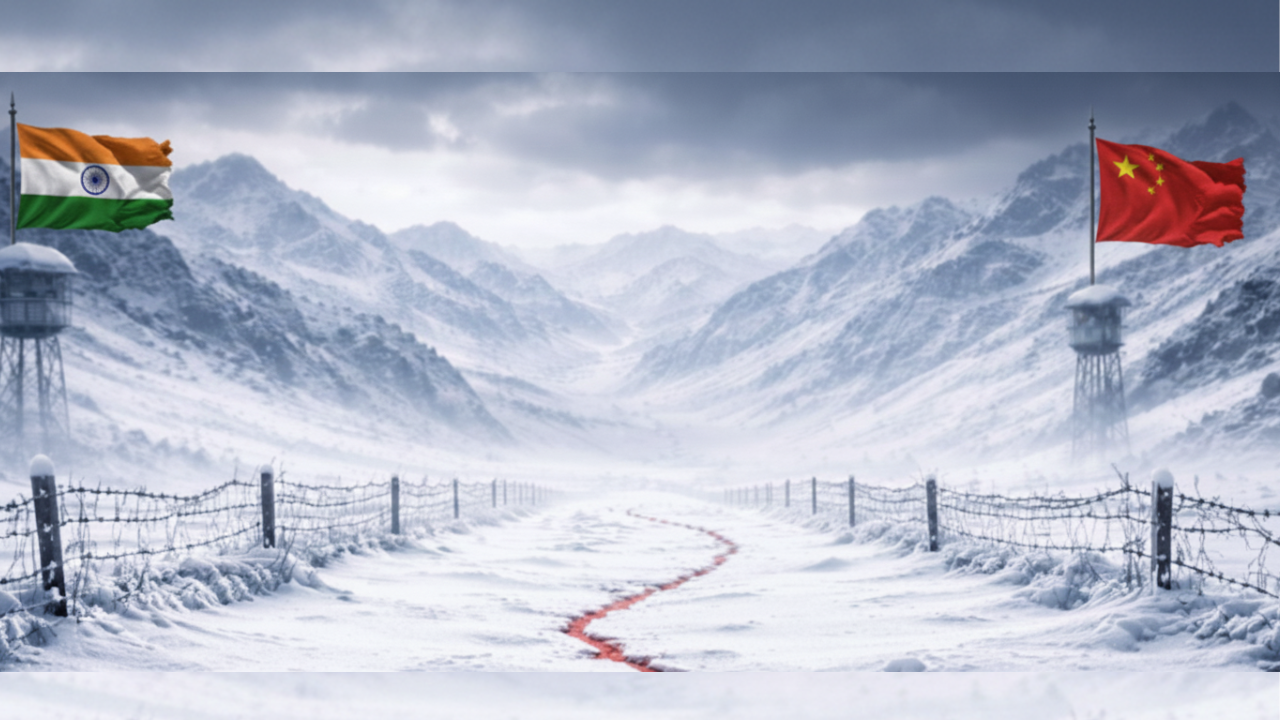
New Delhi: Five years after the violent clash at Galwan Valley, as India reopens channels with China, the moment is an irony that is difficult to ignore. The last time an Indian Prime Minister trusted China, what happened next has been echoing in our ears for at least the last decade.There has been an unexpected turn in India-China relations in 2025. After years of diplomatic frustration, military standoff and harsh rhetoric, both sides have retreated, at least on the surface, to the sidelines. High-level talks resumed, including the visit of Chinese Foreign Minister Wang Yi to Delhi and Prime Minister Narendra Modi’s meeting with the President. Xi Jinping On the sidelines of the Shanghai Cooperation Organization (SCO) summit. Talks were resumed on troop withdrawal at sensitive friction points such as Depsang and Demchok, commercial flights were restored, and limited trade channels were reopened, surprising many observers.For a relationship long defined by suspicion, this thaw has raised many questions as well as expectations.India-China relations have their roots in a long and uneasy history: the trauma of the 1962 war, repeated border confrontations, the Doklam standoff and the prolonged standoff following the 2020 Galwan clash. Against this background, the question arises: how stable is this new peace, and what is it really based on?Equally important is what is behind this change. Strategic compulsions, economic pressures and changing global alignments appear to have pushed both capitals towards a phase of managed stability, driven by less cohesion than necessary.For India, the sudden outreach to China marked a rare realignment in stance. After years of coercion and strategic distancing, New Delhi’s decision to test the reset challenged long-held assumptions about Beijing. This signaled not an abandonment of caution, but a willingness to test whether limited cooperation could co-exist with enduring rivalry without compromising strategic autonomy or long-term security interests.
what has reopened
The 2025 reset unlocked channels that had been blocked due to antitrust since 2020. Direct passenger flights between major cities including Delhi and Beijing resumed after a five-year pause, reviving people-to-people contacts and easing business travel that had been effectively halted since the Galwan clash.On the ground, activity was also seen along border trade routes. Nathu La reopened in Sikkim, allowing exchange of local goods. These measures helped lift bilateral trade, supported by the gradual easing of restrictions on selective shipments and licensing procedures.Diplomatically, both sides revived long-dormant mechanisms, from special envoys to working groups on border issues, creating channels to manage friction without escalating tensions. Although none of these steps achieved any breakthrough on the original border dispute, they helped restore a minimum level of predictability in a relationship that had become dangerously fragile.
,
Exports boomed, but the imbalance deepened
India’s exports to China grew rapidly, rising 90% year-on-year to $2.2 billion in November 2025, according to the Global Trade Research Initiative (GTRI). Exports increased 33% to $12.2 billion from April to November. At first glance, the figures suggest a revival in commercial relations after years of disruption.But the headline numbers hide deeper weaknesses.GTRI believes that India’s export growth to China remains narrow and volatile, driven primarily by a handful of products rather than broad-based expansion of India’s traditional export basket. The bounce was dominated by naphtha and select electronics, while sectors like iron ore and agriculture showed inconsistent or lackluster performance.At the same time, India’s imports from China remain highly concentrated and structurally strong. Between January and October 2025, electronics imports alone stood at $38 billion, followed by machinery imports at $25.9 billion, organic chemicals at $11.5 billion and plastics at $6.3 billion. These categories include mobile phone components, integrated circuits, laptops, solar modules, lithium-ion batteries and pharmaceutical intermediates.As a result, trade imbalance is increasing. India’s exports to China are projected to fall from $23 billion in 2021 to $15.2 billion in 2022, remain low through 2023, and increase marginally to $17.5 billion in 2025. However, imports increased from $87.7 billion in 2021 to an estimated $123.5 billion in 2025, widening the trade deficit to $106 billion.Chinese customs data paints an even starker picture, indicating a deficit of more than $115 billion.GTRI warns that India’s recent export gains to China are narrow, volatile and largely dependent on changes in Chinese demand. Without a sustained strategy to expand competitive manufacturing and reduce import dependence, a short-term boom will not change the fundamentally unbalanced nature of the relationship.
,
forced reset
Many analysts argue that the 2025 thaw was driven less by renewed confidence and more by shared constraints. As Ashley Tellis says in an article, “India-China tensions are more strategic than transformational, driven by US tariff pressure and trade deficit, not real border resolution.”For Beijing, mounting pressure from renewed US tariffs under President Donald Trump, a slowing domestic economy and expanding Western efforts to reduce dependence on Chinese supply chains have made engagement with India more attractive. Stabilizing relations with a major regional power provides China with economic relief and diplomatic signals at a time of global pressure.For New Delhi, calculus was equally practical. Prolonged military deployment along the Line of Actual Control strained resources and preparedness, while global supply chain disruptions underlined the cost of continued confrontation along the world’s manufacturing hub. De-escalation provided space to regroup without conceding key positions.What emerged was a carefully calibrated, transactional, limited and hedged detente, designed to manage risk rather than resolve the rivalry.
,
Is it sustainable?
The durability of the 2025 reset remains uncertain. There is still no consensus on the demarcation of the Line of Actual Control, and troop levels have not returned to pre-2020 levels. Even small patrol incidents can quickly turn into a major crisis.Deep political sensitivities remain unresolved. Beijing’s concerns over the Dalai Lama’s presence and succession in India remain in the background. China’s strategic partnership with Pakistan remains a major source of friction, especially after terrorist incidents such as the Pahalgam attack.“Beijing knows this. New Delhi knows this too,” Gautam Bambawale, India’s former ambassador to China, told DW. For example, India will never allow Chinese companies like Huawei and ZTE to re-enter India’s telecom sector.Without clear ground rules and deep strategic dialogue, many fear that the thaw could remain temporary and leave us vulnerable to the next shock.
Impact on Indian foreign policy
Opinions differ on whether India’s outreach to China reflects tensions with the United States or a broader recalibration. Beijing also rejected claims in a recent Pentagon report that China was stoking border tensions to weaken US-India ties, calling such claims misleading.For India, engagement with China fits into a long-term strategy of deterrence, keeping options open, protecting strategic autonomy and avoiding excessive dependence on any one power. Strategic analyst Happyman Jacob argued in an article that the renewed friendship shows that there are alternatives to a special alliance with Washington.The reset has also improved India’s position in multilateral fora like SCO and BRICS. With tensions temporarily reduced, New Delhi will be able to engage more confidently, taking advantage of a better approach with Xi Jinping on Global South concerns, development financing and calling for a more balanced global order.At the same time, India can quietly continue to strengthen its neighborhood strategy, deepen ties with Bhutan, expand connectivity initiatives, and counter Chinese influence in Nepal and Sri Lanka.
what next
India now finds itself at a familiar but delicate crossroads. Over the past decade, it has sought to establish itself as a central player in a multipolar world, balancing relations with the US and Russia while managing competition with China. This balancing act has become tougher as global fault lines have sharpened, forcing New Delhi to constantly reassess the risks without locking itself into rigid alliances.Strategic analyst Brahma Chellaney, in an article cautioning against overconfidence, cautions that past experience shows how quickly a strategic arrangement with China can unravel. History shows that periods of peace in India-China relations often rest on fragile assumptions, vulnerable to sudden changes due to border incidents, regional crises or domestic political pressures on both sides.Going forward, New Delhi will have to walk a tightrope. Despite diplomatic engagement continuing, military vigilance on the LAC cannot be relaxed. Economically, India should accelerate efforts to reduce significant import dependence, especially in electronics, pharmaceuticals and clean energy components, while also ensuring that trade engagement does not translate into strategic vulnerabilities.The challenge ahead will be to maintain this delicate balance: achieving short-term stability without sacrificing long-term security, avoiding economic over-dependence, and ensuring that strategic resets do not turn into strategic confusion. For now, the 2025 thaw offers scope, but not certainty.


