



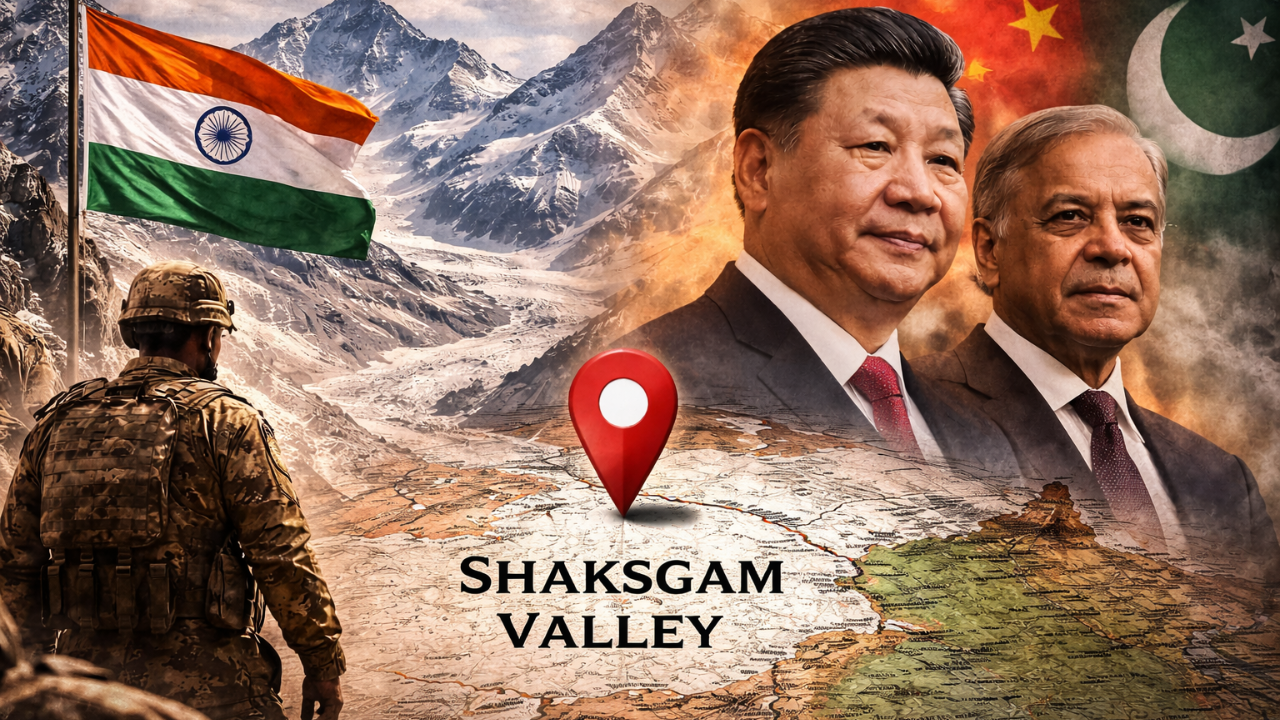
New Delhi: China’s latest claim that the Shaksgam Valley “belongs to China” has reopened a long-forgotten but strategically explosive fault line. kashmir Controversy. Beijing’s defense of infrastructure construction in the region, closely linked to the China-Pakistan Economic Corridor (CPEC), has drawn a sharp reaction from New Delhi, which has once again described the region as an “integral and inseparable part of India”.The disagreement is not merely semantics. At stake is territorial sovereignty, India’s claim to Pakistan-occupied Kashmir (PoK), China’s growing reach in the western Himalayas and the future shape of regional connectivity linking Xinjiang, Gilgit-Baltistan and the Arabian Sea.This explainer explains what the Shaksgam Valley is, why it matters, the legal roots of the dispute, what India and China have said, and how CPEC and the 1963 China-Pakistan border agreement fit into the bigger geopolitical picture.What is Shaksgam Valley?The Shaksgam Valley – also known as the Trans-Karakoram Tract – is a sparsely populated, high-altitude region located in the north. Siachen Glacier. It is bordered by China’s Xinjiang province in the north, Pakistan-occupied Gilgit-Baltistan in the south and west, and the Siachen region in the east.This geographically inaccessible region is marked by glaciers, mountain passes and extreme weather. However, politically, it is one of the most sensitive parts of the region in the Kashmir puzzle.
India maintains that the Shaksgam Valley is part of the former princely state of Jammu and Kashmir and therefore legally belongs to India. Pakistanwhich has occupied parts of Jammu and Kashmir since 1947, transferred control of the region to China in 1963 – a move that New Delhi never recognized.China currently administers the region as part of Xinjiang and treats it as sovereign Chinese land.What is the dispute about?At its core, the dispute revolves around who has the legal authority to decide the fate of the Shaksgam Valley.India’s position is clear: Pakistan has no legal right to hand over any part of Jammu and Kashmir to any third country as it is an occupying power in PoK. Therefore any agreement signed by Pakistan with respect to that area is “illegal and void”.China and Pakistan give different arguments. He says that the China-Pakistan Boundary Agreement of 1963 was a sovereign decision between two independent states to demarcate their border and bring stability to the previously undefined border.Beijing has now gone a step further by saying that infrastructure development in the region is “completely appropriate”, signaling that it considers the issue closed – at least from its perspective.Why is Shaksgam Valley strategically important?Despite its harsh terrain, the Shaksgam Valley holds strategic importance for four major reasons:
- Proximity to Siachen and Ladakh
This valley is located close to the Siachen Glacier, where a military standoff has been going on between Indian and Pakistani troops for decades. Chinese activity in the region adds a third actor to an already volatile theater. - Strategic depth of China-Pakistan
The region provides close regional access to China and Pakistan, allowing coordination between Xinjiang and Gilgit-Baltistan. This was impossible before the 1963 agreement. - Military and logistics implications
The infrastructure in the Shaksgam Valley improves China’s ability to move troops, equipment and supplies to India’s northern borders, especially near Ladakh. - Precedent for territorial claims
For India, accepting Chinese control over Shaksgam would weaken its legal position on PoK and undermine the 1994 parliamentary resolution that states the entire area belongs to India.
What has the Ministry of External Affairs said?India’s response has been unusually strong and consistent. Foreign Ministry spokesperson Randhir Jaiswal has rejected both China’s claims and Pakistan’s role in helping them.“Shaksgam Valley is an Indian territory. We have never recognized the so-called China-Pakistan border agreement of 1963,” Jaiswal said during a weekly briefing.He said India also does not recognize the China-Pakistan Economic Corridor, which passes through “territory under the forcible and illegal occupation of Pakistan”.Jaiswal underlined that the entire Union Territories of Jammu and Kashmir and Ladakh are an integral and inalienable part of India, and said New Delhi has consistently opposed efforts to change the ground reality in the Shaksgam Valley.Importantly, while India has also reserved the right to take necessary measures to protect its interests, the language indicates that both diplomatic and strategic options will remain open.What did China say?China’s response has been equally straightforward.Beijing’s Foreign Ministry spokesman Mao Ning rejected India’s objections, saying, “The area you mentioned belongs to China. It is completely appropriate for China to build infrastructure on its own territory.”He said China and Pakistan had signed a boundary agreement in the 1960s and demarcated their border as an exercise of sovereign rights.
Responding to India’s criticism of CPEC, Mao reiterated Beijing’s longstanding stance that the project is an economic cooperation initiative aimed at development and improving livelihoods.Importantly, he said the border agreement and CPEC do not affect China’s position on the Kashmir issue, which Beijing says should be resolved peacefully in accordance with UN resolutions and bilateral agreements.What is the China-Pakistan Border Agreement of 1963?The China-Pakistan Boundary Agreement, signed on March 2, 1963, formally transferred 5,180 square kilometers of area in the Shaksgam Valley from Pakistan-occupied Kashmir to China.At the time, Pakistan had described the move as a temporary arrangement until the final resolution of the Kashmir dispute. The agreement includes a clause stating that once Kashmir is resolved, the sovereign authority will renegotiate the border with China.India rejected the agreement outright, arguing that Pakistan had no authority to sign it on territory that legally belonged to India.However, for China and Pakistan, the agreement served an important purpose: it created a common land border, laying the foundation for their enduring strategic partnership.Why does India call the 1963 agreement illegal?India’s objections rest on three pillars:
- Pakistan is an occupying power: New Delhi believes that Pakistan’s control over parts of Jammu and Kashmir is illegal, making any territorial transfer invalid.
- Violation of India’s sovereignty: Any change of boundaries in Jammu and Kashmir without India’s consent is a violation of its territorial integrity.
- Dangerous precedent: Accepting the agreement will legitimize third party involvement in the Kashmir dispute. This legal position has remained unchanged across different governments and decades.
What is CPEC and how does it connect to Shaksgam Valley?The China-Pakistan Economic Corridor is Beijing’s flagship Belt and Road Initiative project, worth about $60 billion. It connects China’s Xinjiang region with Pakistan’s Gwadar port through roads, railways, energy projects and industrial zones.Parts of CPEC pass through Gilgit-Baltistan, which is part of PoK.While the Shaksgam Valley is not the most visible section of CPEC, its integration into the Chinese logistics network strengthens Beijing’s western connectivity and supports Pakistan’s role as China’s gateway to the Arabian Sea.India argues that CPEC directly violates its sovereignty and has repeatedly warned against third country involvement in projects passing through PoK.Why is China now pushing infrastructure into this region?Several factors appear to be behind Beijing’s persistence:
- Securing the western approaches to Xinjiang
- Securing CPEC assets amid terrorist threats in Pakistan
- Hint of solution after standoff in eastern Ladakh
- Reinforce claims through physical presence
- In this sense, infrastructure becomes both a logical asset and a political statement.
Where does Pakistan stand?Pakistan has supported China’s position, insisting that the 1963 agreement is legitimate and CPEC is important for its economic future.Islamabad recently announced the creation of a special security unit to protect Chinese nationals working on CPEC projects, underscoring how central the corridor has become to Pakistan-China relations.However, India has been calling Pakistan’s actions illegal and accuses Islamabad of trading in territory that does not belong to it.what happens next?In the short term, the dispute is likely to escalate diplomatically, with India continuing to lodge protests and China moving ahead with its projects.In the longer term, the Shaksgam Valley could emerge as another pressure point in the already tense India-China relations, especially if infrastructure development alters the strategic balance near Ladakh and Siachen.For New Delhi, the challenge is to defend its territorial claims without escalating tensions, while also preventing gradual normalization of a situation it considers unlawful.The Shaksgam Valley may be remote and uninhabited, but it lies at the intersection of India-China rivalry, Pakistan’s regional maneuvering and China’s westward expansion.China’s new claim and India’s firm rejection show that the issue is still not settled. What was once a quiet footnote to the Kashmir dispute is now re-emerging as a living geopolitical fault line – one that could shape the strategic landscape of the Himalayas for years to come.


