



Norberto ParedesBBC Mundo, Caracas

 Getty Images
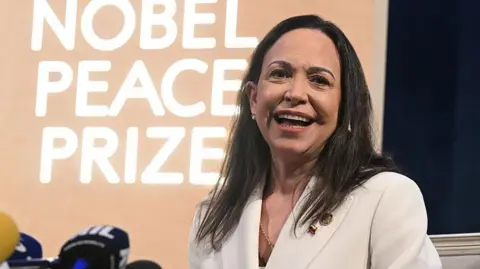
Venezuelan opposition leader María Corina Machado may hold the Nobel Peace Prize, but she knows there is only one foreign endorsement that really matters: Donald Trump’s.
She will meet the US president at the White House on Thursday, after publicly offering to share her Nobel with him – a prize he has long coveted.
Trump has said it would be an “honour” to accept the award, although the Norwegian Nobel Institute said legally it is not possible to transfer the prize. Previously, Trump had criticised the Nobel committee for bypassing him and giving Machado the award.
Largely, he has appeared cool towards Machado, who was given the award in recognition of her long fight for democracy in Venezuela. In 2023, she won the opposition primary by a landslide, and was barred from running against Venezuela’s president, Nicolás Maduro, whose re-election a year later was widely condemned as illegitimate.
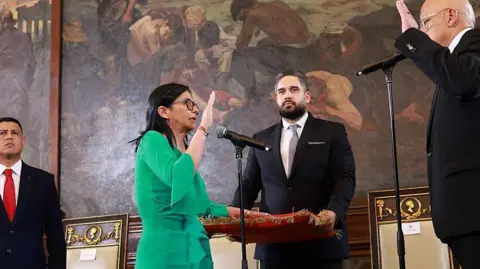
Yet after a US operation ousted Maduro earlier this month, Trump backed Maduro’s vice-president, Delcy Rodríguez, saying Machado was “not respected” enough to lead the country.
Now, she will be hoping to use her face time with the US president to persuade him that his decision to back Rodríguez’s interim government is a mistake, and that her opposition coalition should be in charge of this transition.
When BBC Mundo spoke to Machado after her most recent conversation with Trump – before the US intervened in Venezuela on 3 January – she told me that she thanked him for what he was doing “for peace, freedom, and democracy”, insisting that together they would “liberate” Venezuela.
But immediately after the US operation, Trump announced that he planned to “run” Venezuela himself and that he was content to keep Rodríguez’s interim government in place, saying that she was “essentially willing to do what we think is necessary to make Venezuela great again”.
On Wednesday, Trump told reporters he had a “great conversation” with Rodríguez and praised her as being a “terrific person” following a long phone call.
Could a meeting between Machado and Trump in the Oval Office change all that?
Trump is famously unpredictable in his personal relationships with other politicians, but how he sees Machado’s role is likely to depend less on what she says than on what Rodríguez does in the coming weeks, and whether it meets Trump’s approval.
While many opposition supporters were shocked when Trump sidelined Machado in favour of Rodríguez, some are now beginning to understand what may have been behind that decision.
Machado is a polarising figure. Though loved by her supporters – who, among other things, admire her skill in uniting a previously fragmented opposition – she is hated by the regime and its loyalists for that very same reason. To them, she is a formidable and above all, outspoken opponent.
While the government now commands only minority popular support, according to polls and analysts, it retains firm control over the state’s institutions, including the military.
Armed civilian groups known as colectivos, financed by the state, remain an integral part of the pro-government movement.
In this political and security climate, expressing public support for Machado, or for US intervention, is fraught with risk.
Even some of Maduro’s opponents fear what could happen if Trump was to install an opposition leader without holding fresh elections.
Venezuelans are divided on Trump’s actions – even among those who opposed Maduro.
While some whisper support, others take particular issue with his statements suggesting that the US could control Venezuela and its oil.
The division over who should lead the country is deeper still.
Many Venezuelans admire Machado and recognise her as the only opposition leader who maintained a coherent and consistent challenge to Maduro’s government.
Here in Caracas, some people have told the BBC that, contrary to Trump’s claim, she enjoys strong support within the country.
They point to her landslide victory in the opposition primary ahead of the 2024 presidential election and her ability to mobilise thousands of Venezuelans to protest when Maduro declared victory in the election, even though independently verified tallies showed the candidate backed by Machado had won.
That group views Rodríguez as one of the architects of Maduro’s government and its abuses.
They will want Machado to press Trump at the White House on how the US plans to “run” Venezuela and to try and convince him that, while his promise to “Make Venezuela Great Again” by controlling the country’s oil industry may appeal to some US Maga supporters, it does little to restore democracy.
Others, however, agree with Trump and believe Rodríguez should oversee the transition. They view her as the best option to avoid the instability that could be triggered by a backlash from supporters of the current government and the colectivos.
They would not welcome the opposition taking power after a US military operation in which Maduro was captured and sent to New York to face drug trafficking and arms charges.
The army and the colectivos are currently unlikely to take orders from the opposition and, at least in the short term, some feel the status quo is safer.
 Getty Images
A prominent Venezuelan political analyst – who did not want to be named – told the BBC that many people believe Trump’s ability to overthrow Maduro was made possible largely because of Machado’s efforts to weaken the regime.
“Personally, I doubt that Trump fully believes what he said. If he truly thought Machado lacked support in Venezuela, why would he host her at the White House?” he said.
“More than 80% of Venezuelans want political change,” he adds. “They believe the opposition are the only ones capable of overseeing a process of returning to democracy in Venezuela.
“And most of those Venezuelans who want change do not believe it would happen under Delcy Rodríguez.”


