



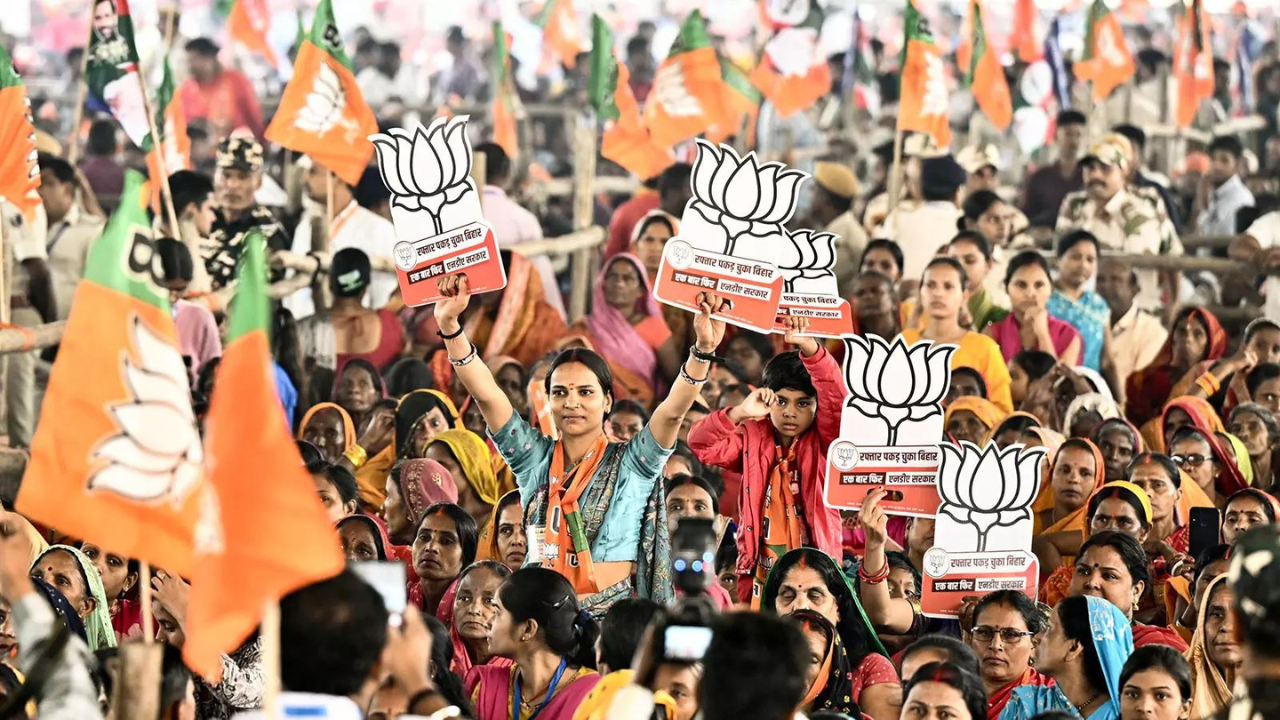
When the results of Maharashtra’s long-delayed civic elections came in on January 16, it became clear that the Bharatiya Janata Party (BJP)BJP) has once again made it to the top. The BJP won 1,425 out of 2,869 seats in 29 municipal corporations, a strike rate of about 50%. Brihanmumbai Municipal Corporation (BMC) of Mumbai has a Shiv Sena The citadel fell out of regional control for 25 years.Since 2014, the rise of the BJP has not completely destroyed regional politics. Instead, it has steadily reduced the space in which regional parties operate, limiting their ability to convert votes into seats, state power into national leverage, and identity politics into a consistent electoral issue. Let’s take a look at how controls have unfolded state by state.
Maharashtra
The recent civic elections in Maharashtra present a clear example of the activism of regional parties.In the January 2026 civic elections, the BJP emerged as the largest party in major urban bodies. In Mumbai’s BMC, he won 89 out of 227 wards on his own. The ruling Mahayuti crossed the majority mark with ally Shiv Sena’s Eknath Shinde’s faction adding 29 more seats. Uddhav ThackerayShiv Sena (UBT) was reduced to 65 seats from more than 130 seats in 2017.
Across the state, the picture was bleak for regional powers. In Pune Municipal Corporation, BJP crossed 110 seats, while the combined strength of both Sharad and Ajit Pawar remained in double digits. Pimpri-Chinchwad, another bastion of the Nationalist Congress Party, gave 87 seats to the BJP.These civic elections were delayed by almost nine years due to legal and administrative hurdles.The BJP designed its campaign around the idea of a “triple-engine government”, led by Prime Minister Narendra Modi at the Center and Devendra Fadnavis at the state level. Welfare schemes like ‘Majhi Ladki Bahin’ found traction among women voters, while support from youth was decisive: about 47% of voters in the 18–25 age group reportedly supported the BJP. But the most decisive factor was political fragmentation. The Shiv Sena split in 2022 made Shinde an ally of the BJP, hollowing out the organizational backbone of the party. 2023 NCP The fracture left Sharad Pawar and Ajit Pawar competing for the same shrinking base. Even Uddhav Thackeray’s strategic alliance with Maharashtra Navnirman Sena (MNS) split the Marathi-identified votes across dozens of wards, indirectly benefiting the BJP.
Bihar
In Bihar, regional parties have not been eliminated but have been subsumed and subjugated into the BJP-led political structure.In the 2025 Bihar Assembly elections, the NDA won more than 200 out of 243 seats, its most decisive victory in the state in decades. In that, BJP emerged as the largest party for the first time in numbers, defeating Chief Minister Nitish Kumar’s Janata Dal (United). The seat data highlighted the changed balance of power.BJP secured 89 seats, while JDU stood second with 85 seats. Smaller allies like Lok Janshakti Party (Ram Vilas), Hindustani Awam Morcha and Rashtriya Lok Morcha joined the NDA’s numbers. On the contrary, the opposition collapsed. The Rashtriya Janata Dal, which had won 75 seats in 2020, was reduced to about 25 seats, while the Congress slipped to single digits.This was not just a defeat for the regional parties in Bihar. This had to be rearranged.Nitish Kumar retained the post of Chief Minister, but there remained some ambiguity in the arithmetic. Power within the alliance now flows outward from the BJP, and not the other way around. JD(U), once the pivot of Bihar politics and the perennial kingmaker in Delhi, now works within the boundaries defined by its larger partner.The trajectory of RJD is also telling the same. Tejashwi Yadav’s party got the maximum 23% votes in the elections: BJP – 20.08%, JDU – 19.25%. Despite maintaining a loyal base among Muslims and Yadavs, vote share did not translate into seats. Welfare schemes, infrastructure expansion and the NDA’s caste-neutral message fractured old social alliances. The Bihar results show an important feature of the BJP’s containment strategy: regional parties are allowed to survive, but not dominate. Here prevention does not mean extinction.This means subordination – a shift from being a senior partner in the political system firmly established by the BJP to being dependent on the alliance.
Uttar Pradesh
In India’s most populous state, the BJP’s containment strategy is working through electoral arithmetic. In the 2024 Lok Sabha elections, the BJP-led NDA won 64 out of 80 seats. On the other hand, Akhilesh Yadav’s Samajwadi PartyDespite the opposition having 111 seats out of 403 in the 2022 assembly, it struggled to expand its footprint. The Bahujan Samaj Party, once a decisive force, had become almost irrelevant by winning only one seat.Vote shares tell a shocking story. In 2024, BJP got about 36 percent vote share, while Samajwadi got about 29 percent votes.
Welfare politics further widened this gap. Schemes like PM Awas Yojana, free ration and direct benefit transfer helped BJP get more votes.The construction of Ram temple in Ayodhya also helped consolidate Hindu votes of all castes.
West Bengal: A fortress with declining margins
Trinamool Congress’ dominance continues in West Bengal, but BJP is ready for the challenge.In the 2021 assembly elections, TMC won 213 out of 294 seats. In the 2024 Lok Sabha elections, it retained 29 out of 42 seats and secured around 45% vote share. However, BJP strengthened itself as the major challenger with around 23% vote share. Trajectory matters. Due to defection, organizational expansion and a polarized campaign, BJP’s vote share increased from 18% in 2019 to about 38% in the 2021 assembly elections. While welfare schemes like Laxmir Bhandar helped TMC consolidate its base, the BJP’s inroads are increasing in urban Kolkata and tribal areas like Jangalmahal.Mamata Banerjee remains powerful within the state. But will she continue to enjoy this power for Log? We will know in a few months as Bengal votes for its next assembly.
Delhi: The collapse of a regional experiment
The 2025 Delhi Assembly elections proved to be a turning point.The BJP won 48 out of 70 seats, ending the Aam Aadmi Party’s decade-long rule and regaining control of the capital after nearly 27 years. AAP’s vote share remained competitive, but BJP’s organizational depth, candidate proliferation and campaign scale ensured better seat conversion.For you the loss was existential. It was once projected as a governance-driven alternative with national ambitions, but it now faces questions about its relevance beyond Punjab. The Delhi decision showed that even a high-visibility regional model can dominate the machinery of a national party.
Odisha and Andhra Pradesh: rapid turnaround
The sharpest decline was seen in Odisha. In 2019, Biju Janata Dal won 113 out of 147 assembly seats. By 2024, the BJP won 20 of the 21 Lok Sabha seats and 78 assembly seats, ending Naveen Patnaik’s long rule. The decline was accelerated by a leadership vacuum and the usurpation of Oriya identity by the BJP.In Andhra Pradesh, the YSR Congress Party’s dominance ended in 2024, when the TDP-BJP-JSP alliance won 135 of the 175 assembly seats, marginalizing the YSRCP despite a significant residual vote share.Both states show how quickly regional dominance can collapse when organizational depth and narrative control change.
south wall
Tamil Nadu: The outsider who resists
Tamil Nadu remains a clear exception to this.Dravida Munnetra Kazhagam won 133 out of 234 seats in the 2021 assembly elections. In 2024, the DMK-led alliance won 22 of the 39 Lok Sabha seats. BJP’s vote share remains in single digits.Strong linguistic identity, strong welfare politics and the legacy of Dravidian ideology have limited the BJP’s expansion. Seat conversion for regional parties remains effective, and internal divisions have been avoided so far.
Kerala: ideological flexibility
Kerala’s alternative Left and Congress alliance continues to oppose national integration. Despite a strong cadre base, BJP’s vote share is around 11-15% with limited seat gains.High political literacy, strong welfare system and united minority groups have hindered the BJP’s growth. Yet, here too, regional dominance remains confined within the state’s borders, yielding little national benefit.
In numbers, BJP’s move
At the national level, the BJP-led NDA rules 19 states and currently has its highest-ever strength in state assemblies. BJP alone currently has 1654 MLAs in the state assemblies. Regional parties together have about 31% MLAs.BJP’s containment strategy is consistent:
- Division weakens rivals without eliminating them.
- Welfare distribution triumphs over identity-based vote banks.
- Grassroots expansion breaks local monopolies.
- Seat conversion efficiency rewards integration.
- Narrative control nationalizes elections.
Urbanization, aspirational voting, and fatigue with dynastic feuds have exacerbated these effects.
big picture
India’s regional parties are not finished. They still win elections and rule states. But data since 2014 shows that their power is becoming increasingly limited.The civic debacle in Maharashtra, the collapse of AAP in Delhi, and reverses in Odisha and Andhra Pradesh all point to the same conclusion: the path from state power to national influence has narrowed dramatically.As the 2026 assembly elections in five states and union territories approach, the challenge for regional parties is no longer survival alone. This has to be reinvented in the current political climate. Will Mamata Banerjee and MK Stalin be able to hold their own or will BJP put their parties in trouble? We will know by the middle of the year.


