



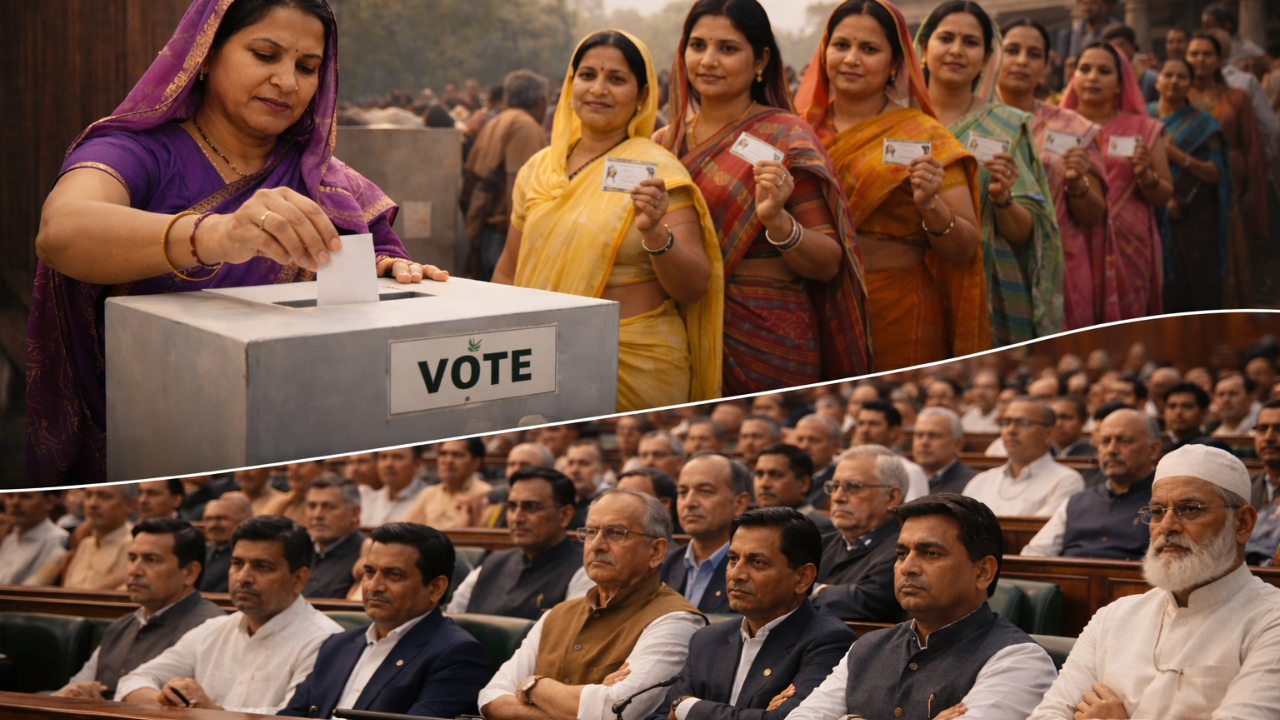
The Bihar Assembly elections were widely celebrated as a democratic milestone. With an overall turnout of 66.91%, the highest since 1951, and participation by an unprecedented number of women, the state appeared to signal a quiet transition.Female turnout was an impressive 71.6%, much higher than male turnout of 62.8%. On the surface, this seemed like a clear victory for women’s political participation. But a closer look at who actually holds power in Bihar raises the uncomfortable question of whether this enthusiasm has translated into real political gains.
Is Bihar really a victory for women?
Despite women making electoral gains, representation in the Assembly remains limited. Of the 243 elected MLAs, only 29 are women, i.e. less than 12%. This reflects a long-standing pattern: women show up decisively at the ballot box but struggle to overcome the gatekeeper barriers to party nomination and electoral success.The picture becomes even clearer in the executive. There are only three women ministers out of 27 in Nitish Kumar’s cabinet, which is only 11%. In fact, women voters won a historic election, but men continued to dominate the institutions that shape policy and governance. The candidate scenario explains part of this imbalance. According to ADR data, only 254 women, about 10% of all candidates, contested the 2025 Bihar elections compared to 2,344 men. This figure is barely changed from the 2020 elections, where women also made up only 10% of the candidates. Structural exclusion at the nomination stage ensures that even high turnout cannot significantly alter the results. The third gender representation is almost negligible, with only two candidates contesting the elections.Zoya Hasan, professor emerita of Jawaharlal Nehru University, said, “After the implementation of the Nari Shakti Vandan Act, parties will have to give tickets to women. Similarly, women’s representation has increased in other countries.”Equally worrying is the quality of the political options on offer. 94 candidates declared cases related to crimes against women, including five accused of rape. The continued success of such candidates on tickets highlights the gap between women’s electoral participation and the political system’s response to women’s safety and dignity.
14% represent 50%
parliamentary The data shows the extent to which women face democratic under-representation. While women constitute almost half the population, they hold only 14% of the seats in the Lok Sabha. This journey has been one of slow and gradual change. In 1957, women constituted only 3% of the candidates contesting the general election; By 2024 this figure will increase to 10%. Electoral success has improved, but only marginally. From 22 women in the first Lok Sabha and 27 in the second, the number increased to 78 in the 17th Lok Sabha and 75 in the 18th – still a fraction of proportional representation.A similar pattern is visible in Rajya Sabha also. The number of women members has increased from 15 in 1952 to 42 today, which is about 17% in the Upper House. While significant, these gains highlight how access to parliament for women is structurally limited, especially when compared to their electoral participation and demographic weight.
The fight for a seat in Parliament… keeps going on
In 2023, India took a significant legislative step towards addressing gender imbalance in politics with the passage of the Constitution (One Hundred and Sixth Amendment) Act, popularly known as the Constitution of India. Nari Shakti Vandan Act. The law mandates rotational reservation of one-third seats for women in the Lok Sabha and all state assemblies, including the National Capital Territory of Delhi. Designed as a landmark reform for decades of under-representation, the amendment seeks to institutionalize the presence of women in legislative decision-making throughout the federal structure.However, the impact of the reform is still pending. The law is scheduled to come into force only after the publication of the next national census, the timing of which has yet to be announced. Once implemented, reservation will remain effective for 15 years. Notably, the amendment does not include the Rajya Sabha, the upper house of India’s Parliament, where women currently constitute only 13%, underscoring the partial nature of the intervention.At the time the bill was passed, the number of women in the Lok Sabha was about 14%, the highest since independence, but still well below global standards. According to a UN report, the global average of women’s representation in national parliaments was 26.5%, while the Central and Southern Asia average was 19%, indicating India’s backwardness despite incremental gains.
Will the Reservation Act lead to ‘MP-husbands’ like ‘Prime-husbands’?
Hasan said, “Panchayats operate at a different level of governance; the logic that has enabled proxy representation or head-husbands there cannot be transferred to higher legislatures.”Hasan further said that the “political arena” in which the Lok Sabha and the Rajya Sabha function is “fundamentally different, leaving little scope for ‘MP-husband’-like phenomena.”There are approximately 14.5 lakh elected women representatives in Panchayati Raj institutions in India, which is approximately 46% of all local representatives, an unmatched achievement globally. Twenty-one states have gone even further, reserving 50% of PRI seats for women, more than the constitutional minimum of 33%. Yet this grassroots success has not translated upward, reinforcing a paradox at the heart of Indian democracy: women lead at the local level but remain marginalized at the national level.Recent global assessments show that progress has not only stalled but has even reversed. India has been ranked 131st in the Global Gender Gap Report 2025 with an overall gender equality score of 64.4%, three places lower than last year. Political empowerment remains a major area of concern.Female representation in parliament fell from 14.7% to 13.8% in 2025, while the share of women in ministerial positions fell from 6.5% to 5.6% – a continuation of the downward trend from the 2019 peak. Against this backdrop, the Women’s Reservation Law represents both a long-awaited promise and a test of political will, with its eventual implementation likely to shape India’s gender equality trajectory in the years to come.
Around the world, the story isn’t so good
Despite decades of advocacy and gradual reforms, women remain significantly under-represented in political power structures around the world. Women in Politics: 2025 The map, released by the Inter-Parliamentary Union (IPU) and UN Women, presents a snapshot of the global gender gap in political leadership by January 1, 2025, underscoring how male dominance in decision-making is slowing progress towards political equality.According to the data, women serve as heads of state or government in only 25 countries, reflecting the narrow reach of female leadership at the highest executive levels. In national legislatures, 27.2 percent of MPs worldwide are women – an improvement from previous decades, but still far from parity. The imbalance in the executive branches is even more pronounced: globally, less than one in four cabinet ministers are women, with only 22.9% of such positions held by women.The distribution of power within cabinets further highlights structural inequalities. While women are more likely to be assigned portfolios related to human rights, gender equality and social security, men overwhelmingly control ministries that shape national security and economic direction, including foreign affairs, finance, home affairs and defence. This gender-based division of political labor reinforces long-standing hierarchies, limiting women’s influence on key policy domains.
Are men still writing the laws?
The findings of the Inter-Parliamentary Union (IPU) and UN Women, released in early 2025, revealed that despite three decades since the Beijing Declaration and Platform for Action laid out a global roadmap for women’s rights, men continue to dominate political leadership around the world.As early as 2025, men outnumbered women by three to one in executive and legislative positions. Women’s representation in national parliaments has increased only modestly, reaching just over a quarter of all MPs globally. In contrast, women’s presence in government roles moved in the opposite direction, reflecting how gains in legislatures have not consistently translated into executive power.Women political leadership at the highest levels remained the exception rather than the norm. Only a few countries were led by women, the largest share of which were in Europe. While many historic things happened for the first time in 2024, more than half of the world’s countries still did not have a female head of state or government.Hassan pointed out that one of the reasons behind the increase in female representation in politics in Europe and the States is their increased representation in decision-making roles within political parties. “In Europe and the United States, efforts to increase women’s representation in legislatures have taken a two-pronged approach. One strategy has focused on increasing women’s presence in decision-making roles within political parties, which in turn has contributed to an increase in the number of women MPs,” the JNU professor said.Cabinet level representation presented a similarly mixed picture. Less than one in four cabinet ministers globally were women, and the number of countries with gender-equal cabinets declined from the previous year. Regional disparities were stark, with Europe and the Americas showing high levels of representation, while large parts of Asia, Central Asia and the Pacific recorded very low participation of women in executive leadership.


