



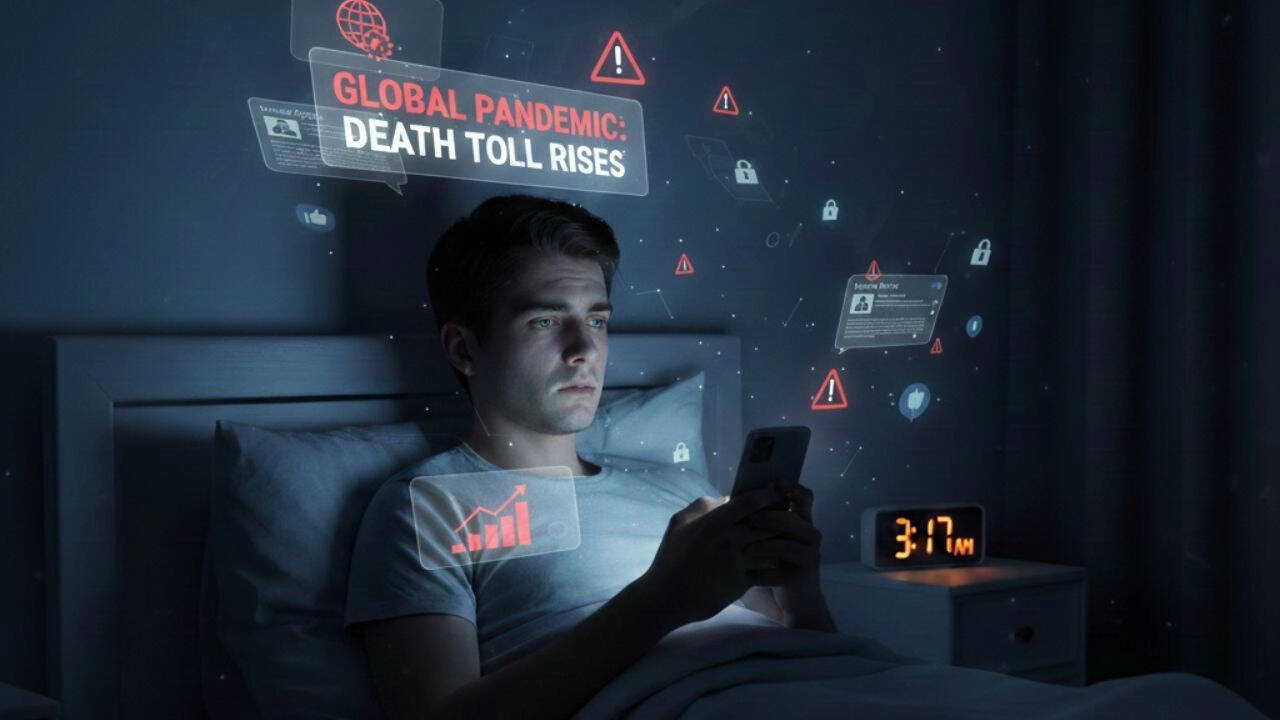
it’s late at night. The house is quiet. You are tired but can’t sleep. Your phone is already in your hand. You tell yourself that you will check just one thing. A title. An update.Thirty minutes passed. Then one hour.You feel worse than before. Your chest feels tight. Your mind is racing. You are angry, anxious, or numb. You put down the phone, but sleep still doesn’t come easily.The next morning, you blame yourself.“I need better discipline.”“I should give up this habit.”“I’m addicted.”
you are doom scrolling
Doomscrolling is the act of repeatedly viewing negative or upsetting news online, even when it begins to affect your mood and mental state. This usually happens without planning. You open your phone to check for an update, and then scroll through bad news, angry posts, or scary information until you find something useful.This usually includes:
- News about violence, war, disasters and crime
- political conflict and anger
- Debate and abuse on social media
- Videos that evoke fear, anger, or helplessness
- Endless updates that never end
People often describe this as “mindless scrolling”. But this is not foolishness at all. Your mind is actually very alert. Very cautious. Doomscrolling occurs when your brain believes there is danger and feels the need to stay informed to avoid it. That’s not laziness. It’s not a lack of control. That’s stress.
.
survival instinct
When humans feel unsafe, the brain goes into survival mode. This is not a new thing. Long before phones existed, our brains were wired to scan the environment for threats, paying more attention to bad news than good, and remembering danger more clearly than safety. This is how man survived for thousands of years. When there was danger nearby, knowing more meant survival.Today, the “danger” is no longer a wild animal or a nearby enemy. It is a constant stream of information telling us that the world is unsafe. The brain can’t tell the difference between the real danger in front of you and the repeated stories of danger on the screen. So it keeps scanning, scrolling, and looking for answers that never come.According to Medical News Today, a 2023 study found that people who already feel anxious about the future are more likely to engage in doomscrolling. A separate study published in 2024 suggested that modern news media’s intense focus on negative events may promote doomsday and deepen people’s existential anxieties.
Why does it feel compulsive
Doomscrolling often occurs at night. This is when distractions go away, the mind finally slows down, unprocessed stress comes to the surface, and the phone becomes an easy way to avoid sitting with difficult thoughts.The brain chooses: “Let me focus on this external crisis instead of my anxiety.” But it keeps the nervous system active when it needs rest. That’s why sleeping after scrolling seems difficult, not easy.People often say, “I don’t even enjoy it. I don’t know why I keep scrolling.” This confusion arises from a misunderstanding of what is happening. Doomscrolling isn’t about fun. It’s about control.When things feel uncertain, the brain seeks more information to reduce that uncertainty. He believes that if he knows more, he can prepare.But modern news and social media do not offer closure. They provide endless updates. There is no clear end.No final answer. There is no moment where the brain feels safe enough to stop.So the scrolling continues.Not because you want to.Because your brain thinks it has to be done.
Why has it gotten worse recently?
Doomscrolling existed before smartphones. People are always worried about the news. But it became much more intense because of three things:24/7 news cycle: There’s no break now. Neither the morning newspaper, nor the evening bulletin. Bad news comes all the time.Social media algorithms: Platforms push content that triggers strong emotions. Fear and anger keep people busy for a long time.Global uncertainty: pandemics, wars, economic stress, climate concerns, political instability. Many people feel that the future is unpredictable.The phenomenon of doomscrolling, named one of the Oxford English Dictionary’s words of the year in 2020, became widely recognized during the pandemic, when disrupted daily routines led people to constantly check updates on Covid 19 cases and deaths.When stress becomes constant, the brain remains in survival mode for longer periods of time. Doomscrolling is a result of that.
.
Why doesn’t saying ‘just stop’ work?
If doomscrolling were just a habit, simple advice would work. “Put away your phone”, “Have self-control”, “Do a digital detox”. But most people have tried these things. They can work for a day. Or a week. Then scrolling returns.This is because stress responses cannot be turned off by willpower alone. Telling someone under stress to “just stop” is like telling an anxious person to “just calm down.” This seems logical. It sounds dismissive. And this often increases embarrassment. Shame makes stress worse. And stress promotes destruction.According to Psychology Today, young adults often find it especially difficult to put down their phones. This is partly because the prefrontal cortex, the part of the brain that helps with impulse control and decision making, is still developing during this stage of life. As a result, cycles like doomscrolling become more difficult to break.
emotional cost
Dr Manoj Kumar Sharma, clinical psychologist and coordinator of the Shut Clinic at NIMHANS, co-authored the study, which observed that during COVID‑19, compulsive “doomsurfing” and “doomscrolling” induced by cognitive biases and poor mood regulation led to anxiety, sleep problems, low motivation and distress, highlighting the need for digital hygiene and offline coping strategies.Doomscrolling slowly changes your feelings about the world and yourself. People feel constantly stressed, angry at strangers, emotionally exhausted, depressed about the future, guilty for “not doing enough,” or numbed from real happiness. This happens because the brain is not designed to process the suffering that occurs on a global scale every day. Seeing pain without the ability to act creates helplessness. Helplessness is deeply stressful. Over time, the nervous system remains active even when there is no immediate threat.Doomscrolling is also often a sign of care. This part is important. A lot of people who doomscroll care deeply. They care about injustice, they care about others. Their scrolling is not indifference. This is a matter of concern without any outlet. But caregiving without boundaries becomes emotional overload. And the brain reacts by being alert instead of relaxing.
understanding changes everything
The Mayo Clinic talks about checking your mood while scrolling, setting deadlines, and using reminders to manage screen time.When you understand that doomscrolling is a stress response, your relationship with it changes. You stop asking:“what is wrong with me?” And start asking: “What am I reacting to?” This change matters. Because you can’t fix what you keep blaming.The first step is to not cut down on screen time. The first step is to recognize the stress. Ask yourself: What am I worried about right now? What feels uncertain in my life? What am I trying to prepare for? You may not have clear answers. That is okay. The goal is not the solution. This is awareness. When the brain feels seen, it doesn’t need to shout as loudly.
.
Support regulation rather than coercive regulation.
Doomscrolling is a sign, not a failure
Your scrolling is telling you something. It’s saying: “I’m overwhelmed.” “I’m trying to understand.”“I don’t feel safe enough to relax.” Listen to that message instead of fighting it.The goal is not to be ignorant. It has to be regulated. You can care without drowning. You can be aware without being worried.If you’re wasted, you’re not broke. You are responding to a world that feels overwhelming. Your brain is doing what it was designed to do – protecting you. But security should not be at the cost of peace.Be gentle with yourself. Reduce noise as much as possible. The rest is not ignorance. This is also existence. And sometimes, the bravest thing you can do is put down the phone and breathe.


