



A home World Cup final was meant to be Sri Lanka’s moment. Instead, it became the night West Indies walked into Colombo, absorbed a stadium’s expectations, and left with the 2012 T20 World Cup — their first title in the tournament and a rare ICC summit after years of near-misses.
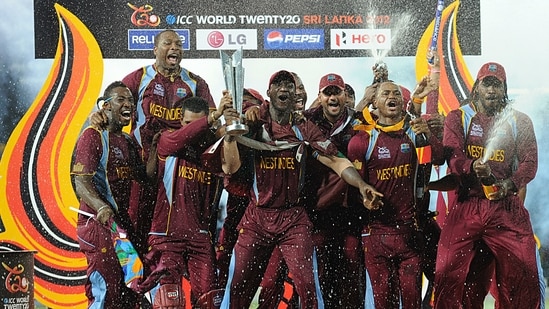
The numbers were blunt. West Indies posted 137/6, then dismissed Sri Lanka for 101 in 18.4 overs to win by 36 runs — a final decided by control more than chaos, and by a team that handled the surface better when it mattered most.
West Indies win a World Cup by refusing to blink
The story of the 2012 edition is often told through flair — Caribbean swagger, big-hitting reputations, celebrations. But the trophy was won through something less glamorous: reading conditions faster than everyone else and playing the game that the pitches demanded.
Sri Lanka’s venues didn’t hand out easy runs. Boundaries had to be earned, innings had to be paced, and bowlers with deception became the real luxury. West Indies weren’t flawless through the tournament, but they were adaptable — and in a knockout format, adaptable beats are more dangerous than people like to admit.
Marlon Samuels’ final was the innings Sri Lanka couldn’t break
West Indies were in early trouble in the final. Johnson Charles fell without scoring, and Chris Gayle crawled to 3 off 16 before being trapped lbw — the kind of start that can make teams panic into a bad 120.
Samuels didn’t let the innings become a rescue mission. He made it a takeover.
His 78 off 56 wasn’t just top-scoring; it set the only template that worked that night: absorb dots, pick the right bowlers, and keep enough fuel for a late surge. When he finally fell at 17.1 overs with West Indies at 108/6, the hard work was already banked.
This is what tournament finals often become — not a highlight reel, but a test of who can play a “correct” innings under pressure. Samuels played the correct one, and it looked even bigger once Sri Lanka began their chase.
Sunil Narine and the choke that turned a chase into a scramble
Sri Lanka’s chase wasn’t a collapse from ball one. By 9.3 overs they were 48/2, with Kumar Sangakkara and Mahela Jayawardene still there — exactly the platform a home side wants in a final.
Then the game tightened like a knot.
Sunil Narine’s spell was the defining squeeze: 3.4 overs, 9 runs, 3 wickets. He removed Jayawardene, then returned to slice through the lower order, taking the air out of the chase with every over that offered no release.
West Indies didn’t just rely on Narine. Daren Sammy chipped in with 2 for 6 in his two overs, and the fielding stayed sharp enough to turn singles into risks. The scoreboard pressure did the rest.
Ajantha Mendis’ World Cup, even in defeat
There’s an irony baked into this final: the best bowler on the night wore Sri Lankan colours.
Ajantha Mendis produced a brutal 4-over spell of 4 for 12 — including Gayle, Bravo, Pollard and Russell — basically preventing West Indies from turning 137 into something closer to 160.
And it wasn’t a one-off. Mendis finished as the tournament’s leading wicket-taker with 15, underlining how heavily the conditions and match-ups leaned toward spinners and variation.
Sri Lanka had the right bowlers for their own pitches. What they didn’t have, on the last night, was a chase that could survive a squeeze without a counter-punch.
The semi-finals that set the mood: Gayle’s storm, Sri Lanka’s steady march
The tournament’s last week in Colombo produced two very different semi-finals — both of which explained why the final went the way it did.
West Indies arrived with a statement blow: 205/4 against Australia, powered by Chris Gayle’s 75 off 41, then bowled Australia out for 131 to win by 74 runs. It was their loudest performance of the event — a reminder that even when the pitches were sticky, they could still do damage if they got a platform.
Sri Lanka, meanwhile, did it the home way: 139/4, then a controlled defence to beat Pakistan by 16 runs. Their route to the final wasn’t about intimidation; it was about structure.
The final became a clash of those identities. West Indies didn’t try to out-Sri Lanka Sri Lanka. They simply stayed calmer inside the squeeze.
Shane Watson’s all-round tournament that still ended short
If 2012 had a “player of the tournament” story, it wasn’t from the champions.
Shane Watson finished as the leading run-scorer with 249 runs and was named Player of the Tournament. He also took 11 wickets, a rare double that tells you how much Australia depended on him for balance.
Australia didn’t win the trophy, but Watson’s campaign captured another truth of that edition: teams were hunting multi-skill players because conditions demanded flexibility — and because in T20s, roles matter as much as reputations.
Why 2012 still matters
The 2012 T20 World Cup was the first time the tournament was staged in Asia, and it forced teams to confront a different kind of T20 logic — one built on grip, match-ups, and the ability to win ugly when the ball didn’t come on.
West Indies won because they didn’t treat the final like a festival. They treated it like a problem to solve: post a defendable total, shrink the chase, and keep the game in a corridor where the crowd can’t play for you.
Sri Lanka had the home advantage, the occasion, and the support. West Indies had something more valuable in that final hour — composure, and a plan that didn’t wobble.


