



Indian Railways is looking to move to a passenger train services model that offers faster, more comfortable, and premium travel experience. In that context Finance Minister Nirmala Sitharaman’s Union Budget announcement of seven new high-speed corridors assumes significance.This comes at a time when Indian Railways is already working to upgrade its overnight train travel with the launch of Vande Bharat sleeper trains that allow for faster and more world-class passenger focus. At the same time, Amrit Bharat trains with better amenities are being launched for the common man.
Announcing the move in her Budget speech, the Finance Minister said, “In order to promote environmentally sustainable passenger systems, we will develop seven High-Speed Rail corridors between cities as ‘growth connectors.” India is already constructing its first bullet train corridor between Ahmedabad and Mumbai, the first stretch of which is expected to be operational in the coming years. While bullet trains run at 300 kmph, high-speed rail by some definitions includes travel at 220-250 kmph.Which seven routes have the new high-speed rail corridors been announced and by how much will the travel time come down? Why are high-speed rail or bullet train corridors important and where do Vande Bharat sleeper and Amrit Bharat trains fit into the broader objective of offering new-age train travel? We decode:
Seven New High-Speed Rail Corridors: Key Details
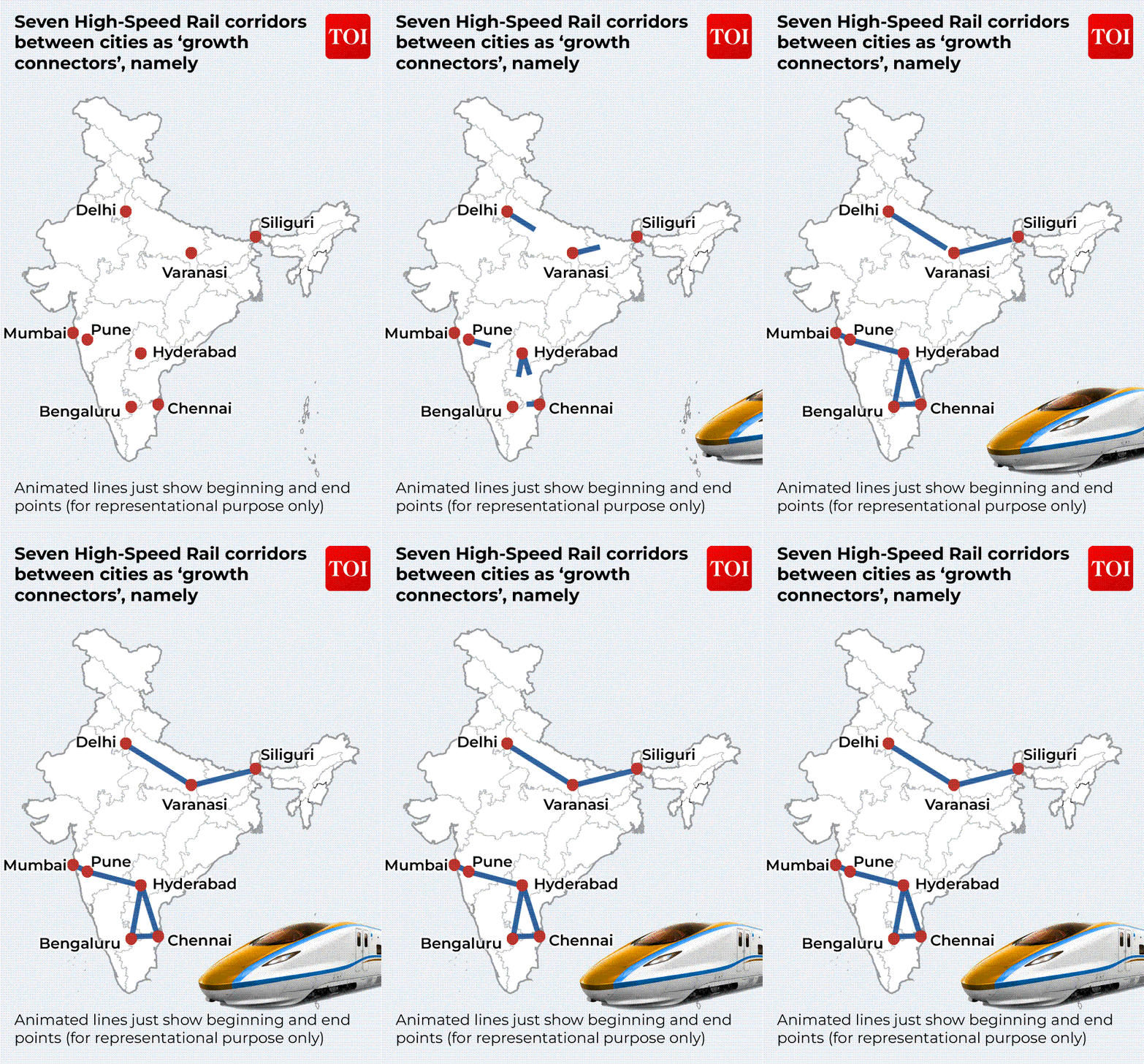
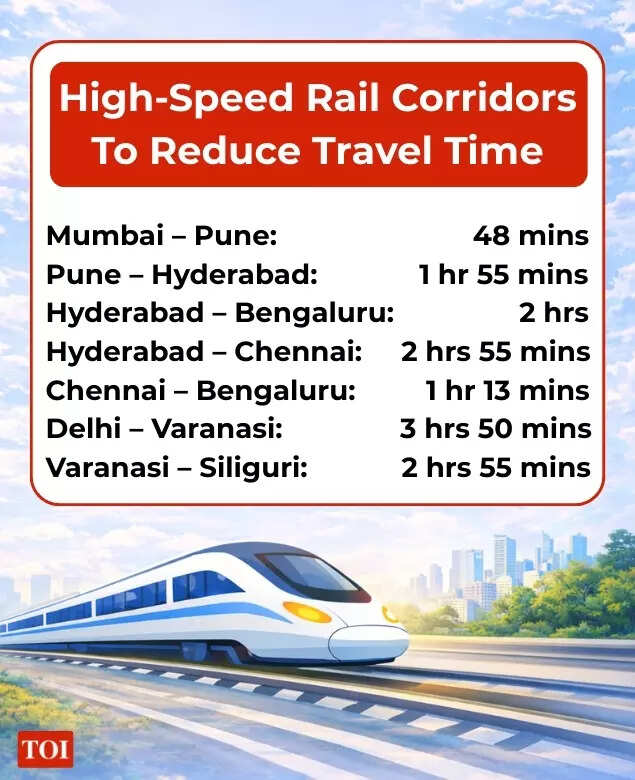
Mumbai–Pune: The western region’s flagship corridor will integrate India’s major urban centres, cutting travel time to just 48 minutes! This project, combined with upgrades to congested trunk routes and suburban rail services, aims to accommodate the state’s rapidly growing passenger and freight demand.Pune–Hyderabad: Linking Maharashtra with Telangana, this corridor will enable travel in approximately 1 hour 55 minutes, creating a continuous high-speed spine across western and southern India. Passengers and regional economies are expected to benefit from faster, more reliable connectivity.Hyderabad–Bengaluru: As part of the emerging southern high-speed rail “diamond,” this route will reduce travel time to about 2 hours, significantly improving mobility across major IT, manufacturing, and service hubs in Karnataka and Telangana.
High-speed rail corridors
Hyderabad–Chennai: Travel between these southern economic centres will take around 2 hours 55 minutes. The corridor is expected to enhance business, talent mobility, and inter-state commuting across Andhra Pradesh, Telangana, Tamil Nadu, Kerala, and Puducherry.Chennai–Bengaluru: This corridor will compress travel to approximately 1 hour 13 minutes, further strengthening southern India’s high-speed network and acting as a growth multiplier for key urban centres and surrounding regions.Delhi–Varanasi: Connecting the national capital with eastern Uttar Pradesh, this corridor will enable travel in around 3 hours 50 minutes. It aims to strengthen tourism, link secondary cities, and create a new economic belt spanning Delhi, Uttar Pradesh, Bihar, and West Bengal.Varanasi–Siliguri: Travel between Varanasi and Siliguri will take about 2 hours 55 minutes via Patna, connecting important religious, educational, and medical centres across Uttar Pradesh, Bihar, and West Bengal. This route will mark the first high-speed rail service in eastern India, expanding trade, services, and inter-regional mobility.
Bullet Train Corridors: What do they mean for passengers, Indian Railways?
Jagannarayan Padmanabhan, Senior Director & Global Head, Consulting, Crisil Intelligence believes that the seven high-speed rail corridors respond directly to rising commuter demand for faster, reliable and energy-efficient travel.“They can substantially cut journey times between high-density city pairs, expand passenger capacity and enable a shift away from road and short-haul aviation. While capital-intensive, such systems tend to become cost-effective over time through higher utilisation and productivity gains,” he tells TOI.
High Speed Rail Corridors: How Much Time Will Trains Take?
The 7 high-speed rail corridors have been identified with an aim to provide high-speed connectivity across key economic centres, covering nearly 4,000 km with an estimated investment of ₹16–20 lakh crore, says Anurag Gupta, Partner, Deloitte India. “This will significantly transform the inter-city passenger movement and will act as a key economic multiplier,” he tells TOI. Anurag Gupta highlights some of the important takeaways from the proposed projects:
- Delhi–Varanasi (~3.5–4 hrs): fast connectivity to a heavy passenger footfall and high tourism corridor and further to Siliguri.
- Mumbai–Pune (~45–50 mins) and Pune–Hyderabad (~2 hrs): links major industrial and IT hubs
- Hyderabad–Chennai (~3 hrs) and Hyderabad–Bengaluru (~2 hrs): strengthens the South economic triangle, by facilitating high-value business travel and generating substantial economic multiplier effect.
- Sharp reduction in travel time coupled with competitive pricing will enable modal shift from both air and road mode
- Frees up existing railway lines, complementing freight and conventional passenger services
G Raghuram, Advisor, The Infravision Foundation explains that high-speed rail travel, in principle, is good for faster travel and capacity expansion. “This will have an impact on economic development. There are also positive externalities, because the technology used for high-speed rail will have benefits in other domains: better concrete, construction management, better mechanical and precision engineering amongst others,” G Raghuram who is also Former Dean, IIM Ahmedabad and Director, IIM Bangalore tells TOI.“I think it is time for India to expand high-speed rail. Mumbai-Ahmedabad, hopefully, will be completed in the next couple of years, and it’s time we plan for more,” he says.However the railway and infrastructure sector expert raises concerns on funding for the ambitious projects.“Where will the money come from and what is our bandwidth in executing these? At the current estimate of Rs 2 trillion for the Mumbai-Ahmedabad project, 7 more corridors may mean at least Rs 16 trillion. The Rs 2 trillion for Mumbai-Ahmedabad is being spent over 11 years, which means roughly under 0.2 trillion per annum. Even if railways steps up the rate of spending to 0.5 trillion per year, it will take 32 years before these seven projects are done. Or maybe 25 years if we step up the allocations,” he says.“I am wondering whether we will see all the corridors done before Viksit Bharat, the Amrit Kaal, in 2047. Also, it is not the first time budgets are announcing high speed projects. Many announcements of different corridors were made in various (then) railway budgets of 2007 to 2014,” he adds.
Vande Bharat Sleeper Trains In Focus
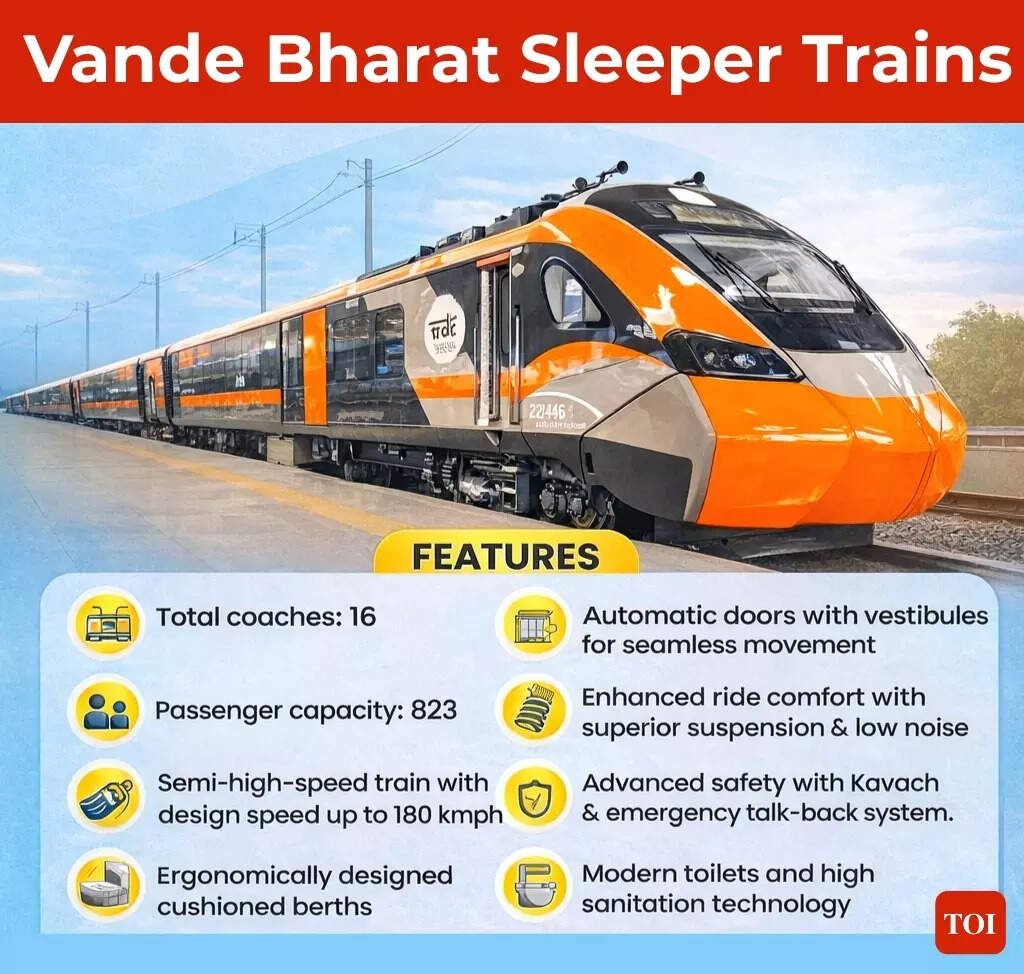
Apart from high-speed trains, Indian Railways is also betting on self-propelled semi-high speed offerings like Vande Bharat Express and Vande Bharat sleeper for world-class travel experience. Vande Bharat Express is India’s first indigenously designed and manufactured semi-high-speed train set. It combines advanced technology with improved passenger comfort and reduced journey times, strengthening inter-city rail connectivity. Now a sleeper variant has been launched and Railway Minister Ashwini Vaishaw has said that plans are in place to launch 260 such train sets. Vande Bharat sleeper with advanced Kavach integration (indigenous train protection system) and a host of passenger amenities offers better and faster overnight travel compared to Rajdhani Express trains. According to a TOI report, Indian Railways has decided to have a fixed fare for each class of travel for Vande Bharat sleeper trains. Rs 2.4, Rs 3.1 and Rs 3.8 per km for third, second and first AC. No dynamic pricing rules will be applicable.
Vande Bharat sleeper trains
The train is a central part of India’s long-term plan for rail modernisation. By 2047, the fleet of Vande Bharat trains including sleeper is expected to reach around 4,500 trainsets, while in the medium term, about 800 trainsets are planned to be operational by 2030, depending on infrastructure and manufacturing capacity. Keeping in mind the needs of the common man, Indian Railways is also launching the Amrit Bharat trains.
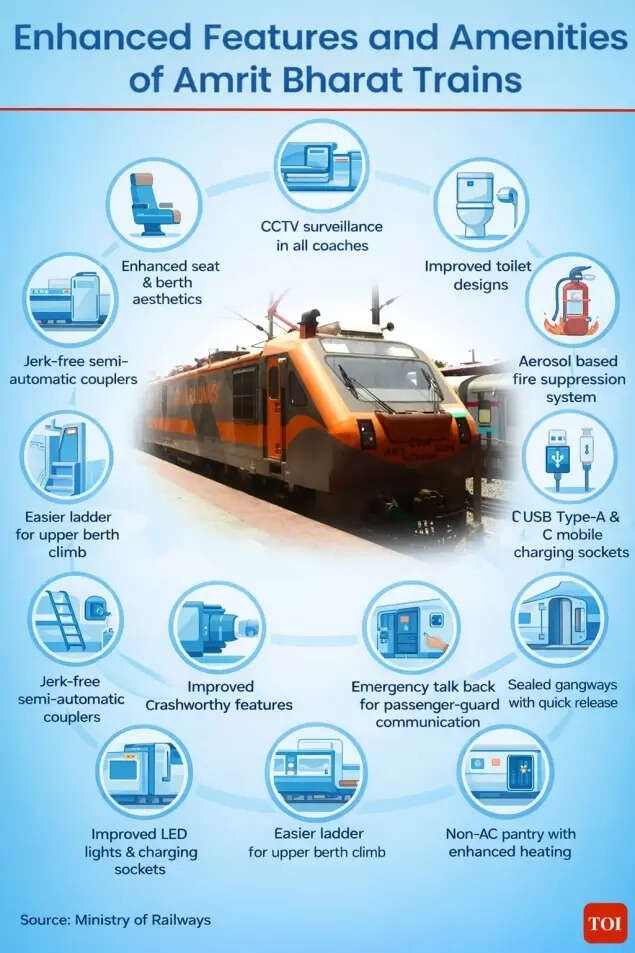
Amrit Bharat features
To Anurag Gupta of Deloitte, Vande Bharat sleeper and Amrit Bharat trains represent a fundamental upgrade across passenger services and amenities, safety, comfort etc. bringing quality of train travel for common man on par with global countries and competing modes like air. G Raghuram sees potential in Vande Bharat sleeper trains changing overnight travel experience and time, but is less enthusiastic about Amrit Bharat trains. “Vande Bharat is a very good technology platform for passenger rolling stock in India. It is our own design and has proved itself in intercity trains. Now we are moving into sleeper. I hope the Vande Bharat sleeper will make many city pairs in the 1,200–1,800 km range become overnight journeys—for example, Bangalore-Mumbai, which is currently 24 hours, could be reduced to 15–16 hours. Guwahati-Kolkata is another example where the train has been introduced,” he tells TOI.“Instead of continuing with LHB coaches, more investment will go into Vande Bharat sitting and sleeper coaches. It will definitely have a good impact,” he adds.Amrit Bharat, on the other hand, mainly improves interiors, G Raghuram says. “It has not increased speed. The train timings do not show any improvement over regular trains. I am less optimistic about Amrit Bharat, but Vande Bharat sleeper is definitely promising. In fact, it should have been brought in much earlier than 2026, given that the technology platform was first ready in 2018,” he says.For Jagannarayan Padmanabhan of Crisil Intelligence, these two new trains signal a shift towards more efficient, modern rail travel. “The sleeper variant combines speed with overnight connectivity, offering an energy-efficient alternative to flying, while Amrit Bharat focuses on capacity and affordability. Together, they upgrade both premium and mass travel segments,” he notes.For passengers, the Budget promises shorter travel times, improved safety, modernised stations and better last-mile connectivity. At the same time, Indian Railways’ long-term target of 3,000 million tonnes of freight loading is expected to be supported through dedicated freight corridors, upgraded tracks, modern locomotives and advanced signalling. In the coming years, high-speed rail travel and Vande Bharat sleeper trains are set to change travel options in India, and it’s a change whose time has come.


