



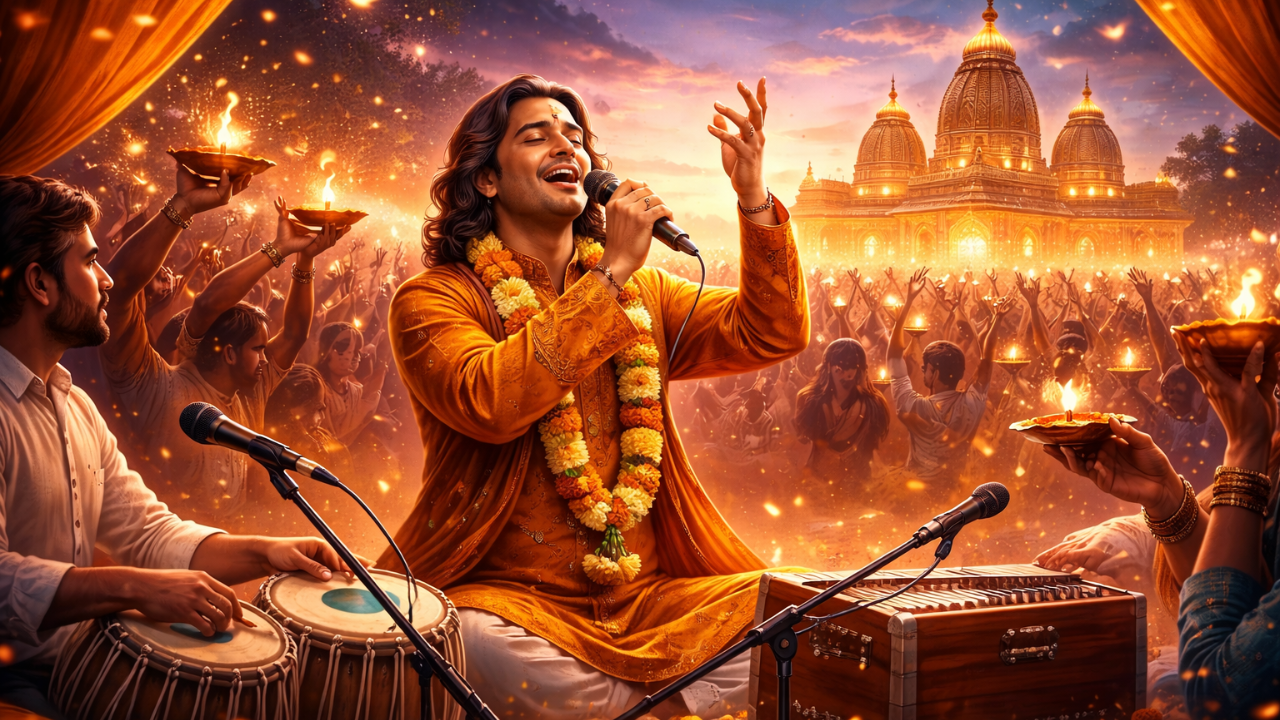
Imagine a concert where there is no chaotic crowd following you, no rush to get closer to the stage and no noise competing with the music.Instead, people sit in quiet anticipation, moving in rhythm, listening as much as they sing.Imagine a musical evening where the audience is inspired not by the spectacle, but by the steady beat of harmonium, tabla and manjira.The sound coming from the speaker does not affect you. It gradually settles into the chanting of mantras and sacred names, which seem to resonate deeper than sound.The audience is not shouting here. Some people sit with their eyes closed and absorb the melody. Others slowly clap, sing and dance together in an unspoken rhythm before slowly rising to their feet.The artist also remains sitting. Calm, collected, guiding the music rather than performing for applause.There is an atmosphere there which seems simple and pure. The children sit next to the grandparents, both equally engrossed in the experience. The children sit next to the grandparents, both equally engrossed in the experience.And when the evening ends, the place remains in order but something within you feels calm, as if some inner chaos has calmed down for a while.If this sounds different than a concert, that’s because it is. And yet, it is exactly what a bhajan or kirtan concert is like.
Over the past few years, devotional and spiritual music festivals have begun to attract larger and younger audiences across India and among the global diaspora.Digital streaming platforms have witnessed a steady rise in the consumption of devotional music, especially among listeners under 35, while large-scale kirtan and bhajan programs are being held exclusively in auditoriums and conference centers rather than temples or community spaces.Organizers and artists attribute this shift to a growing search for experiences that combine music, community and an emotional underpinning in fast-paced urban life.The increasing visibility of such gatherings has also added to the public discussion. In his recent Mann Ki Baat address, Prime Minister Narendra Modi talked about the cultural significance of bhajans and collective devotional practices.“Young people are gathering in large numbers in different cities across the country. The stage is decorated… there is lighting, there is music… there is all the pomp and show, and the atmosphere is no less than a concert. It feels like a huge concert, but what is being sung there is an echo of the hymns sung with complete concentration, dedication and rhythm. This trend is being called ‘bhajan-clubbing’ today, and it is becoming increasingly popular, especially among Gen Z. Beach,” the PM said.
This context reflects how devotional music, once largely limited to religious or local settings, is now being discussed in the context of social and cultural engagement on a national level.I was introduced to this world through the music of international spiritual artist Radhika Das.I first saw his work online a few years ago. His videos blending traditional Indian kirtan with contemporary musical arrangements quickly caught on.Seeing the chants of Radhe-Radhe Govinda echoing in places like London’s Union Chapel felt both familiar and unexpectedly global.The energy of those videos, where people sang and danced together in devotion, created a curiosity in me. I wanted to experience that environment firsthand.At that time, it seemed impossible. Das appears to live mainly in the UK and I thought the chances of him attending any concerts would be remote. When I later came to know that he had visited India, I realized that I had missed the opportunity. Disappointed but hopeful, I silently promised myself, the next time he returned, I would be present.A year later, life had moved on. College paved the way for my first newsroom job. My typical days were spent scanning agency wires and chasing stories.One such routine afternoon, an entertainment wire, which often looks like promotional material, caught my eye. I almost scrolled ahead before a familiar name stopped me. -Radhika Das. This was the announcement of his upcoming visit to India.Within minutes, I was searching for tickets. The early bird window was open and without much hesitation I booked one.Later I wondered if any of my friends would be interested in participating in the bhajan ceremony. After some persuasion and some shared YouTube clips a friend agreed, more out of curiosity than conviction. The plan was set.After months that evening finally came.Like most evenings in Delhi, the plan to reach early remained just a plan. After dealing with the Delhi traffic and making a hasty entry into the Yashobhoomi Convention Centre, the atmosphere started changing even before the music started.As soon as people entered the hall, the volunteers warmly welcomed the attendees and applied tilak on them. The auditorium slowly filled, there was an atmosphere of anticipation rather than impatience.When Das and his team came on stage, the applause seemed welcoming rather than frenetic. He started not with high energy, but with calm, asking the audience to close their eyes and take a few deep breaths, as if preparing everyone to come fully into the moment.After this there was a gradual change. Chants of Namah Shivay and later Sita Ram spread throughout the hall, moving the audience from silence to participation.Without realizing it, people who had started the evening sitting found themselves clapping, swaying and eventually dancing.
Strangers smiled at each other, united by rhythm rather than familiarity. My friend, initially unsure of what was about to happen, soon became completely absorbed in the atmosphere.Between performances, Das talked about the importance of chanting and the role of devotion in shaping his own journey.His ideas were simple, often humorous, but impressed audiences.At one point, he told a story about a devotee playfully called ‘Patel’, which drew laughter from the entire hall, but also created an unmistakable sense of identification.In the story, the devotee is repeatedly invited by Krishna (God) to leave worldly life and return to the spiritual realm.However, each time he requests more time: first to complete his education, then to build a career, later to marry, raise children, and fulfill responsibilities. Years pass and the invitation keeps getting postponed.When the divine messenger finally returns, he discovers that Patel has passed away – only to find that he has been reborn as a domestic dog, still attached to worldly duties, still asking for more time.The audience laughed, but there was an underlying message in the humor that many people seemed to connect with.The story reflects a familiar human tendency, the persistent belief that spiritual reflection can wait until everything else is settled. In that shared laughter, there was also a moment of quiet self-awareness visible throughout the hall.As the evening progressed, the music became louder. The final presentation, Bhajaman Radhe Radhe Govinda, became the emotional peak of the concert.Speaking about his recent visit to Vrindavan and his connection with India as his spiritual home, Das’s voice was full of emotion. The audience reacted in different ways. Hands raised, eyes closed, voices merging into a collective chant. For a brief moment, the boundaries between artist and audience dissolved.Almost two hours passed without even realizing it. Worries about late night commutes or early workdays faded into the background.When the music finally stopped, there was a reluctance to leave, that familiar feeling of returning to normal life after an unusually immersive experience.As we walked out, I asked my friend if it would be worth coming. He smiled and simply said, “I still get goosebumps.” This was probably the simplest summary of the evening.For me, the experience also reshaped what a concert could mean. Previous concerts I’d attended were defined by crowd anxiety or performative spectacle. It felt different, less entertainment and more participation.Bhajan concerts may seem to be a modern phenomenon, but their roots run deep in the cultural traditions of India.The practice of Naam Sankirtan, popularized by saints such as Chaitanya Mahaprabhu, has long brought communities together through collective singing and devotion.Be it the Varkari tradition of Maharashtra, local jagrans or domestic kirtans, the essence has remained the same, music as a shared spiritual expression.This idea is also echoed in classical Bhakti literature. In the Ramcharitmanas, Goswami Tulsidas writes, “Kaliyuga keval naam adhara, sumir sumir nar utrahin para”, suggesting that in an age marked by distraction and restlessness, remembrance through the divine name becomes the path to inner stability.Viewed in that context, the contemporary choral concert appears less like an innovation and more like a continuation, a familiar tradition finding new form for a new generation.The thing that seems to be changing today is the form. Young audiences are rediscovering these traditions through contemporary presentation, larger venues and global artists that connect devotional music with modern sensibilities.That night as I hurried towards the metro, the chants of ‘Radhe-Radhe Govinda’ were still playing in my mind, it felt as if the concert had ended, but something calm had begun.The bridge of that experience may have closed with the final note, but it also revealed a path that perhaps each listener continues to walk on their own.


