



New Delhi: At one time, the Jayalalithaa-led AIADMK had reined in the weak Atal Bihari Vajpayee government at the Centre. Withdrawal of support following a no-confidence motion in 1999 led to the collapse of the NDA, leading to mid-term Lok Sabha elections. For the BJP, this was not just a political setback, but a stinging lesson in the weakness of coalition politics.By any measure, the 1999 episode can be read as a betrayal. And yet, nearly three decades later, history seems to be folding in on itself.
(file photo)
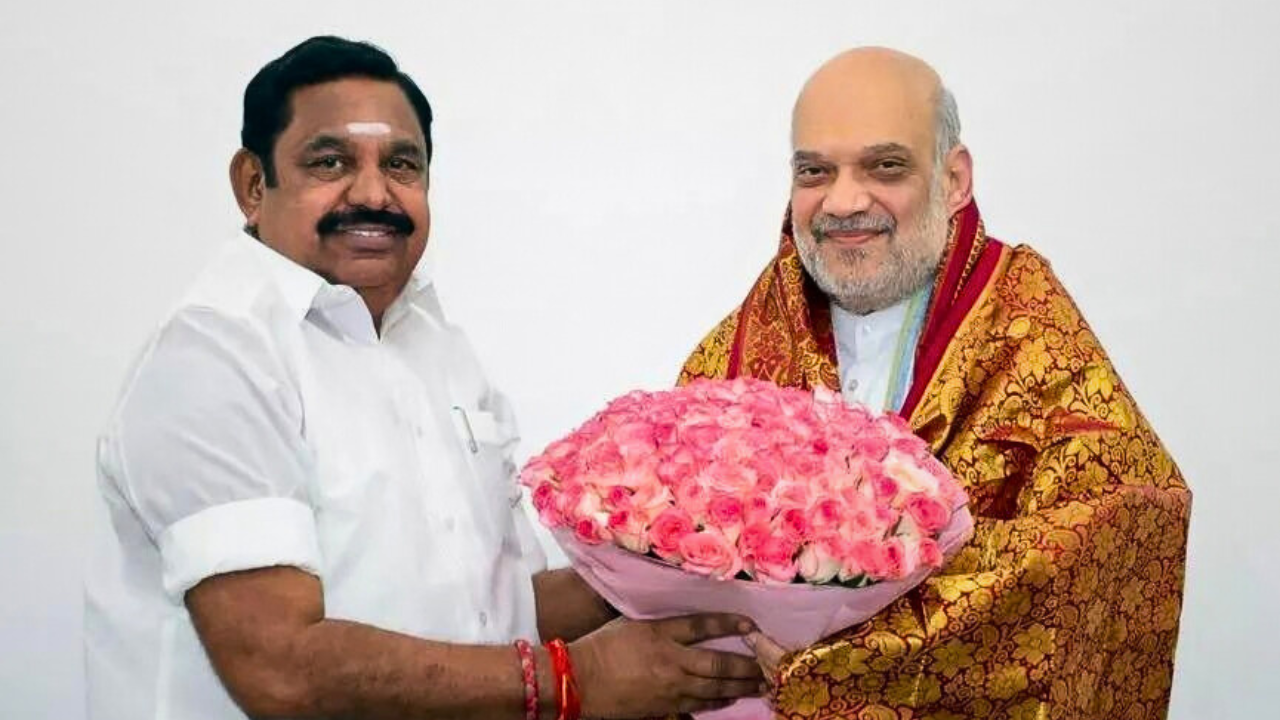
With Tamil Nadu assembly elections just a few months away, the BJP has formally sealed the alliance with the AIADMK, which is now led by the former chief minister and party general secretary. Edappadi K Palaniswami (EPS). The objective is unambiguous: to create a strong front aimed at removing the incumbent from power. DMK government under the chief minister mk stalin.From 1999 to 2026, relations between the BJP and the AIADMK have followed a familiar cycle – alliance, break and reunion. Despite repeated ruptures, political compulsions have ensured that both parties keep finding their way back to each other.
Sample
While the BJP and AIADMK have a long history of alliance, relations have rarely been smooth. This has been suddenly exposed more than once, exposing deep mistrust beneath the surface.The most dramatic rift came in 1999, when Jayalalitha He withdrew support from the Vajpayee government, causing the government to fall by one vote. Nevertheless, within a few years, the two parties came together again. This cycle has been repeated several times since then – most recently after the 2024 Lok Sabha elections, when they fought separately, only to return to the same negotiating table ahead of the 2026 Assembly elections.So the story of BJP-AIADMK relations is less about ideology and more about arithmetic – a relationship driven by necessity.
A timeline of relationships and tensions
1998–99: First alliance and major collapse
In the 1998 Lok Sabha elections, which paved the way for BJP stalwart Atal Bihari Vajpayee to become Prime Minister, the BJP extended a conciliatory hand to the Jayalalitha-led AIADMK. However, this partnership proved short-lived. Within a year, the AIADMK withdrew its support from the NDA, leading to the fall of the weak Vajpayee-led multi-party government.The separation took place in the backdrop of several corruption cases against Jayalalithaa and her poor relations with the DMK. The Supreme Court dealt a blow to their legal strategy by upholding the formation of special courts and rejecting attempts to transfer cases back to regular courts. This judicial setback hardened his political stance, culminating in withdrawal of support from the Centre.
In a dramatic twist, the rival DMK led by veteran Dravidian leader M Karunanidhi stepped in to support the Vajpayee government, which completed a full five-year term.
2004: reunion
A few months before the 2004 Lok Sabha elections, the DMK broke ties with the BJP-led NDA. After this the saffron party once again turned to Jayalalithaa led AIADMK and formed a new alliance in Tamil Nadu. However, the experiment yielded little electoral benefit and the BJP failed to win a single seat in the state.At the national level, the NDA’s “India Shining” campaign lost its luster, paving the way for the return of the Congress-led United Progressive Alliance to power at the Centre, and Manmohan Singh taking over as Prime Minister.In May 2004, then BJP president M Venkaiah Naidu told reporters in Chennai that the alliance with the AIADMK was formed specifically for the elections – by then indicating the largely strategic nature of the alliance.
2016–2019: Post-Amma era
Following the death of veteran politician and AIADMK supremo J Jayalalithaa in late 2016, the party that ruled Tamil Nadu for decades was plunged into intense factionalism. A bitter succession battle ensued, with several contenders emerging in the post-Amma era, including the Sasikala family, O Panneerselvam and Edappadi K Palaniswami, who eventually consolidated his position and now heads the party.During this period, while any formal alliance was absent, the AIADMK started extending policy-based support to the Narendra Modi-led government at the Centre.This relationship eventually culminated in an electoral alliance for the 2019 Lok Sabha elections. However, this experiment ended in defeat, when the AIADMK-BJP alliance lost 39 out of 40 Lok Sabha seats in Tamil Nadu and Puducherry.
2021-2023: Together, then apart
Despite the 2019 defeat, the AIADMK-BJP alliance continued in the 2021 assembly elections. The result was another defeat: the AIADMK won only 66 seats, the BJP managed to win four seats, and the DMK-Congress alliance led by Stalin returned to power.
The results suggested that the alliance helped the BJP gain a foothold but did little for the AIADMK.BJP will contest local body elections alone till 2022. Relations eventually broke down in 2023 when then BJP state chief K Annamalai made controversial remarks on Jayalalitha, sparking outrage within the AIADMK.
2026: another comeback
Two years after their split, the BJP and AIADMK formally came together again in 2025, and announced that the NDA will contest the upcoming assembly elections under the leadership of EPS.Once again, political necessity trumped the bitterness of the past.
Why do they need each other in 2026?
For most of the last year, talks between the BJP and AIADMK have been indecisive. The EPS-led AIADMK has hesitated, and has repeatedly considered, the costs and benefits of embracing the BJP as a partner to counter what is widely seen as a strong and strong Stalin-led DMK.Despite long uncertainty, this deal now seems to be almost final. All indications suggest that both parties are ready to formally revive the NDA alliance in Tamil Nadu just before the elections.As the election campaign gets louder, Prime Minister Narendra Modi, undoubtedly the BJP’s most powerful election face in the last decade, is scheduled to visit Madurai in the last week of February. Palaniswami is expected to share the stage with him, in a symbolic show of unity PM Modi At the BJP-led rally, it was hinted that old enmities may finally be overcome.
BJP’s compulsion
Tamil Nadu is one of the BJP’s weakest links – a state where the saffron party has struggled to translate its national dominance into local relevance.The BJP’s renewed push for an alliance reflects a difficult political reality: the Dravidian voter base cannot be wooed by outsiders. The politics of Tamil Nadu is strongly based on grassroots Tamil parties, primarily the ruling DMK and the opposition AIADMK.Amit ShahIn particular, he has stepped up his attacks on the Stalin government, accusing it of being “the most corrupt in the country” and of undermining Hindu values. His rhetoric often presents the AIADMK as a “natural ally”, a party that straddles the line between secular Dravidian politics and a moderate form of Hindu assertion.The BJP’s immediate agenda is not to dominate, but to prevent vote fragmentation, otherwise the DMK-Congress alliance will benefit.
EPS doubts BJP!
AIADMK’s hesitation is rooted in precedent. The BJP has a track record of entering alliances as a junior partner, often presenting itself as a supporting force with access to power at the Centre, but ultimately tipping the balance and emerging as the dominant player.The latest example is Bihar. Like the AIADMK, Nitish Kumar’s JDU has at times been an ally of the BJP and was long considered the “big brother” in the state. That equation changed dramatically in November 2025, when the BJP emerged bigger than the JD(U) in terms of seats for the first time, even as the chief ministerial post was given to Nitish Kumar.While the BJP is still far from becoming an immediate threat to the AIADMK in Tamil Nadu, insecurity within the EPS camp is evident.
Keeping an eye on entry in Tamil Nadu
The BJP’s renewed push for an alliance reflects a difficult political reality: the Dravidian voter base cannot be wooed by outsiders. The politics of Tamil Nadu is strongly based on grassroots Tamil parties, primarily the ruling DMK and the opposition AIADMK.The BJP’s immediate agenda is not to dominate, but to prevent vote fragmentation, otherwise the DMK-Congress alliance will benefit. Tamil Nadu is one of the few states where the BJP’s organizational presence is weaker than that of the Congress, a party that has been in steady decline nationally for over a decade.To rebuild the broader NDA, the BJP is reaching out to several regional players. TTV Dhinakaran’s AMMK is already showing interest in joining hands, while talks are underway with Pattali Makkal Katchi (PMK) founder S Ramadoss. Former allies and breakaway factions are also being included as part of a larger consolidation exercise.Two years after their split, the BJP and AIADMK formally came together again in 2025, and announced that the NDA will contest the upcoming assembly elections under the leadership of EPS.In New Delhi, the AIADMK is seen as the BJP’s primary vehicle for political relevance in the southern state, a view that reflects the urgency of Amit Shah’s strategy.
A ‘natural alliance’
Describing the BJP-AIADMK alliance as a “natural alliance”, Shah argued that the outcome of the 2024 Lok Sabha elections would have been very different if the two parties had contested the elections together.“We fought together in 1998, in the 2019 Lok Sabha elections and in the 2021 Assembly elections. But in 2024 we contested elections separately. If our vote shares are added, we will win 36 seats,” he said, adding that 2024 and 2025 have been victorious years for the BJP in many states and the trend will be repeated in Tamil Nadu and West Bengal.
Tamil Nadu BJP chief Nainar Nagenthran echoed the same sentiment and claimed that there was widespread public disillusionment with the DMK government. He held former minister Senthil Balaji responsible for the stampede in Karur during actor-politician Vijay’s TVK rally.These public claims are intended to project confidence, yet they also underscore a deeper truth: without the AIADMK, the BJP has little real chance of expanding in Tamil Nadu on its own.
caste mathematics
The AIADMK’s election strategy focuses on Dalits and the Thevar community, who together constitute about one-third of the state’s voters. In contrast, the BJP is working on a broader Hindu integration strategy that often transcends Tamil Nadu’s complex caste equations.The NDA may also benefit from the support of Vanniyars, who form about 15 per cent of the population and are largely represented by the PMK.EPS themselves bring ethnic capital to the alliance. A Gounder, classified under the backward class, represents a community that constitutes about 7 per cent of the state’s population and is concentrated in the Kongu Nadu belt.
What next?
After years of distrust, breakups and rapprochement, both parties now appear determined to join hands against the Stalin government.Palaniswami described the AIADMK-BJP alliance as “necessary” to oust the “anti-people” DMK government.“AIADMK will win power in 2026 with an absolute majority… Tamil Nadu has never had such a corrupt, incompetent, anti-people government in its history,” EPS said.Amit Shah also struck a similar tone, accusing the DMK of dynastic politics and corruption and declared that the NDA would oust the Stalin government “at any cost”.From 1999 to 2026, the BJP and the AIADMK parted ways more than once, but reunited when elections came. Whether this latest reunion will become a durable partnership or another short-term truce will ultimately be decided by the Tamil electorate.


