



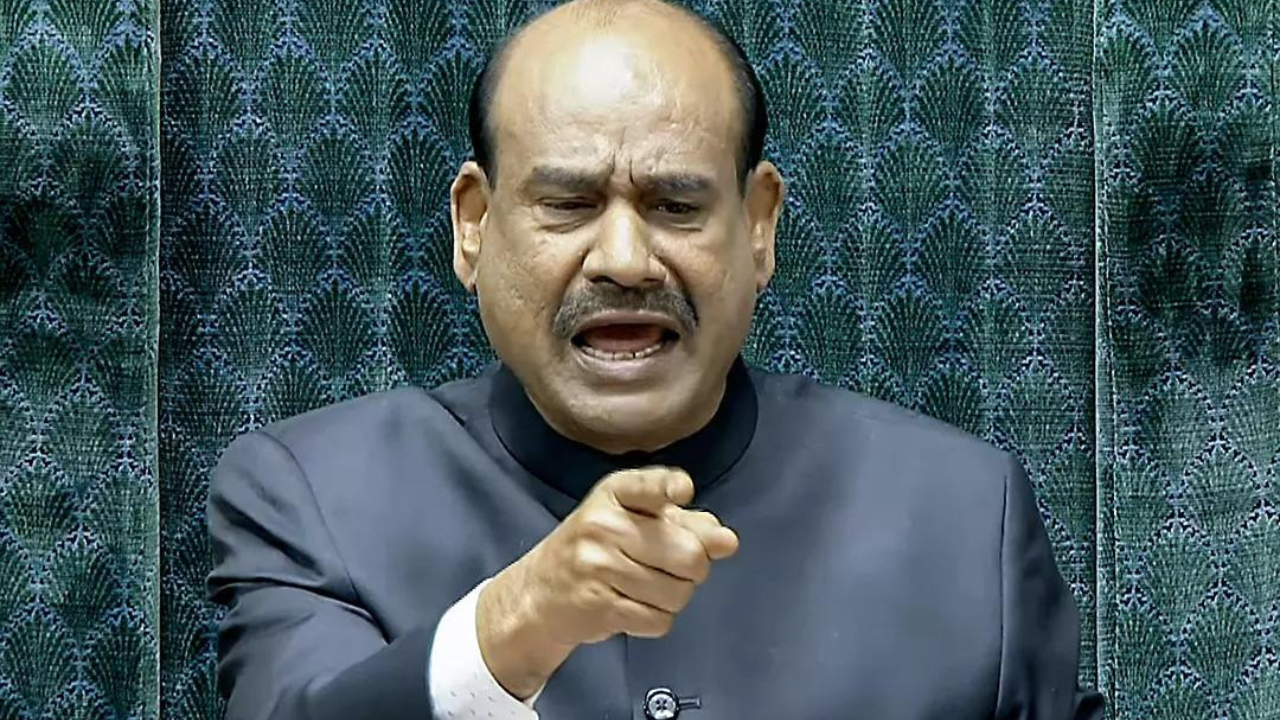
New Delhi: Escalating its confrontation with the BJP-led NDA government. Congress A no-confidence motion was moved against Lok Sabha Speaker Om Birla on Tuesday, alleging repeated incidents of gross partisan conduct during the ongoing budget session, including denial of speaking time to Leader of Opposition Rahul Gandhi and suspension of MPs.The no-confidence motion of Congress, signed by 118 opposition MPs, was presented to stop opposition leader Rahul Gandhi from speaking in the House and not to initiate action against him. BJP MP Nishikant Dubey is accused of making baseless allegations against women MPs of Congress and suspending eight opposition MPs.“In accordance with the provisions of Article 94 (c) of the Constitution of India, notice of a motion for the removal of Om Birla from the post of Speaker of the Lok Sabha has been given for his grossly partisan manner in conducting the business of the Lok Sabha. On several occasions, leaders of opposition parties have not been allowed to speak, which is their basic democratic right in Parliament,” the resolution moved by the Congress said.In a social media post on Twitter, Congress MP Manickam Tagore said the opposition had taken such a step under “extraordinary circumstances”.Tagore said, “The opposition has placed its faith in constitutional propriety. With personal respect to the Honorable Speaker, we are saddened and distressed by opposition MPs being consistently denied opportunities to raise issues of public importance.”“After many years, a no-confidence notice has been moved against the Speaker – an extraordinary step born out of extraordinary circumstances,” he said.The proposal got the support of 118 MPs, which also included the support of Samajwadi Party and DMK. However, TMC, another Indian block partner, is yet to declare its position.why nowDuring the budget session, there was a huge tension in the Parliament between the opposition and the ruling party. It started when Speaker Om Birla stopped Congress leader Rahul Gandhi from quoting an article which referenced an unpublished memoir of former Army chief General MM Naravane. During the discussion on the motion of thanks on the President’s address, the House descended into an uproar when Rahul refused to proceed and repeatedly tried to quote portions of the memoir on the 2020 Galwan Valley clash with China.Additionally, Birla also suspended eight Congress MPs for repeatedly disrupting the House.On 4 February, Birla had advised Prime Minister Narendra Modi not to come to the House to deliver his much-awaited speech, as he claimed that he had received information that some Congress MPs may reach the Prime Minister’s seat in the House and “resort to an unprecedented event”.However, Rahul Gandhi refuted Birla’s claims and stood by PM Modi He avoided attending the House because of the issues he was raising.Rahul said, “This issue started a few days ago when Naravane’s book came out. The government did not want me to discuss it and hence stopped the House.”“The fact is very clear, the Prime Minister was afraid of coming to the House, not because of the members, but because of what I was saying. He is still afraid because he cannot face the truth,” he said.Claims and counterclaimsEarlier on Monday, a group of Congress women MPs also wrote a strongly worded letter to Om Birla, accusing him of making “false and defamatory allegations” against them.“We are writing this letter with deep pain and a strong sense of constitutional responsibility. It is extremely unfortunate that as the Honorable Speaker of the Lok Sabha, you have been forced by the ruling party to make false, baseless and defamatory allegations against women Parliamentarians of the opposition,” the letter said.This was countered by a letter written by BJP women MPs to Birla, alleging that Congress MPs had crossed parliamentary limits.BJP MPs wrote to Speaker Birla alleging that opposition women MPs “surrounded the Prime Minister’s seat” and later aggressively reached the Speaker’s chamber on February 4.He urged the Speaker to take “strongest action” against the MPs involved in the alleged incident.Parliamentary Affairs Minister Kiren Rijiju also shared a video of the impasse that erupted in the Lok Sabha on February 4. Rijiju criticized the grand old party for instigating its women MPs to block the lane from where the Prime Minister used to enter the House, saying BJP MPs showed maturity and restraint, otherwise it could have led to a complete pandemonium in the House.In the video, two or three ministers including Ashwini Vaishnav, Giriraj Singh and other MPs are seen pleading and coaxing the women MPs to go back to their seats and desist from such unparliamentary behaviour, but the women remained adamant and stood firm with banners and posters.What is Article 94(C)Article 94(C) in the Constitution deals with the procedure for moving a no-confidence motion against the Speaker of the Lok Sabha.The Constitution states, “A member holding office as the Speaker or Deputy Speaker of the House of the People may be removed from his office by a resolution of the House of the People passed by a majority of all the then members of the House.”It further says, “Provided that no motion for the purpose of clause (c) shall be moved unless not less than fourteen days’ notice of the intention to move the motion has been given.”how it worksAccording to the rules of procedure and conduct of business in the Lok Sabha, any member of the House can demand the removal of the Speaker. Under Chapter 18 of the Rule Book, the member must submit a written notice to the Secretary General of the House with the full text of the resolution.Once the notice is received, the motion seeking leave to move the motion is entered in the List of Business in the name of the member submitting the notice. The date for taking up this motion is decided by the Speaker – usually the Deputy Speaker, because he cannot preside over the House when the motion to remove the Speaker is taken up.The Speaker then puts the motion before the House and asks whether leave should be given to take it up. After the proposal is placed before the House, at least 50 members are required to stand in support of it. If this limit is not met, the motion fails and the member moving it is informed accordingly.If the proposal is accepted, it is put to a vote. Voting can be done by voice vote, division of votes or other prescribed means.Will the proposal be accepted?Even after the signatures of 118 opposition MPs, it will still depend on the Deputy Speaker of the House whether the proposal will be implemented or not.For a solution to be acceptable, it must meet specific conditions set out in the rules. The resolution should be specific in relation to the allegations, stating the allegations clearly without any ambiguity.It should be expressed clearly and precisely, with no scope for vague or loosely worded claims. Furthermore, the resolution should not contain arguments, conclusions, sarcastic expressions, allegations or defamatory statements, ensuring that it is factual, sober and limited to the alleged allegations.Does the opposition have the numbers?The proposal appears to be more symbolic and a matter of political posturing, as removing the Lok Sabha Speaker requires an effective majority – a majority of the current strength of the House, excluding vacant seats.Even if the motion is moved, it appears to be an uphill battle for the opposition as it does not have the required numbers in the 543-member House. In the 18th Lok Sabha, the BJP-led NDA has an absolute majority with 293 seats. In contrast, the India Bloc has 238 seats, which is less than the required number.However, if the motion is discussed in the House, it will give the opposition an opportunity to place on record their allegations against Speaker Birla.Has this happened before?Although rare, such resolutions have historically been used to question the moral authority of the Speaker rather than to remove him from office.This is not the first time that the opposition has decided to bring a no-confidence motion against the presiding officer of Parliament. Earlier in 2024, the opposition had also presented a similar proposal against the then Rajya Sabha Chairman and Vice President Jagdeep Dhankhar.However, Deputy Chairman Harivansh rejected the proposal, calling it an inappropriate act that was seriously flawed and hastily prepared to tarnish the reputation of Vice President Jagdeep Dhankhar.At least 60 opposition members had signed the notice on December 10 demanding the removal of Vice President Dhankhar from his post.There are at least three such instances recorded in history since independence when a no-confidence motion was brought to remove the Speaker. The first was against the first Lok Sabha Speaker GV Mavalankar in 1954, when MP Vigneshwar Mishra alleged that the Speaker was not impartial.In 1966, opposition MPs moved a motion against Speaker Sardar Hukum Singh, led by Madhu Limaye and Deputy Speaker SV Krishnamurthy Rao as Chairman.The third motion to remove Speaker Balram Jakhar was moved by CPI(M) MP Somnath Chatterjee on April 15, 1987, which was headed by Deputy Speaker Thambi Durai. This proposal was rejected by the House.


