



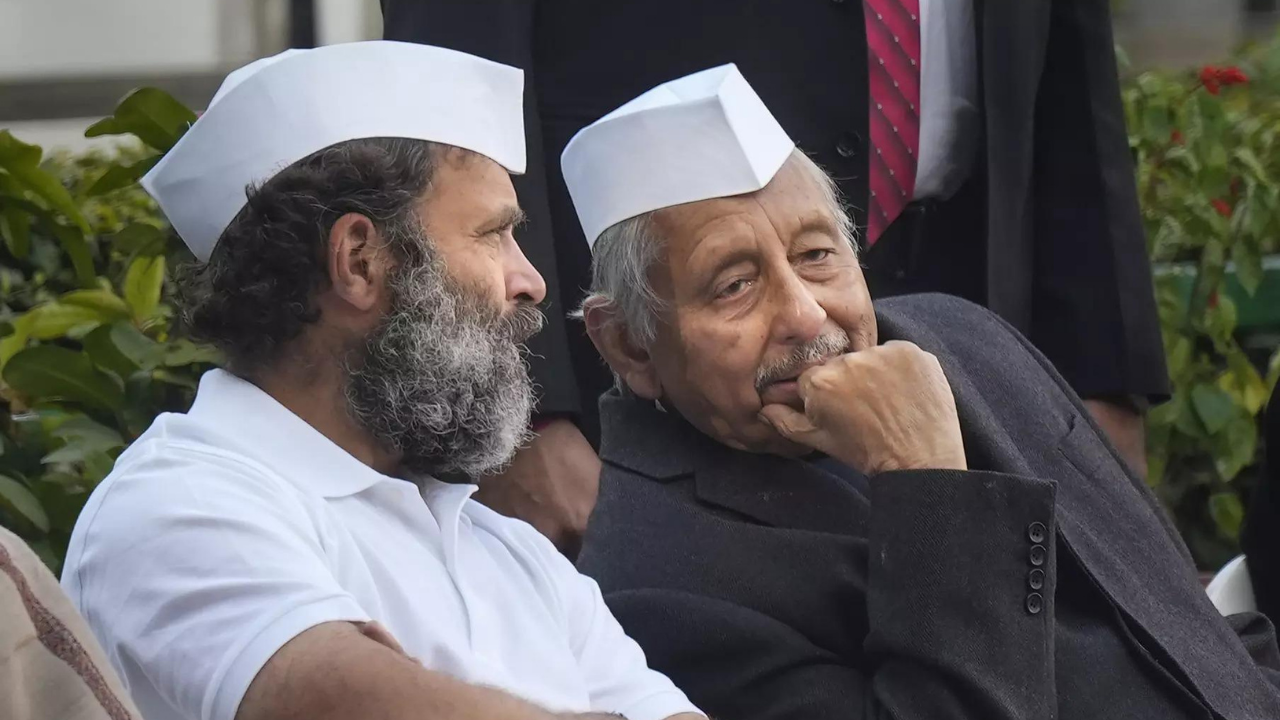
New Delhi: When the veteran leader Mani Shankar Iyer Declaring that he is “a Gandhian, a Nehruvian, a Rajivian but not a Rahulian”, at first glance it seemed like another bout of his familiar provocation. But this comment, given between CongressThe attempt to introduce discipline and unity ahead of key assembly elections has given rise to major debates about ideology, authority and discontent inside the grand old party.The Congress quickly distanced itself from Aiyar’s comments and said the leader had no connection with the party. But was Aiyar merely savoring the rebellion in rhetoric, or was he pointing to something real about how the Congress has turned ‘under’? Rahul Gandhi?Political analyst and Congress historian Rashid Kidwai believes that there is “a certain amount of truth” in Aiyar’s claim, but not in the way the former minister imagines.
Also read: Mani Shankar Aiyar returns and Congress goes into hiding again
From Nehruism to ‘civil society’ politics
Kidwai explains, “There is some truth in what Mani Shankar Aiyar is saying because the Congress has moved away from the Nehruvian way of looking at things or rather the Nehruvian ideology and has moved towards civil society.”
Rahul Gandhi has not got the clean bill. His three, four uncles keep an eye on him.
Rashid Kidwai, writer and political analyst
According to him, this change has not happened overnight. He argues that Congress has traveled through three distinct ideological phases.He says, “What used to be Nehruvian thinking…Congress moved from Nehruvian thinking towards economic reforms, which was during the time of Narasimha Rao and Manmohan Singh Rao, now it has moved towards civil society thinking.”
Kidwai argues that this change helps explain why Aiyar’s attack on “Rahulian” politics resonates in some circles. The Congress under the leadership of Rahul Gandhi does not work within a rigid ideological framework in the classical sense.Kidwai says, “So what you are seeing around Rahul Gandhi are people coming from civil society and they are influencing him. So civil society does not have a dogmatic ideology.”He suggests that this absence of dogma has an impact on the party’s political response. Unlike the Nehru era, where ideology shaped policy, or the reform years, where economic pragmatism dominated, today’s Congress often appears reactive and issue-driven rather than programmatic.
Impact of ‘Jai Jagat’
Kidwai has previously written about what he describes as a growing “civil society” impression within the Congress, especially around Rahul Gandhi. He argues that this ideology prioritizes moral reasoning, decentralized activism, and individual agency over state-led or party-led political action.This direction, which had gained visibility through bodies such as the National Advisory Council during the Sonia Gandhi-led UPA years, now “almost dominates the party organization under Rahul Gandhi,” writes Kidwai.
Mani Shankar Iyer has become completely isolated. There is no group, no leader in Tamil Nadu or outside who will take membership of Shri Mani Shankar Aiyar.
Rashid Kidwai, writer and political analyst
Civil society leaders, often associated with the so-called “Jai Jagat” group, are said to be close to Rahul Gandhi and play influential organizational roles. His emphasis on simple living, minimalism and symbolic politics has become part of the contemporary aesthetics of the Congress.Yet, as Kidwai has written in his earlier writings, this culture sits uneasily with traditional Congress leaders who rose through the ranks and understand politics as a matter of negotiation, organization and power management rather than moral signaling.
Iyer’s isolation within Congress
While Aiyar positions himself as the custodian of Congress ideology, Kidwai has been unclear about his position within the party.“Manishankar Aiyar thinks he represents the ideology of the Congress, be it panchayats or foreign policy or pro-poor socialism… This is not right. So there is no one to buy Mr Iyer,” says Kidwai.He further said, “Mr Aiyar is completely isolated. There is no group, no leader in Tamil Nadu or outside who will take membership of Mr Mani Shankar Aiyar.”Kidwai has compared Aiyar’s isolation to other Congress leaders who disagree with Rahul Gandhi but retain organizational hold.“Shashi Tharoor and many others still have some influence in the Congress… Manish Tiwari and many others. But there is no one who will support Mani Shankar Aiyar,” he says.Kidwai argues that Aiyar’s contradiction lies in his political identity. “Manishankar Aiyar’s claim to fame was his loyalty to Rajiv Gandhi,” he says. “There is a bit of a contradiction now that he is taking on Rajiv Gandhi’s son,” says Kidwai.That contradiction goes to the heart of Iyer’s frustration.
Disagreement, discipline and ‘uncle syndrome’
Aiyar once again claimed that the Congress of the past tolerated rebels while today’s leadership punishes them. But is it true?“In most political parties, when adverse conditions come, they get divided,” he says, recalling the Congress splits after 1967, 1969, 1977 and the fragmentation of the party during and after Narasimha Rao’s rule.Kidwai argues that what makes the post-2014 period unusual is not intolerance but endurance.He says, “What happened from 2014 to 2024, and now it is 2026, is very unique, because there has been a long period of adversity, but there has been no division. 150 leaders have left, but there has been no division in the Congress.”
The result is a party that has the leadership burden of several generations.Kidwai says, “Rahul Gandhi’s face is not clear. His three, four uncles keep an eye on him. “Manishankar Aiyar is an uncle who says – you are not doing the work properly.”Also read: Crisis of the oldest party – Why are the people of Congress Party separating?Iyer’s anger is very personal. “He felt that during Rajiv Gandhi’s time, he was on ‘Arsh’, which means the line of clouds,” he says. And he has come to the floor.Aiyar, he says, has not satisfied himself with his diminishing access to the Gandhi family. “He is very hurt and angry about this whole incident,” says Kidwai.
After all, why did Congress draw the line?
Aiyar has repeatedly embarrassed the Congress with his comments like ‘chaiwala’ and ‘neech man’. There was nothing new in the recent explosion. So has Congress now clearly said after so many years that he has no connection with the party? Kidwai considers the reason for this to be the changing internal equations.“There was a perception that Mr Sam Pitroda and Mr Mani Shankar Iyer were close to the family,” he says. That perceived closeness once served as insulation.But Kidwai argues that that cover has disappeared. He says, “Now people know that he did not have the support of his family. So Mr Iyer had a false cover… Now that has been exposed.”On the contrary, Kidwai says, Pitroda is safe. “Mr. Sam Pitroda is still among Rahul Gandhi’s good friends, so no one says anything about him,” he says, although according to Kidwai, both men are “motor mouths” whose comments have often “hurt the political interests of the Congress.”
spin doctor without any party
Kidwai links Iyer’s provocation to his past.Recalling Aiyar’s diplomatic career and his role as a key aide of Rajiv Gandhi, he says, “Before the social media and internet boom, Shri Mani Shankar Aiyar was an original spin doctor.”Kidwai argues that that tendency persists, but now operates without institutional relevance.“He is trying to get the attention of Sonia Gandhi, Rahul and Priyanka… and he is not getting it,” says Kidwai.Kidwai believes that Aiyar’s use of the term “Rahulian” is part of an attention-seeking strategy rather than a serious ideological intervention.“He has the ability to spin and that is what he is doing,” says Kidwai.But is there any truth in Iyer’s warning?While rejecting Iyer’s influence, Kidwai does not completely reject his diagnosis.“There is an uneasiness, which is not obvious,” he says, referring to the uneasiness within the Congress over Rahul Gandhi’s reliance on civil society input rather than organizational consensus.He points to campaign slogans and movements such as ‘Chowkidar Chor Hai’ and ‘Vote Chori’ as examples of strategies that did not emerge from the party’s internal deliberations.“None of these things have come from the Congress organization,” says Kidwai.Yet, unlike Shashi Tharoor, who had secured 11-12 per cent of the votes in the 2023 Congress presidential election, Aiyar has no following.Kidwai says bluntly, “Manishankar Aiyar will get zero.”For now, Aiyar has coined a new word, ‘Rahulian’, which Congress’ opponents may try to stick in the public memory. However, its originator may become irrelevant later on.Iyer may have named something real, an ideological shift from structured theory to the politics of civil society. But by doing so, Kidwai argues, he has personalized a change that is bigger than Rahul Gandhi and older than Aiyar’s own complaints.In the end, Aiyar’s rebellion may say less about the future of the Congress but more about a stalwart’s inability to accept that the party he once shaped has moved on without him.


