



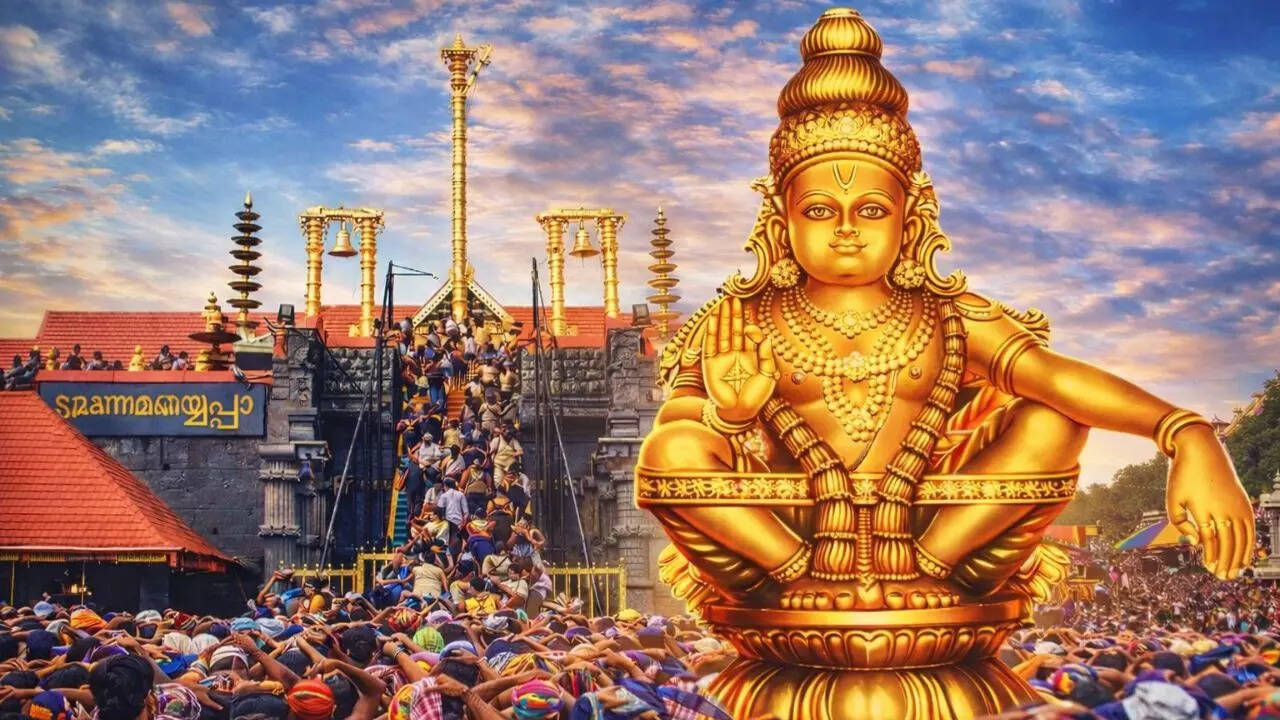
Before dawn in the dense forests of Pathanamthitta, chanting begins. Barefoot men wearing black or blue dhoti, observing for 41 days vratam18 climb the sacred stairs irumudi Same name on their heads and on their lips. Ayyappa! For them, a visit to Sabarimala Sri Ayyappa Temple is not tourism. it is tapas. This is discipline. This is dedication.As a larger nine-judge bench of the Supreme Court gets ready to hear the case once again, the hill temple again finds itself at the center of the nation’s conscience.It is at such moments that faith collides with constitutional scrutiny and the peace turns into a storm, especially in a country that calls itself secular but often struggles to remember that secularism means keeping the state out of the sanctum sanctorum, not turning the sanctum sanctorum into an extension of the state.The Sabarimala controversy is not just about entry. It is about whether diversity in practice can be mistaken for discrimination, and whether courts can redefine the sacred geometry of devotion.
a temple apart
Sabarimala This temple is dedicated to Lord Ayyappa, who is revered here ascetic celibateEternal celibate. Tradition holds that women between 10 and 50 years of age, which is roughly the menstruating age group, do not enter this temple. This restriction lies in the specific form in which the deity is worshiped here. There are over a thousand other Ayyappa temples across India where women of all ages freely pray.
10 facts about deity ayyappa
This difference becomes the center of debate. Is this restriction an expression of a particular communal practice, or is it gender discrimination disguised as practice?The legal history begins in 1990, when a petition was filed in the Kerala High Court seeking enforcement of the ban. In 1991, the High Court upheld the ban, considering it an integral part of temple practice.After that the matter remained quiet within the mountains for about 15 years.
When the law came to enter the religious place
In 2006, the Indian Young Lawyers Association approached the Supreme Court of India, arguing that barring women violated constitutional guarantees of equality and religious freedom. By 2016, the Court began to openly question whether such a ban could withstand constitutional scrutiny.In September 2018, a five-judge Constitution bench delivered a 4-1 verdict that shocked Kerala.The then Chief Justice Dipak Misra, Justices Rohinton Fali Nariman, AM Khanwilkar and DY Chandrachud held that the exclusion of women was unconstitutional. He ruled that this practice was a violation of Articles 14, 15, 17 and 25. He said biological factors such as menstruation cannot justify exclusion. He argued that constitutional morality should prevail over public morality rooted in patriarchal attitudes.Justice Chandrachud said the boycott was destructive to freedom and equality. Justice Nariman said that superstitions beyond religion cannot claim constitutional protection.
Sabarimala case: timeline
But interestingly, the sole dissent came from Justice Indu Malhotra. a woman.There was a sober warning in his decision. Courts should exercise restraint in matters of faith, he said. Considering PILs against religious practices may harm the secular fabric of a pluralistic society. Article 14 alone cannot be the criterion to judge religious customs. Equality in religion must be viewed within the framework of the essential practices of that faith.He argued that Sabarimala devotees constitute a separate religious sect and the ban is an integral part of their worship. Explaining the difference from untouchability under Article 17, he said that this analogy is wrong.His dissatisfaction resonated deeply among devotees, who believed that the court had stepped into sacred territory.
Ritual and resistance
The decision was not limited to law books. It spread on the streets. The Kerala government led by Chief Minister Pinarayi Vijayan took steps to implement the decision. Large scale protests started. Devotees blocked the roads. Women journalists were chased away. Police security at the temple gates became regular.In January 2019, two women entered the temple amid heavy security. Widespread unrest was witnessed in the state.Meanwhile, review petitions were filed. In November 2019, a five-judge bench led by Chief Justice Ranjan Gogoi referred the broader constitutional questions to a larger bench. The Court did not stay the 2018 decision but acknowledged the need to examine the deeper issues: What is an essential religious practice? How should courts balance equality with communal rights?
The Supreme Court ruled by a majority of 3-2 to hear the case in a larger bench.
On February 10, 2020, a nine-judge bench upheld the decision to examine these larger questions, expanding the scope beyond Sabarimala to include other faith-based entry controversies.The debate has now expanded beyond a hill temple to the entire landscape of religious freedom in India.
2026 hearing
In 2026, the issue again comes into focus in a dramatic manner. A bench of nine judges is going to hear petitions related to discrimination against women at religious places including Sabarimala.The hearing, scheduled to begin on April 7 and expected to conclude by April 22, will examine the review petitions and the broader constitutional framework. The bench will hear the parties supporting the review, the original writ petitioners opposing it and finally the amicus curiae.Along with Sabarimala, the top court will consider petitions related to entry of Muslim women into mosques and dargahs, entry of Parsi women into fire temples after marrying outside the community and the practice of female genital mutilation by the Dawoodi Bohras.
Devotees of Lord Ayyappa wait to offer prayers during Chingam 1 or Malayalam New Year at the Sabarimala temple in Sabarimala. (PTI photo)
The stakes are huge. The court must decide whether it has the authority to interfere with ritual practices that communities hold sacred.As Kerala heads towards assembly elections, political currents have once again intensified. The ruling Left government has avoided taking a definitive stance, saying it will consult experts and clarify its position if necessary. Opposition parties demand clarity. Devotee organizations exert pressure to protect the tradition.Faith and franchise go hand in hand. again.
Is diversity discrimination?
One of the devotees’ most powerful arguments is simple: diversity of practice is not discrimination.Across India, many temples follow unique customs shaped by theology, legend and regional belief. Consider some examples.At Attukal Bhagavathy Temple, lakhs of women gather for the Attukal Pongala festival. Men are not allowed inside the temple premises during the rituals. This is a celebration of women’s devotion.Chakkulathukavu temple hosts the annual Nari Puja, where women are worshiped and men cannot enter the temple area during the ceremony.At the Kamakhya temple, the Ambubachi fair celebrates the goddess’s menstrual cycle. The temple closes for three days, and certain restrictions are in place, reflecting the sanctity of the event.Santoshi Mata Temple in Jodhpur is known for its traditions that prohibit men from entering the inner sanctum on specific days.In each of these places, exclusion is defined not as persecution but as religious compatibility. The ritual space is shaped to honor a particular spiritual meaning.
ban on men
The Brahma temple has traditions associated with mythology that restrict the entry of married men at certain places. The Kanyakumari temple maintains the practice of barring entry of men into the inner sanctum, maintaining the sanctity of the form of the goddess.Devotees ask that if such practices are an expression of diversity, then why is Sabarimala considered discriminatory?This question does not negate equality. It asks whether equality should mean uniformity.
constitutional crossroads
The essential religious practice principle is at the center of the controversy. Since the Shirur Math case in 1954, courts have determined which practices are essential to a religion and therefore protected under Article 25.In Sabarimala, in 2018 the majority held that the exclusion of women was not necessary. Justice Malhotra dissented, saying that courts should not rationalize faith.Chief Justice Gogoi later framed the issue more broadly: Can constitutional courts step into questions involving practices that are essential to a religion but appear to violate fundamental rights?
Devotees climb 18 steps to worship Lord Ayyappan at Sabarimala Sannidhanam in Pathanamthitta. (PTI photo)
This tension between equality and communal autonomy is not easily resolved.Constitutional ethics strives to maintain dignity and non-discrimination. Religious freedom seeks to preserve autonomy and belief. When these principles collide, judges must weigh not only the law but also history, sociology, and theology.The nine-judge bench is now tasked with developing a coherent judicial policy for future cases involving similar conflicts.
emotional landscape
For devotees, Sabarimala is not about excluding women. Many women themselves support the traditional practice, arguing that devotion sometimes expresses itself through abstinence. they see vratam It is seen as a temporary renunciation by male devotees. He argues that the unique character of the temple would change if its core discipline were modified.
Melashanti AK Sudheer Namboothiri (Chief Priest for 2019-2020) along with other priests perform rituals for the inauguration of the Sabarimala temple on the first day of the holy Malayalam month of Chingam in Pathanamthitta district.
For those supporting the 2018 decision, the issue is simple that no woman should be denied entry into a public temple on biological grounds. They consider the ban patriarchal and inconsistent with modern constitutional values.There is a complex emotional sphere between these states.The 620-km Women’s Wall built across Kerala in 2019 symbolizes one side of the debate. The mass protests by Ayyappa devotees symbolize the latter.
vratam
Devotees gather at temples across the country to mark the beginning of the 41-day Vratam celebrated before the annual pilgrimage to the Sabarimala Sri Ayyappa temple in Kerala. The period of penance holds deep spiritual significance for followers of Lord Ayyappa, who adopt strict fasting, celibacy, vegetarianism and a disciplined daily routine as preparation for the arduous journey to the hill temple. Dressed in traditional black or blue attire symbolizing sacrifice and equality, devotees offer special prayers for strength, self-control and purity of mind before setting out on the holy journey.
Devotees offer prayers at a temple on the first day of the Tamil month of ‘Kartigai’ in Chennai, which marks the beginning of the 41-day fasting period for the pilgrimage to the Sabarimala temple. (PTI photo)
Beyond Sabarimala
The current hearing extends beyond a shrine. Petitions related to Muslim women’s entry into mosques, Parsi women’s rights to fire temples, and Dawoodi Bohra practices highlight a broader question: how should India negotiate the boundary between reform and respect?If the courts intervene too aggressively, they risk being seen as arbiters of theology. If they step back completely, real injustice may remain unchecked.The Sabarimala case has become a lens through which India examines its constitutional soul.
Awaiting decision
As the April hearings approach, the country watches again. The nine-judge bench will hear the review petitioners, respondents and amicus curiae within a stipulated time frame. Its decision could reshape the limits of religious freedom.For Kerala, with elections on the cusp, the issue is political. It is personal for the devotees. For scholars it is constitutional.Yet beneath the logic and analysis lies a simple truth. Temples are not mere structures but vessels of memory. People who climb Sabarimala bring gifts as well as heritage.Whatever the bench decides, the question now goes deeper than the admission itself. It asks whether a civilization that values diversity can protect equality without erasing difference.


