




Modi government’s push for ‘Make in India’ is facing resistance and criticism from US and China – the two largest world economies. India is currently the world’s fifth largest economy, on its way to become the third largest in the coming years.The move to transform India into a major global manufacturing hub faces a challenge from the US and China – both the countries have argued that India’s subsidy policies violate international trade rules.
US, China Challenge ‘Make in India’ push
Central to the disputes is India’s production-linked incentive programme, launched by the Modi government in 2020 with the aim of strengthening domestic manufacturing. Covering 14 industries ranging from electronics and pharmaceuticals to solar equipment and medical devices, the scheme involves a total allocation of ₹1.91 trillion ($21 billion).According to a Bloomberg report, trading partners maintain that these incentives give domestic companies an edge over foreign competitors. In the solar industry, firms such as Waaree Energies Ltd., Adani Enterprises Ltd., and Reliance Industries Ltd. have gained from government backing through production-linked incentives as well as a range of non-tariff measures.
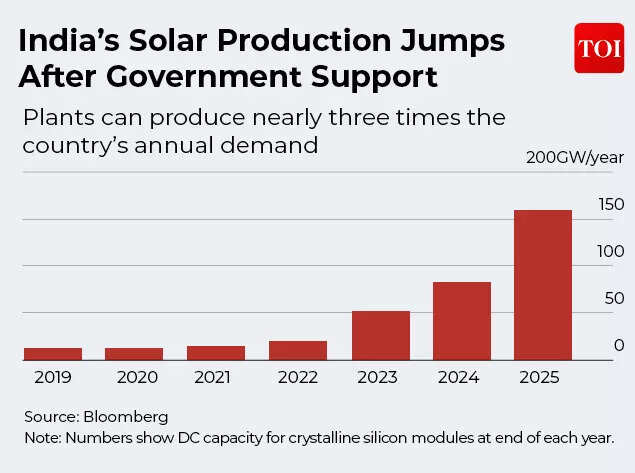
India’s Solar Production Jumps After Government Support
On Wednesday, the United States announced preliminary tariffs of 126% on solar equipment imported from India after concluding that the industry had received unfair government support. Analysts believe these steep duties will likely make it difficult for Indian solar manufacturers to compete in the US market.The development followed a decision by the World Trade Organization’s dispute settlement body to form a panel to review China’s complaint that India’s incentive schemes for the automotive and renewable energy sectors favor domestically produced goods over imports, placing Chinese exporters at a disadvantage. The panel was constituted after initial consultations between the two sides – the first stage of the WTO dispute mechanism – did not resolve Beijing’s objections to India’s industry-specific subsidies.Officials told Bloomberg that the government intends to firmly defend its incentive schemes and maintains that they are consistent with WTO regulations.These initiatives play a key role in India’s strategy to increase manufacturing’s contribution to gross domestic product to roughly 25%, but rising objections from major trading partners could present challenges for policymakers. At present, the manufacturing sector accounts for about 17% of the economy.“Without schemes like PLI, revival of manufacturing looks difficult,” said Biswajit Dhar, a New Delhi-based independent trade economist and former professor at Jawaharlal Nehru University. At the same time, India needs to explore alternative ways to support industries, such as investing more in technology and innovation, he added.The criticism comes at a time when India is attempting to stabilize its relationships with both the United States and China. New Delhi and Washington have only recently reached an agreement that brought an end to months of trade tensions, during which India faced some of the steepest US tariffs imposed on Asian economies. At the same time, India has been working to improve ties with Beijing.
US, China Themselves Under Scrutiny
The United States and China have themselves come under examination for their respective subsidy policies. In 2024, Beijing challenged aspects of the US Inflation Reduction Act of 2022, arguing that certain subsidies were tied to the use of domestically produced inputs or unfairly disadvantaged Chinese goods. Separately, European nations have accused China of relying on large-scale subsidies to accelerate the growth of its electric vehicle and solar manufacturing industries.


