



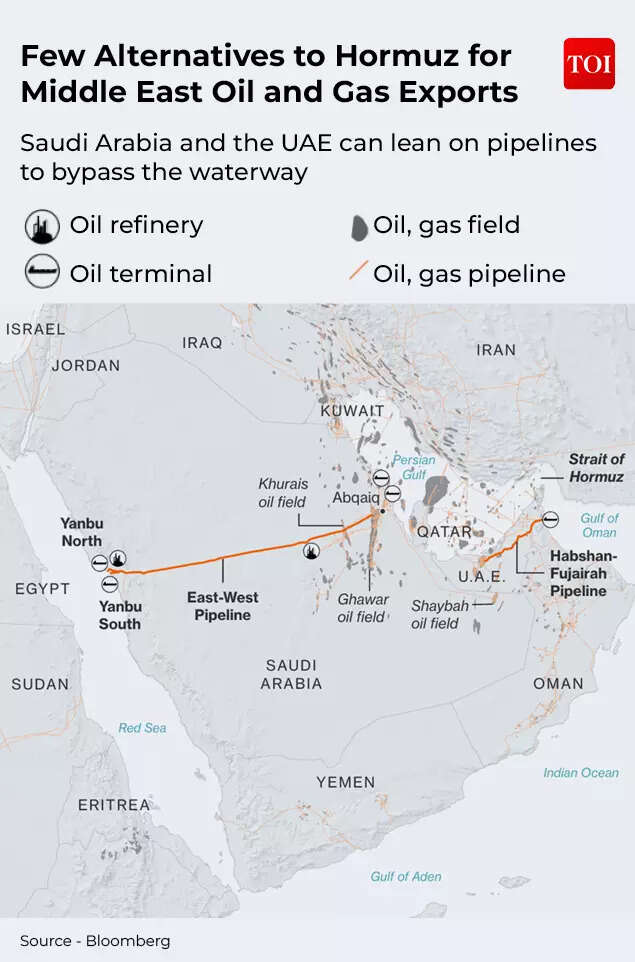
The Middle East conflict continues to squeeze global energy supplies as the war drags on, sending ripples of concern across markets worldwide. Against this uncertain backdrop, Saudi Arabia, appears long prepared for a worst-case scenario like this. The kingdom has effectively pressed the “contingency plan” button after the Strait of Hormuz was disrupted following US and Israeli strikes on Iran, moving swiftly to keep its oil exports flowing even as tensions continue to climb.At the centre of this preparation is a 1,200-kilometre East-West pipeline, built in the 1980s, running across the Arabian Peninsula from the country’s eastern oil fields to the Red Sea port of Yanbu, Bloomberg reported. The route, originally designed as a backup to Hormuz, has quickly taken a front seat as the crisis intensifies.Within hours of the escalation, Saudi Arabia began rerouting crude through this inland corridor. Yanbu, a relatively low-profile industrial port compared to the Gulf coast hubs, has now become the main export point, with a growing number of oil tankers assembling offshore to load shipments as more vessels arrive each day.State-owned Saudi Aramco is now operating under pressure to scale up flows through this alternative route. Crude exports from Yanbu have reached a five-day rolling average of 3.66 million barrels, according to Bloomberg ship-tracking data, around half of the kingdom’s pre-conflict export levels.
‘Global economy is better with the line in operation’
The importance of the pipeline lies in its ability to offset the impact of the Hormuz closure. Everyday, roughly 20 million barrels or about one-fifth of global oil consumption, typically pass through the strait. With that route disrupted, producers across the region have faced constraints, but Saudi Arabia has retained an alternative outlet that allows it to continue moving crude to market.“The East-West pipeline is looking like a strategic masterstroke right now,” Jim Krane, the Wallace S. Wilson Fellow for Energy Studies at Houston’s Rice University told Bloomberg. “The entire global economy is better off with the line in operation.”The current reliance on the pipeline marks a return to a system conceived during earlier regional conflicts. Initially developed during the Iran-Iraq war in the 1980s, the East-West pipeline was intended to reduce dependence on Gulf shipping lanes. Over time, it has been expanded and adapted, eventually reaching a capacity of around 5 million barrels per day in the 1990s, with further enhancements allowing higher throughput in times of crisis.
Saudi Aramco, which operates a highly integrated global logistics network, has had to pivot quickly. The company began contacting customers as soon as hostilities began, requesting that vessels be redirected to Yanbu. Saudi tanker operator Bahri issued similar instructions to shipowners, helping coordinate the sudden shift in export flows. By March 4, Aramco confirmed it had begun ramping up pipeline operations, and within days, international buyers, including a major Indian refiner, had started securing cargoes from Yanbu.The scale of the rerouting has been significant. By March 10, at least 25 supertankers were heading towards the Red Sea port. Shipping sources indicate that Bahri was paying rates exceeding $450,000 per day to secure enough vessels to service Yanbu. Despite the high costs, the number of ships bound for the port has continued to rise, reflecting the urgency to maintain supply chains. At times last week, Yanbu was loading more than 4 million barrels per day.“The mere existence of an alternative route helps calm markets by reassuring buyers that not all the region’s exports are trapped,” says Carole Nakhle, chief executive officer of energy consultancy Crystol Energy Ltd. “That said, it’s not a risk-free alternative. If Yanbu and the East-West system were to come under sustained pressure, that would mark a serious escalation,” Bloomberg cited the expert.That risk has already been highlighted. Iran’s strike on the Samref refinery in Yanbu, a joint venture between Saudi Aramco and Exxon Mobil Corp, came just days into the escalation. This followed Israeli strikes on Iran’s largest gas production and processing facilities, prompting Tehran to retaliate with attacks on energy infrastructure across the Gulf.The East-West pipeline itself has previously been targeted, including as recently as 2019, and remains exposed in the event of further tit-for-tat strikes. Saudi Arabia’s eastern production facilities have also faced attacks, and the Ras Tanura refinery, the country’s largest, was temporarily shut down. Aramco has at times reduced crude production by as much as 2.5 million barrels per day, resulting in lost revenue despite higher oil prices.
Yanbu at center of outflows
Yanbu itself has now moved to the centre of Saudi Arabia’s export operations. Historically overshadowed by the eastern Gulf coast, from Jubail to Ras Tanura, where Aramco shipped its first crude cargo in 1939, the Red Sea port is now handling the bulk of the kingdom’s export activity. Refineries and petrochemical plants in Yanbu, though less prominent, are currently serving as a critical interface between Saudi production and global buyers.The pipeline feeding Yanbu originates near Abqaiq on the eastern coast, where it connects to major oil fields. From there, it crosses desert terrain and climbs to elevations exceeding 1,000 metres over the Hijaz mountains before reaching the Red Sea. Alongside crude exports, around 2 million barrels transported through the pipeline are directed to domestic refineries along the western coast, which continue producing refined products such as diesel for export.
A lifeline with risks
The idea of an alternative route dates back to the late 1970s and early 1980s, when concerns over Hormuz first intensified. A 1980 report in the Mideast Report described the planned pipeline as a safeguard against the “strategic yet vulnerable Strait of Hormuz, which could eventually come under Iranian guns.” Since then, successive expansions and upgrades have turned it into a core component of Saudi Arabia’s export infrastructure.However, the Red Sea route is not entirely without risk. Vessels travelling to and from Yanbu must still pass through the Bab El-Mandeb Strait, another critical chokepoint linking global shipping lanes between the Mediterranean and Asia. In recent years, this area has seen intermittent attacks from Houthi militants, raising concerns about potential disruptions to maritime traffic.“The Houthis now have a veto on Saudi oil exports via the Bab al-Mandab,” says Rice University’s Jim Krane. “If they decide to back Iran by shutting another critical chokepoint, oil markets will gyrate even more wildly.”The broader implications of Hormuz being blocked are now becoming clear. The war has triggered a global energy shock, with commodity prices rising across sectors. Brent crude has climbed to its highest levels since Russia’s 2022 invasion of Ukraine, up 55% in the three weeks since the conflict began, closing at $112.19 per barrel on Friday.Over the longer term, the crisis is likely to reshape energy strategies across the Middle East. Countries are increasingly evaluating alternative export routes and infrastructure resilience. Oman has been positioning its port of Duqm as a regional hub, with plans for large-scale storage capacity. The United Arab Emirates operates a 1.5 million-barrel-per-day pipeline to Fujairah in the Gulf of Oman, bypassing Hormuz, though that terminal has itself come under repeated attacks in recent weeks.


