



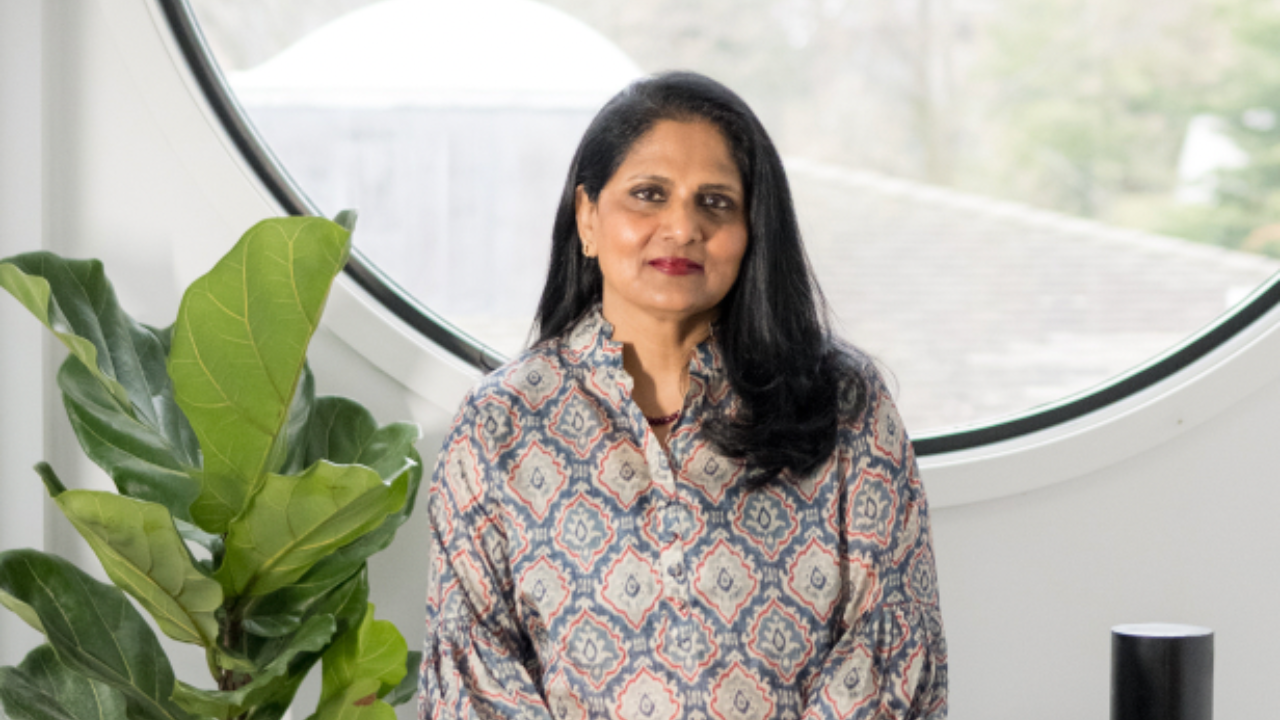
Priyamvada (Priya) Natarajan Joseph S., a distinguished astrophysicist and inaugural professor of astronomy and physics at Yale University. And Sophia S. Fruton is a professor. She also serves as an external principal investigator at Harvard’s Black Hole Initiative. Professor Natarajan has made fundamental contributions to our understanding of the universe, particularly dark matter and supermassive black holes. A respected figure in the scientific community, his honors include the 2022 Liberty Science Center Genius Award and the prestigious 2025 Danny Heineman Prize in Astrophysics. In 2024, he was named to the TIME100 list of the world’s most influential people for his pioneering contributions to the field. A member of the Yale faculty since 2000, Professor Natarajan serves as a principal advisor NASANational Science Foundation (NSF), and Department of Energy (DOE). During a recent visit to Bengaluru for the Indiaspora Forum – a gathering of global Indian leaders – she sat down with Ishani Duttgupta To discuss our enduring ties with India, the transformative role of AI in astrophysics and the future of cosmic exploration. Following are edited excerpts of their conversation.Many students from India go to America for higher education, especially in the fields of science. Are there any challenges they are facing? The increasing pressure on the United States’ science and technology research funding system is extremely worrying. For decades, the research model that has worked really well in the United States has been federal funding for basic science, supporting graduate students and post-doctoral researchers. It fosters a unique ecosystem of intensive mentorship and expertise-building, supported by well-resourced universities and faculty involved in cutting-edge research. The flow of international students was vital to keeping this type of engine running. As funding declines, the US could lose its position as a leading destination and no longer be attractive to the world’s brightest young minds. I think this is a matter of concern. Furthermore, there has been a fundamental change in the research landscape driven by AI, which is both exciting and unknown. While the initial ‘LLM revolution’ in AI catered to specific business use cases, it also required a change in the research base. And universities left research into that kind of cutting-edge AI to the corporate sector because of the enormous computation required. However, as we move towards ‘AI for science’ – where short-term monetary returns may not be very clear – the intellectual work may be concentrated back in universities. These are big uncertainties. Despite the skepticism I have seen among some of my colleagues, we are on the verge of a fundamental shift in the scientific method with AI. At the end of the day what really matters is making breakthroughs in what is actually ‘good science’.As a distinguished scholar in the field of astrophysics, please provide an overview of the most significant paradigm shifts and technological advances currently reshaping our understanding of the universe?Astrophysics is the original ‘big data’ science. Since the first systematic mapping of the entire night sky in the 1920s and 30s, the field has evolved from physical photographic plates to massive digitized datasets. This is a discipline where the search is technology-intensive with large-scale computing and better cameras. And new tools not only provide better visualizations, they also give rise to radically new ideas.Over the past five years, we have seen an amazing confluence of ideas, tools, and computational power. This alignment has opened up our understanding of the universe in ways previously unimagined. My own work focuses on new ideas around big cosmic questions such as why are we here and how did we get here? And I’m not talking about the psychology of existence, rather I’m talking about the physical universe. How is it enabled? How does the universe exist, how has it manifested, how has it manifested? That’s what inspires me, those big, fascinating and exciting questions. My mind is driven by a detective-like curiosity, trying to figure out the clues. Many times we lack direct data and have to infer from indirect data what is really going on in terms of physics. But we are fortunate that in this search we are firmly stuck to the laws of physics which are universal. In this age of AI, we are fortunate to have the unique advantage of the laws of physics that provide a rigorous order to guide and validate machine learning, ensuring that our computational leaps remain based on universal truths.Please share some of your journey, especially from India to America. I am extremely grateful for many opportunities and circumstances that I had no hand in. I had a huge advantage of being born into a home full of books, where learning was encouraged and curiosity in a child was praised. I got a lot of support from both my parents to do what I wanted. He was an educationist, though not in science. My father trained as a civil engineer and then went into engineering education. My mother is a sociologist. My parents worked in Delhi and I grew up there. My parents’ house was an intellectual ‘salon’ where all kinds of people gathered, including scientists, artists, writers and poets. I was very fortunate to grow up amidst this vast social circle, allowing me to dream and fly high. And then serendipitous events happen – you meet people who change your life in some way, mentors and teachers. At that time, it was very rare to go from India to the United States as an undergraduate and I had to get a full scholarship. With fellowships and fully paid scholarships, I reached several top positions. I chose MIT because they had a graduate research opportunities program. Once a big door opened for me it transported me to a different classroom. Looking back, I have certain personal qualities, such as extreme mental discipline. And focus. And there’s ambition – but what drives my ambition is very innocent and childlike. It’s the joy of figuring things out. I was always that kid who tried to solve a problem three different ways to understand it better. Often in our educational scenario, the years spent in school take away the childlike joy. But I’m very lucky that I still have that, at this age – I’m in my 50s now. And this is the inspiration for my work. For me, the central challenge is how to remain a lifelong learner without being intimidated by the scale of what I don’t know. To this day, I view every scientific paper I write as a learning exercise. This journey is about refusing to let frustrations set in and instead turning those challenges into something positive.I’ve been fortunate to work in an environment that pushed me into new horizons. The first was MIT; The second was the University of Cambridge, where I attended the Institute of Astronomy at Trinity College. Immersed in that vast legacy, I took full advantage of every opportunity. In 1997, I was elected a Fellow of Trinity College – the first woman to achieve this distinction in astrophysics. These years were transformative not only for my PhD, but also for my development as an interdisciplinary thinker. Connecting with minds from different walks of life is what really gives me the ‘juice of life’. This momentum eventually led to a faculty position at Yale University, which I secured even before I could defend my PhD thesis.I think one of the favorite things for a scientist like me is to propose a brand new idea and work out a whole plan to get that abstract type of idea to a point where you can directly compare it with observational data to see if it’s correct or not. I feel very fortunate that over the last five years, many of the ideas I have proposed have actually been validated. A scientist dreams that the entire cycle should be completed within his lifetime. How do you balance your consulting role and your research role?This is very complicated. I am not particularly interested in administrative careers and I really want to be able to do research, teach and guide. And now as the department chair, I have a lot of responsibilities and sometimes I find it burdensome. It requires a lot of intention and well-thought-out planning and prioritization. Over time I’ve learned how to do this, but it’s still very challenging. I think one advantage of this is that there are no demands left in my domestic life. So this has freed me to live a life of the mind. And that helps. How are you connected to India professionally and personally?My mother and brother are in India; I lost my father a few years ago. And, so, I have always had a very strong relationship with India. I come from a middle class Tamil Brahmin family and I am still very traditional. I think we imbibe amazing values growing up in Indian families and understanding the power of inter-generational bonding. I was fortunate enough to spend my formative years in India, and I embrace all those values. In terms of professional relationships, I don’t have many Indian colleagues in the fields I work in; But I am on the advisory board for science at Ashoka University. I don’t have many professional deep connections because I didn’t study anywhere in India other than school. I’m thinking a lot about what I can do to give back and try to do what I can. I give a lot of public talks and meet young aspiring students. Many Indian students have come to work for me. But I think it was great for me to see that when I was growing up, the scientific research environment in India was really marked by a lack of resources. Now we have moved towards abundance. I believe we should spend more on fundamental basic science research. But I think what has changed is the demand.


