




India’s social security framework is at an important inflection point. After the labour codes, the government is reportedly considering another major reform: raising the wage ceiling for mandatory Employees’ Provident Fund (EPF) coverage from the current ₹15,000 to ₹25,000 per month. At this stage, the increase in the wage ceiling is under policy consideration, and the final contours would be known only once the change is formally notified.While this may sound like a routine policy adjustment, the impact could be far reaching. A higher wage ceiling would bring many more employees under mandatory social security coverage, enhance pension and insurance protection, and increase both employer contributions and employee deductions. For employees, this could mean a lower monthly take home salary in the short term, but stronger financial security over the long term.Why does the EPF wage ceiling matter?The EPF wage ceiling determines who must be compulsorily covered under India’s key social security schemes: the Employees’ Provident Fund (EPF), the Employees’ Pension Scheme (EPS), and the Employees’ Deposit Linked Insurance (EDLI) Scheme.At present, EPF coverage broadly works as follows:
- Employees earning wages up to ₹15,000 per month must be enrolled under the EPF.
- Employees earning more than ₹15,000 per month can opt out of EPF at the time of joining, provided they were not members of EPF in earlier employment.
When the wage ceiling was fixed at ₹15,000 more than a decade ago, it reflected wage levels and compensation structures prevalent at that time. Since then, entry level salaries and average wages have increased sharply across sectors such as services, retail, logistics, and manufacturing.As a result, a large section of today’s workforce earns more than ₹15,000 but remains outside compulsory social security coverage. Raising the EPF wage ceiling seeks to bridge this gap by aligning statutory coverage with present day wage realities.How would a higher wage ceiling impact EPF coverage?If the wage ceiling is increased from ₹15,000 to ₹25,000, the most immediate impact would be on mandatory EPF enrolment.Employees earning between ₹15,000 and ₹25,000 would no longer be able to opt out of EPF, even if they are first time job entrants with no prior provident fund account.For instance, today a new employee joining with a basic wage of ₹18,000 can legally avoid EPF enrolment if he / she has never been an EPF member earlier. Under the proposed ceiling, the same employee would be compulsorily enrolled under EPF from the first day of employment.Employees earning more than ₹25,000 would still remain outside mandatory EPF coverage, similar to how those earning above ₹15,000 are treated today.This change could lead to a meaningful expansion of social security coverage, especially in labour intensive sectors where a large proportion of employees fall in the ₹15,000 to ₹25,000 wage range.
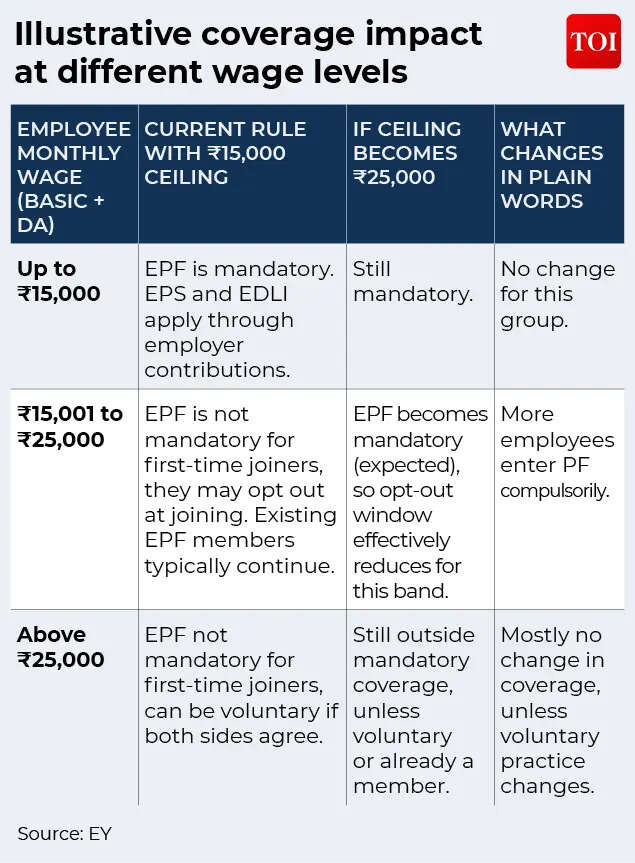
How would EPF contributions and take home salary be affected?Under the EPF framework, both employers and employees contribute 12 percent of an employee’s wages. However, for employees earning more than ₹15,000, contributions are often restricted to the ceiling amount, unless higher contributions are agreed voluntarily.If the wage ceiling is raised to ₹25,000, statutory EPF contributions would need to be calculated on wages up to the new limit.To understand the impact, consider an employee earning ₹20,000 per month. Today, EPF may be calculated only at ₹15,000, resulting in a contribution of ₹1,800 each from the employer and employee. Under the revised ceiling, contributions would be calculated on ₹20,000, increasing the monthly contribution to ₹2,400 each.For employees, a higher wage ceiling would translate into higher EPF deductions every month, which would reduce take home salary in the short term. However, these higher contributions would also help build a larger retirement corpus over time, supported by a statutory saving framework.For employers, the change would lead to higher payroll costs, since employer contributions would need to be matched on a higher wage base. This would increase recurring statutory outflows, particularly for organisations with a significant number of employees earning between ₹15,000 and ₹25,000.While the immediate impact would be reflected in monthly payslips and payroll costs, the longer term outcome would be stronger retirement savings and broader social security coverage.How would the change affect EPS coverage and contribution allocation?The Employees’ Pension Scheme operates alongside EPF and is funded entirely from the employer’s contribution. Presently, 8.33 percent of the employer’s EPF contribution is diverted to EPS, but only for employees whose wages do not exceed ₹15,000.Employees who became eligible for EPF membership after 1 September 2014 and earn more than ₹15,000, even if they contribute to EPF, do not receive EPS benefits. In such cases, the employer’s entire contribution flows into EPF.If the wage ceiling is increased to ₹25,000, employees earning up to this level would become mandatory members of EPS. Employers would be required to divert 8.33 percent of wages, within the statutory framework, towards EPS for this expanded group of employees.For example, an employee earning ₹22,000 today may be covered under EPF but not EPS. After the proposed change, the same employee would start accumulating pension eligibility, which was earlier unavailable.This would significantly widen pension coverage and provide long term income security to a larger segment of the organised workforce. Over a full working career, this expanded EPS coverage can translate into a meaningful monthly pension after retirement for employees who were earlier outside the pension net.
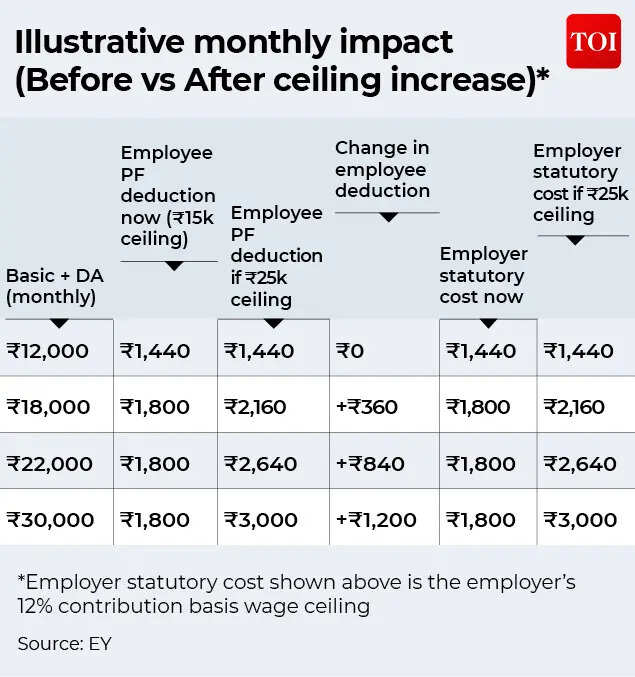
As illustrated above, employees and employers with wages between ₹15,000 and ₹25,000 are likely to see the most noticeable increase in PF deductions and statutory costs if the ceiling is raised.What does it mean for EDLI contributions and benefits?The Employees’ Deposit Linked Insurance Scheme provides life insurance cover to EPF members. In the event of an employee’s death during service, insurance benefits are paid to their nominee.Currently, EDLI contributions are calculated on wages up to ₹15,000, and the entire contribution is borne by the employer. If the EPF wage ceiling is increased, the EDLI contribution base would also rise to ₹25,000.This would lead to a modest increase in insurance related contributions for employers, while employees would benefit from higher insurance coverage. Although EDLI often receives less attention than EPF and EPS, it plays an important role in protecting employees’ families against financial risk.Key takeaways for employersIf the EPF wage ceiling is revised, employers should prepare for several changes:
- Payroll budgets may need reassessment, particularly in organisations with a large workforce earning below ₹25,000.
- HR and payroll systems will need updates to reflect new contribution thresholds and EPS allocations.
- Clear communication with employees will be important to explain higher deductions and manage expectations.
- Wage and compensation structures should be reviewed to ensure continued compliance with social security requirements.
While the change may increase short term costs, it also strengthens the overall social security framework for employees.Key takeaways for employeesFor employees, a higher EPF wage ceiling brings both adjustments and long term advantages:
- Monthly take home pay may reduce initially due to higher EPF deductions.
- Retirement savings will grow faster because of higher mandatory contributions.
- More employees will become eligible for pension benefits under the EPS framework.
- Life insurance coverage linked to EPF membership will improve.
For younger employees especially, mandatory participation from early in their careers can significantly improve financial security at retirement.The labour codes marked a significant step towards modernising India’s employment and social security laws. Building on that, raising the EPF wage ceiling to ₹25,000 would be one of the most meaningful expansions of statutory social security coverage in recent years, affecting millions of employees.While employers may face higher contribution costs and employees may see a modest reduction in monthly cash in hand, the long term benefits of larger retirement savings, wider pension coverage, and stronger insurance protection are aligned with the changing wage landscape of a growing economy.As incomes rise and the country becomes more prosperous, social security thresholds too must evolve. For millions of salaried employees and the organisations that employ them, the proposed increase represents a shift towards social security keeping pace with real wage levels and longer working lives.(The author, Puneet Gupta is Partner, People Advisory Services Tax at EY India. Amiya Bhaskar, Senior Manager, EY India also contributed to the article)


