



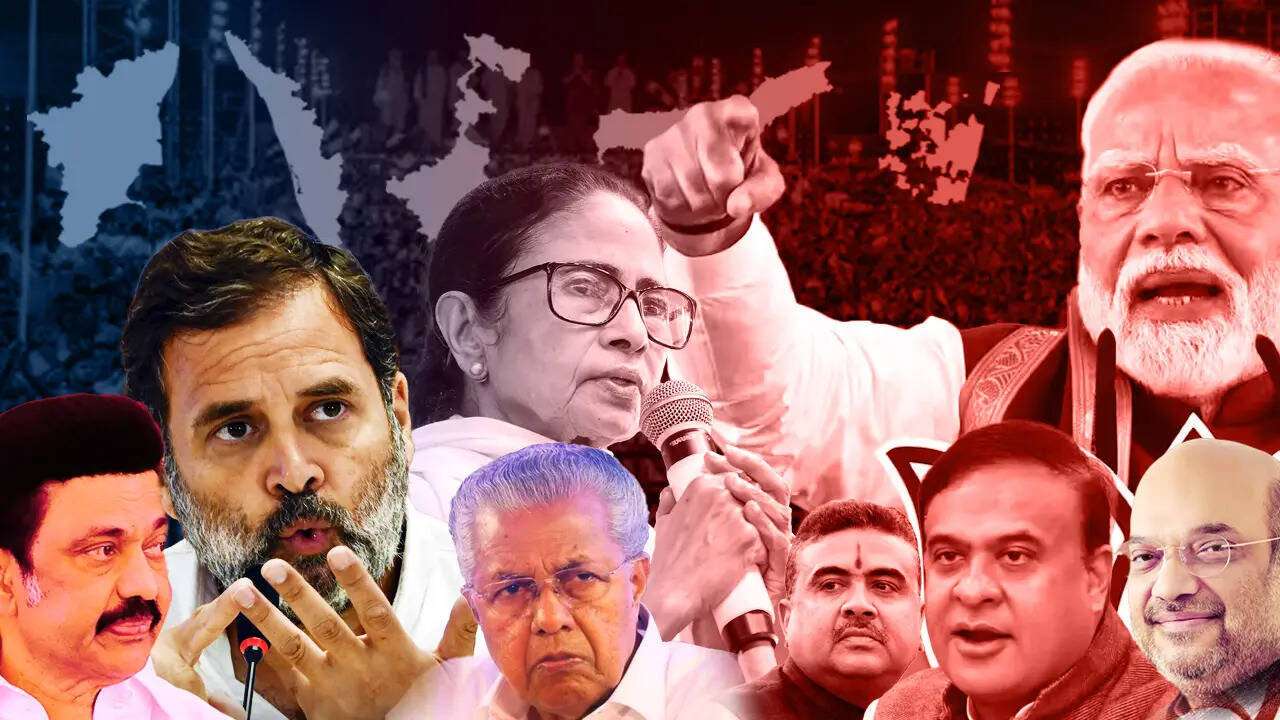
New Delhi: As vote counting trends tighten across five states and union territories, the 2026 assembly elections are already changing the political map in dramatic ways. From Victoryblockbuster debut of Tamil Nadu Thanks to the saffron success in West Bengal and Kerala’s return to the rotation, the verdict is throwing up clear winners and decisive losers. It is not just about who forms the government, but also who redefines the narrative and who is marginalised. Established centers of power have been shaken, new forces have emerged and old beliefs have collapsed.Follow complete coverage of election results 2026
Here’s a look at the top 10 winners and losers who define its story assembly election results 2026 .
Note: This list is based on trends and leads. Counting of votes is still going on and the final results will be out in a few hours.
winners
1. Vijay
Vijay is the biggest winner of the 2026 assembly elections, not just in terms of numbers. By emerging as the largest party in Tamil Nadu with over 100 seats, Vijay has fundamentally changed the political grammar of the state. Leading the Tamilaga Vetri Kazhagam to cross the majority mark in the trends, Vijay has effectively disrupted the five-decade-old Dravidian monopoly.With this, Vijay has set a new standard of electoral debut.At the heart of this change is what many are calling the ‘MGR 2.0’ effect. Like MG Ramachandran, Vijay transformed cinematic charisma into a mass political movement, but with a contemporary edge. His decision to contest all 234 seats independently proved crucial, establishing the TVK as a clean, alternative force outside traditional alliances. This ‘third way’ seems to be strongly associated with youth and first-time voters seeking a break from the DMK-AIADMK cycle.Ideologically, Vijay formulated a broader idea – combining social justice with a well-organized political position that challenged both Dravidian power and the expansion of the National Party. Its effect was finally visible on the results day: TVK not only did not compete, but also disrupted it. This is more than an election victory. This marks the arrival of a new pole in Tamil Nadu politics and potentially the beginning of a bipolar era.
2. PM Modi and Amit Shah
Continuing the script, Prime Minister Narendra Modi and Amit Shah once again emerged as the biggest winners of the 2026 assembly elections.Basically, this election was not just about the five states/UTs, it was a referendum on whether the BJP’s national dominance could be sustained in various regional areas. Any gains in states like West Bengal or incremental growth in Tamil Nadu indicate that the Modi-Shah electoral model is no longer limited geographically. The biggest story is from Bengal where PM Modi held several rallies and Amit Shah camped for 20 days, holding several public meetings and rallies before voting.These results are not isolated, they directly impact the crucial assembly elections in Punjab, Uttar Pradesh and other states next year and ultimately the Lok Sabha elections in 2029. A strong performance allows PM Modi to maintain the narrative of electoral invincibility, while Amit Shah cements his reputation as the architect of booth-level dominance.
3. Himanta Biswa Sarma
Himanta Biswa Sarma’s status as one of the standout winners of the 2026 assembly elections rests on a rare political achievement: converting power into profit and leading the BJP-led NDA to its third consecutive victory in Assam.In a state where anti-incumbency wave has historically played a decisive role, Sarma has managed to ride the pro-incumbency wave. Her government’s emphasis on infrastructure expansion and targeted welfare delivery, especially schemes like Orunodoi, created a direct connect with rural families and women voters. There is evidence of continuity rather than fatigue in voter support.His dominance in Jalukbari, where he is leading by a huge margin, underlines his personal popularity. More importantly, he has been able to transfer that appeal across the state, which is a key factor behind the NDA’s ability to garner impressive numbers and achieve the target.Sarma’s campaign relied heavily on identity politics and security concerns, particularly illegal infiltration and indigenous rights. This sharp message helped consolidate the majority vote base and mitigated the challenge posed by the Congress-led coalition.This victory is more than securing another term. This enhances Sarma’s stature within the BJP as a leader who can deliver repeated electoral success in a complex, multi-caste state.
4. VD Satheesan and Rahul Gandhi
VD Satheesan and Rahul Gandhi stand as the twin pillars behind a historic political transformation in Kerala. The Congress-led United Democratic Front (UDF) has crossed the majority mark in the first few hours of counting, ending the decade-long rule of the Pinarayi Vijayan-led Left Democratic Front (LDF).As leader of the opposition, Satheesan emerged as the key architect of the UDF’s revival. His statewide outreach and sustained campaign intensified the anti-incumbency wave and rebuilt the grassroots machinery of the alliance. By maintaining a strong lead in Paravur, he strengthened his credibility as both a mass leader and strategist.By fending off the Left’s bid for a third consecutive term and restoring Kerala’s traditional power cycle, he is now the clear frontrunner for the chief minister’s post.On the other hand, Rahul Gandhi’s continued involvement with Kerala, especially as MP from Wayanad, boosted the UDF’s campaign. There was strong youth participation in his rallies and momentum grew in key areas. The victory gives Rahul Gandhi a significant political boost at the national level, strengthening his position within the opposition faction and strengthening his CongressAbility to compete with strong regional powers.
5. Suvendu Adhikari
Suvendu Adhikari has emerged as the central figure behind the BJP’s historic success in West Bengal, widely seen as the strategist who shifted the momentum to the majority. As leader of the opposition, he played the role of both architect and executor, taking the party to the majority mark at the time of writing this article and ending TMC’s 15-year rule.His campaign hinged on an intense Hindu unification narrative, which delivered results in border districts and tribal belts, demolishing dozens of former TMC strongholds. Even though he defeated Mamata Banerjee in the high-profile Bhawanipur contest, he seems to have strong control over his base in Nandigram.Adhikari also took advantage of public anger over issues such as the RG tax case and corruption allegations and reframed the election as a referendum on governance and accountability.Even though his personal competition remains tight, the big mandate establishes him as the BJP’s decisive force in Bengal’s political transformation and a top contender for the CM post.
lost
6. MK Stalin
The decision to call the 2026 assembly elections marks a stunning political reversal for MK Stalin, marking not only the loss of power but also the collapse of the DMK’s long-standing dominance in the Tamil Nadu political system.For decades, Tamil Nadu politics revolved around the DMK-AIADMK axis. This election has disturbed that balance. DMK slipped to third place in many areas.After five years in office, the DMK faced intense anti-incumbency. Allegations of corruption, concerns over law and order and persistent attacks on ‘family rule’ created a narrative which the opposition successfully promoted.The emergence of Vijay’s TVK proved decisive. By directly targeting the DMK as the main rival and positioning itself as a new alternative, the TVK wooed core sections of the DMK vote base, especially youth and urban voters. The symbolism of the results is as damaging as the numbers. Stalin lagging behind in Kolathur and Udhayanidhi Stalin facing tough competition in Chepauk points to a deep rejection not only of governance, but of the leadership. DMK’s electoral mathematics depended on opposition fragmentation. Instead, the TVK boom demolished that notion. Instead of dividing the anti-incumbency vote, the new entrant absorbed it, causing the DMK’s seats to decline sharply.Perhaps the most important warning sign is the change in urban Tamil Nadu, especially Chennai and its surrounding areas. These were once DMK strongholds. Their movement towards TVK reflects a generational and aspirational shift that the party failed to anticipate or respond to.
7.Mamata Banerjee
Mamata Banerjee’s defeat marks the end of 15 years of political dominance in West Bengal, with trends showing the BJP moving past the majority mark. The loss of the CM’s chair reflects the confluence of many pressures. The fallout from the RG Kar incident became a powerful symbol of public anger over governance and women’s safety through the ‘Didi’ brand. The particularly intensive revision of voter lists added another layer of controversy, with the TMC blaming the massive deletions for destroying its core base.After three terms, the anti-incumbency wave finally became dominant. The BJP, led by Suvendu Adhikari in the state, capitalized on this with a strong identity and infiltration narrative, flipping key districts. Record turnout indicated a decisive voter effort for change. Even if Mamata retains her seat, the larger mandate represents a structural collapse of TMC dominance.
8. Pinarayi Vijayan
Pinarayi Vijayan and the Left Democratic Front (LDF) have slipped into the list of losers as their bid for a historic third consecutive term was decisively stopped by the Congress-led UDF. The defeat indicated the limitations of Vijayan’s centralized ‘Captain’ leadership model, which critics successfully redefined as authoritarian, losing its earlier appeal.The symbolism is clear: Vijayan himself is locked in a tight race in Dharmadam, with several Cabinet ministers trailing or losing to him, pointing to widespread disapproval of the regime. Internal dissent, including PV Anwar’s rebellion, fragmented the vote base in key areas. Combined with a strong anti-incumbency wave around corruption and policy fatigue, the result marks a decisive dent in the Left’s Kerala stronghold and the end of its attempt at continuity. With this, the Left has also lost the only state it ruled and will now struggle for relevance.
9. Gaurav Gogoi
Gaurav Gogoi finds himself among the losers in Assam election results 2026 after failing to convert a high-profile campaign against the BJP and Himanta Biswa Sarma into a credible electoral challenge. Losing Jorhat against BJP’s Hitendranath Goswami is a personal blow, undermining his attempt to transform from a national figure to a state-level chief ministerial face.The Congress-led Assam Sonmilito Morcha (ASM), despite forming an alliance, failed to reduce the BJP’s dominance and fell well short of expectations. Gogoi’s reliance on the legacy of his father, Tarun Gogoi, did not adequately reflect against the BJP’s welfare-driven ‘Himanta model’.The late allegations regarding EVM security and breach in the strong room also had the opposite effect, appearing defensive rather than mobilising. Importantly, the Congress failed to regain its lost ground in key areas such as Upper Assam and tea plantation areas.For Gogoi, this election was a defining moment; Instead, it leaves him to lead a weak opposition.
10. Edappadi K Palaniswami
EPS may be able to hold his own personally, but politically, he figures in this list because of his failure to capture power or re-establish the AIADMK as Tamil Nadu’s primary alternative. Despite a clear anti-incumbency wave against the DMK and MK Stalin, the party could not secure many seats, leaving the EPS in the opposition once again.The decisive blow is the rise of Vijay’s TVK, which effectively took over the opposition space that traditionally belonged to the AIADMK. Equally stagnant is also being reported in seat share, with numbers broadly similar to 2021, indicating no real growth after five years out of power. Even EPS’s strategy of alliance with BJP and others failed to counter this surge.The result points to a simple fact: AIADMK is no longer the default challenger in Tamil Nadu politics.


