



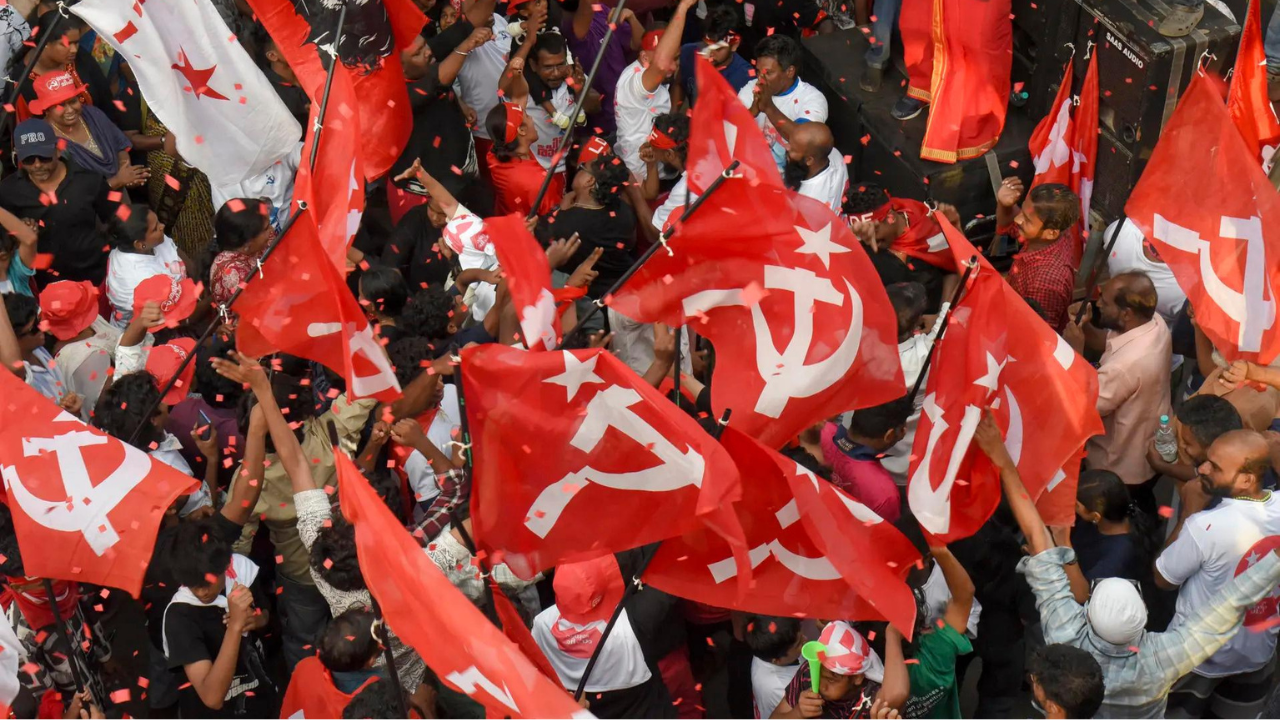
New Delhi: After a decade, Kerala’s compass dial has again turned away from the Left Democratic Front. Due to this, the leftists have no stronghold left in the country. This is the first time in many decades that there is no communist government in any state in India. According to the Election Commission website at the time of writing this article, UDF has won more than 95 seats. LDF was reduced from 94 to about 35 seats. Kerala was never just another state for the Left. after Trinamool Congress finished off cpmAfter 34 years of rule in West Bengal in 2011 and the BJP in 2018 ending the Left Front’s 25-year hold on Tripura, Pinarayi Vijayan’s government stood as the last Red bastion. Its collapse now completes a long political comeback that has transformed the Left from a national power broker to a marginal parliamentary force with six consecutive Lok Sabha MPs. This defeat sends a deeper message than a routine change of government. While Kerala politics has historically swung between the LDF and the Congress-led UDF, the scale of the setbacks, including defeats in traditional CPM strongholds and BJP gains in key constituencies, have raised uncomfortable questions within the party.
Why does this defeat matter?
The CPM’s defeat is not surprising given the trend of changing governments in Kerala, although the party needs serious introspection as it lost its communist-strongholds, including seats in Kannur.Not only this, the Bharatiya Janata Party won three seats in the state assembly – Chathannur, Nemom and Kazhakoottam – which were all held by LDF leaders.Interestingly, the CPM has performed poorly in seats that are traditionally considered its strongholds such as Kannur, Peravoor and other seats in Kannur district.Chief Minister Pinarayi Vijayan, who won from Dharmadam by 19,247 votes, lagged behind in the initial round of counting. The former state health minister, who gained recognition for his handling of Covid 19 in the state, lost the Peravoor seat to Congress’ Sunny Joseph. State education minister and CPM’s V Sivankutty lost the Nemom seat to BJP’s Rajeev Chandrasekhar. Health Minister Veena George lost from Aranmula to Congress’s Abin Varkey Kodiyattu.
Bengal: Where the decline of the Left first became visible
The decline did not start from Kerala. The first major rupture occurred in West Bengal, where the Left Front, led by leaders like Jyoti Basu and Buddhadev Bhattacharya, ruled continuously from 1977 to 2011. What was once seen as the world’s longest-serving elected communist government gradually collapsed under the burden of organizational fatigue, agrarian unrest, and ideological confusion.The turning point came with Singur and Nandigram. The CPM’s push for industrialization through land acquisition sparked violent protests and alienated sections of the rural base that had sustained the Left since Operation Barga and the land reform era. Mamata Banerjee and the Trinamool Congress successfully positioned themselves as defenders of farmers against a party that critics accused of moving away from its traditional social base.The crisis deepened in 2016 when the CPM forged an alliance with the Congress in Bengal – a move that confounded sections of its cadre and supporters who had long viewed the Congress as the party’s key ideological rival. The experiment failed electorally and symbolically, reinforcing the perception that the left no longer had a clear political direction.
Tripura: Citadel collapsed in BJP wave
Tripura’s decline in 2018 was even more sudden. The BJP, which was once electorally insignificant in the state, rode anti-incumbency wave and tribal mobilization to end the 25-year rule of the Left Front. The defeat triggered an internal debate within the CPM over whether the party had failed to recognize the changing political realities and the growing organizational reach of the BJP.This left Kerala as the Left’s last governance model – and ultimately its last major fort. Unlike Bengal, the Kerala unit of the CPM had retained a clear ideological structure and a strong grassroots organisation, which helped the LDF return to power for a second consecutive term in 2021 under Pinarayi Vijayan. The government attempted to combine welfare politics with infrastructure-led development, supporting projects such as Vizhinjam port while expanding social welfare delivery.But the pressure continued to increase. After a decade in office, the Vijayan government faced criticism over anti-incumbency, allegations of corruption, financial stress and concentration of power within the Chief Minister’s office. At the same time, the gradual rise of the BJP in select constituencies and the resurgence of the Congress-led UDF in parliamentary elections began to reshape Kerala’s political arithmetic.The CPM also reorganized its social strategy, seeking closer engagement with influential caste-community organizations such as the NSS and SNDP Yogam while attempting to retain its traditional minority support base. Critics on the left argued that the party’s growing comfort with private capital and identity-based outreach reflected a deeper ideological shift driven by electoral survival rather than political conviction.With Kerala now slipping from its grip, the Left faces its most serious existential question in decades – whether the communist movement in India still has the organizational depth, ideological clarity and social coalition required to remain a major electoral force in contemporary politics.
What is the reason for the decline of Leftism in Kerala?
The LDF’s defeat in Kerala was a combination of anti-incumbency, ideological disorientation, organizational fatigue and the gradual rise of the BJP in the state. After two consecutive terms in power, the CPM-led Left found itself in a more polarized political environment, forcing a political recalibration that critics argued weakened its traditional secular and class-based identity.The Left’s outreach to influential Hindu organizations and temple-related mobilization marked a marked shift in their political message, especially after the Sabarimala controversy. At the same time, comments by senior CPM leaders during the controversies involving Jamaat-e-Islami and allegations of communal violence triggered criticism that the party was increasingly resorting to rhetoric it had historically opposed.The Vijayan government also faced allegations of abandoning grassroots politics in favor of development-based and corporate-backed projects, with the Vizhinjam port becoming a symbol of that change. Criticism from sections of civil society and the opposition intensified as the project received strong government support, along with protests by fishermen and environmental groups.Beyond ideological questions, the LDF also faced increasing governance pressure after almost a decade in office. Allegations of corruption, concerns about unemployment, financial tensions and criticism over the concentration of power within the Chief Minister’s office continued to contribute to voter fatigue.The rise of the BJP further changed Kerala’s traditional bipolar political structure. Its rising vote share, local body gains and first Lok Sabha victory in the state turned many constituencies into a triangular contest, weakening the LDF-UDF binary that had dominated Kerala politics for decades. In the end, the left was caught between maintaining ideological stability and adapting to changing electoral realities – a balancing act that became increasingly difficult to maintain.
The Left is slowly declining at the center
The decline of the Left in India has been gradual but continuous. From winning 59 Lok Sabha seats in 2004 and emerging as a major force behind the UPA government, the Left’s presence has steadily declined to 24 seats in 2009, 10 in 2014, five in 2019 and only six seats today. This slide reflects deep structural problems: the absence of young and dynamic leadership, ideological confusion on issues such as globalization and privatization, and weak engagement with workers and labor groups. Together, these challenges have marginalized the Left in India’s rapidly changing political landscape.
Why is Kerala different from Bengal and Tripura?
The LDF’s defeat in Kerala is unlikely to resemble the decline of the Left in West Bengal or Tripura, where the CPM has steadily lost its organizational base and political relevance. In Kerala, the result is being seen as a return to the long-standing pattern of alternating government formation between the LDF and the UDF in the state.The Left’s victory in 2021 broke Kerala’s four-decade cycle of regime change, largely due to Pinarayi Vijayan’s crisis management during the floods and pandemic. The UDF’s comeback in 2026 therefore suggests a restoration of Kerala’s traditional electoral rhythms rather than a complete rejection of the Left.Unlike Bengal and Tripura, Kerala remains a competitive bipolar contest, where the CPM has retained a strong cadre network and significant vote share. Even after the defeat, the Left is likely to remain a major political force in the state rather than becoming long-term irrelevant.


