



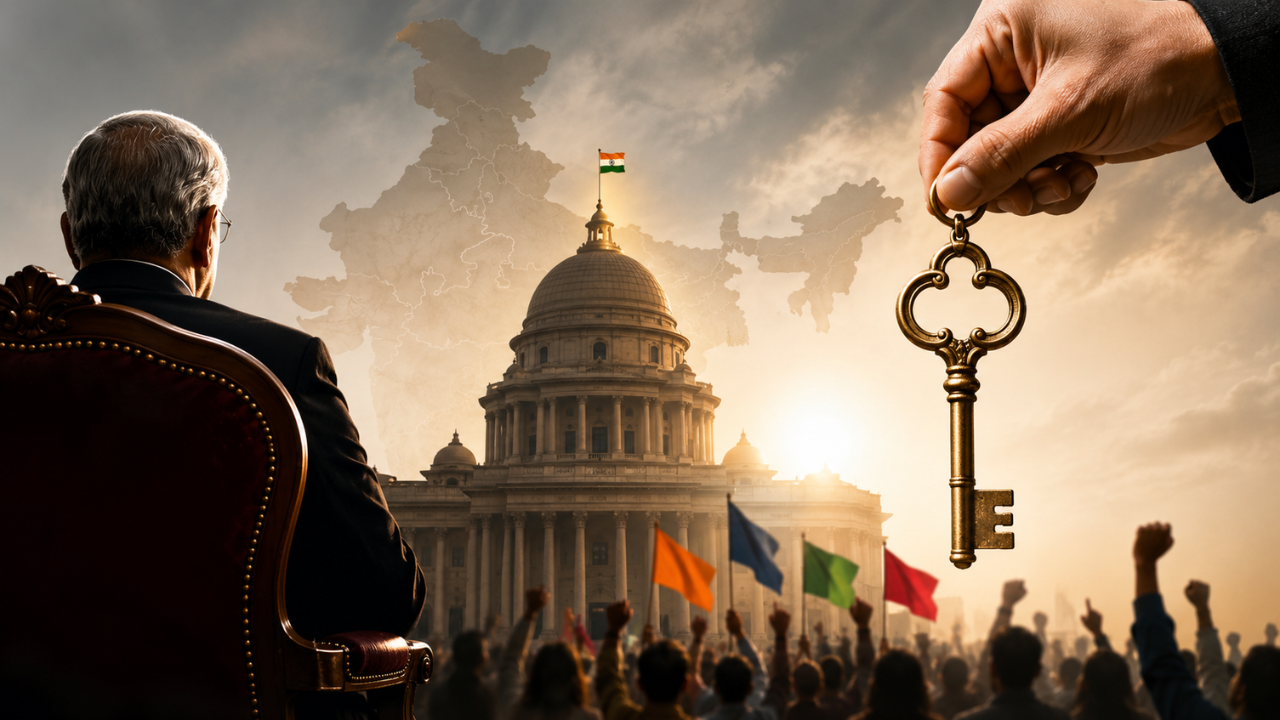
New Delhi: In the world’s largest democracy, election results do not always end the suspense. Sometimes, the real drama begins after the votes are counted – inside the Raj Bhavan.Whenever there is a fractured mandate in an assembly election, the Governor takes center stage and becomes the final arbiter. Political parties rush to support letters, alliances are formed overnight and constitutional debates divide the public.At the heart of the fight is a question: Who gets invited first to form a government?
The Constitution gives the Governor the power to appoint the Chief Minister under Article 164, but it does not clearly state the order in which parties or alliances should be invited. That constitutional gray zone has given rise to some of India’s biggest political conflicts.
in numerical test Tamil Nadu
One such flashpoint was recently in Tamil Nadu when the people of the state voted for Thalapathy.Victory‘ But the actor-politician’s star performance fell just short of “breakthrough”.The entry of Thalapathy Vijay into the electoral scene of Tamil Nadu shook the foundation of Dravidian politics. For almost six decades the state oscillated between DMK and this AIADMK. But the 2026 decision broke that familiar pattern. Barely two years old and contesting assembly elections for the first time, Vijay’s Tamilaga Vettri Kazhagam (TVK) pipped both the Dravidian stalwarts and emerged as the largest party with 108 seats in the 234-member assembly. The Thalapathi wave was so strong that Tamil Nadu’s powerful leader and then Chief Minister MK Stalin failed to retain even his MLA seat.DMK was pushed to 59 seats, while AIADMK was reduced to 47 seats. The message from the voters was clear: Tamil Nadu wanted change. They voted for change. But Vijay fell short of half the mark of 118 runs needed to make the change on his own.Since Vijay himself had contested and won from two constituencies, the effective strength of TVK was 107. Congress with five MLAs made the first big move. In a dramatic change, it broke its 11-year-old alliance with the DMK and extended support to Vijay. Soon after, CPM and CPI, with two MLAs each, also supported TVK from outside. But the numbers still remained low.Then came the rebels and reluctant allies.AMMK MLA S Kamaraj supported Vijay’s camp. The VCK and the IUML, both initially hesitant despite having two seats each, finally joined hands with the TVK after several days of suspenseful negotiations. Only then did Vijay finally get enough support to cross the majority mark and stake claim to power.
The celebration that started over the figures came to a halt midway as Vijay started searching for the figures for the hung assembly. The road to Fort St. George suddenly became a test not of popularity, but of arithmetic. The ball was now in Governor Rajendra Arlekar’s court and he wanted to test the data. After this, discussions, persuasion and political calculations continued behind the scenes for a week.
Raj Bhavan: The last hurdle?
Now the spotlight has shifted from the cine star to the Governor. Armed with assurance of the historic decision and numbers, Vijay went to the Governor in the hope of receiving an invitation. But they were asked to show their marks on paper.Governor Rajendra Arlekar, who was holding additional charge of Tamil Nadu at that time, did not immediately invite Vijay to form the government. The delay sparked intense political and constitutional debate.The Constitution does not provide any rigid formula for how governors should exercise their discretionary powers in such situations.Traditionally, the Governor invites the leader of the largest party or pre-poll alliance able to prove majority. But our political history is replete with moments when this constitutional convention clashed with the political conscience of the Governor, who is often accused of working at the behest of the party ruling at the Centre.
(ANI photo)
Tamil Nadu in 2026 became the latest chapter of that story.After having all the supporting letters and proving majority in numbers, Vijay finally received the Governor’s invitation. On May 10, the actor-politician finally took oath as Chief Minister at the Nehru Indoor Stadium in Chennai and became the first leader outside the DMK-AIADMK duopoly to hold the post since 1967.But the number test was still not over. The Governor gave him three days to prove his numbers in the Assembly, which he did easily.Victory fever not only affected the public but also significantly influenced political circles. The matter went so far that the half-century old party founded by veteran leader MG Ramachandran – AIADMK – split. Current AIADMK boss and former Chief Minister Edappadi Palaniswami could not hold on to his MLAs as a large section of the winning faction emerged as rebels and supported Chief Minister Vijay in the floor test.For Vijay, this was more than a political victory. It was the culmination of his remarkable transformation from cinema icon to chief minister. For Tamil Nadu, it symbolized the collapse of the decades-old political system. And for Indian politics, it was another reminder that in a democracy, the decision of the people may decide the destination, but the journey to power may still depend on negotiations, conferences and the discretion of constitutional offices.
what does the constitution say
Former Lok Sabha secretary general PDT Acharya told TOI, “The Governor cannot insist on a floor test before forming the government. He has the discretionary power to choose any person to form the government. But he must be able to get a majority in the Assembly. The Governor has to decide whether the person he chooses will be able to get a majority or not. He can call the leader of the single largest party to form the government, provided the Governor is satisfied that he can get a majority in the Assembly.“But not everyone agrees how far those powers extend.Senior advocate and former Delhi HC Bar Association president Kirti Uppal argued that being the largest party does not automatically guarantee first invitation.“There is no constitutional rule or absolute right that the largest party be invited first. “Largest party” is a political convention, not a binding constitutional mandate,” Uppal told TOI.
He pointed to Article 163(2), which grants discretionary powers to governors in specific situations.“163(2): If any question arises whether or not any matter is one in respect of which the Governor is required by or under this Constitution to act in his discretion, the decision of the Governor in his discretion shall be final, and the legality of anything done by the Governor shall not be called in question on the ground that he should or should not have acted in his discretion.”Uppal also defended the use of floor tests as the ultimate democratic check.
The Governor can order a floor test at any time, even before the government. During the formation or tenure of the ministry. Ultimately, the floor test is considered the supreme democratic method to test the government’s majority on the floor of the House.
Senior Advocate Kirti Uppal
However, Supreme Court lawyer Vivek Narayan Sharma completely disagreed with the idea of seeking proof of majority before inviting the government for swearing-in.“The governor cannot insist on a floor test before inviting a party to form the government. The floor test is meant constitutionally to test the majority of an already appointed government, not to determine who is appointed in the first place,” Sharma told TOI.“The role of the Governor at the invitation stage is only prima facie satisfaction, not a conclusive decision. The Governor can conduct prima facie scrutiny through letters of support or alliance claims, but cannot insist on a ‘first prove majority, then I will appoint you’ approach as if Raj Bhavan itself is the floor of the House.”
Governors vs Governments : history of fights
That debate is not just theoretical. The country’s political history is replete with examples of friction between the Governor’s office and elected players.In Maharashtra in 2019, the state witnessed one of the most dramatic political twists in recent memory. Governor Bhagat Singh Koshyari administered the oath to Devendra Fadnavis early in the morning with the support of NCP’s Ajit Pawar. Due to lack of numerical strength, the government surprisingly fell within a few days.When BJP’s ally Shiv Sena, led by Uddhav Thackeray, withdrew its support and joined with Congress and other factions of NCP to form its government.A year ago, Karnataka Governor Vajubhai Vala had invited veteran leader BS Yediyurappa to form the government despite the Congress-JD(S) alliance claiming majority support. The Supreme Court had to intervene and order an immediate floor test.In Goa and Manipur in 2017, Congress emerged as the largest party, yet governors invited BJP leaders after the post-poll alliance changed in a numbers game.The tension between governors and elected governments has not been limited to hung assemblies.In Arunachal Pradesh and Uttarakhand in 2016, political crises escalated into full-scale constitutional battles between governors, rebel MLAs and the Centre. In both cases, the courts later reinstated the elected governments.
Article 356 debate
Any discussion on the role of governors will be incomplete without discussing Article 356. There was a time when this provision of the Constitution was used to destabilize state governments, especially if they were in opposition to the party ruling at the Centre.Article 356 allows imposition of President’s rule if the constitutional machinery in a state collapses. And its basis was usually the Governor’s report.
The earliest and most controversial example came in 1959, when the first elected communist government in Kerala, led by EMS Namboodiripad, was dismissed.The landmark SR Bommai vs Union of India judgment subsequently put a major check on the arbitrary use of Article 356, making the floor test the gold standard for proving majority and opening up President’s Rule to judicial review.History is replete with examples of governors using their discretion to dismiss state governments.The interference of governors has long been criticized, with critics arguing that since they are appointed by the Centre, they often act in a partisan manner against opposition-ruled states.Yet, every time election results give a hung mandate, the same political and constitutional questions return. How much discretion should a governor have? Can constitutional power prevail over political arithmetic? And after all, who actually decides the mandate – the House of Assembly or the Raj Bhavan?


