



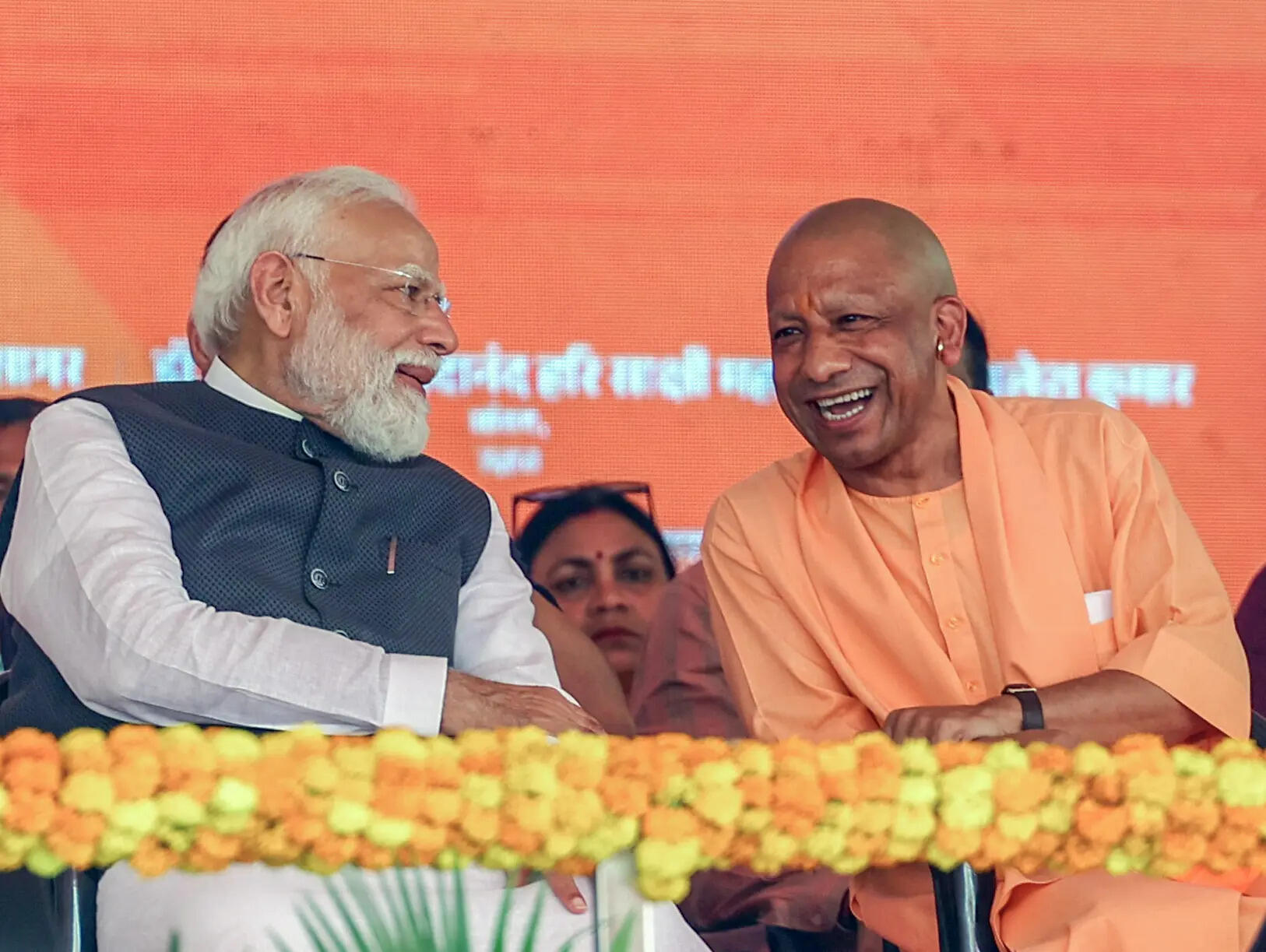
Being the most populous state of the country, Uttar Pradesh – With 80 Lok Sabha seats and 403 assembly constituencies – it is widely seen as the “Gateway to Delhi”. Buoyed by its landslide victory in the recently concluded West Bengal Assembly elections, which brought the party to power in the state for the first time, BJP Now our focus has been shifted to UP. When elections are held in Uttar Pradesh early next year, the saffron party will complete almost a decade in power in the state.A victory here will have far-reaching political implications, especially considering the next Lok Sabha elections to be held in 2029.
BJP’s caste mathematics before 2027
With caste dynamics expected to play a significant role, the BJP government in the state expanded its cabinet earlier this month, less than a year before the crucial elections. Chief Minister Yogi AdityanathSet to make an unprecedented bid for a third consecutive term, former state BJP chief Bhupendra Chaudhary and Samajwadi Party (SP) rebel Manoj Pandey were inducted as cabinet ministers. Kailash Rajput, Hansraj Vishwakarma, Krishna Paswan and Surendra Diler were inducted as ministers of state.Additionally, ministers of state Ajit Singh Pal and Somendr Tomar were made ministers of state with independent charge.Among the new entrants, Chaudhary, Vishwakarma and Rajput are from the Other Backward Class (OBC) category, while Tomar is from the influential Gujjar community, which wields influence in parts of western UP. The Pals represent the Pal community, which has a significant presence in the Kanpur-Agra belt. SP rebel Pandey belongs to the Brahmin community.The cabinet reshuffle was widely seen as an attempt by the BJP to counter its arch rival SP’s “backward, Dalit, minority” (PDA) narrative – referring to backward classes, Dalits and minorities – which has emerged as the central plank of former chief minister Akhilesh Yadav’s political strategy in the state. According to political observers, the SP’s PDA pitch, along with several other factors, played a key role in it winning 37 of the 80 Lok Sabha seats in the state, while the BJP’s seats dropped to just 33 from 62 in 2019 and 71 in 2014.
A Kurmi UP BJP chief
Earlier, in December 2025, the BJP had appointed Union minister and Lok Sabha MP Pankaj Chaudhary as the president of its Uttar Pradesh unit.Chaudhary, like his predecessor Bhupendra Chaudhary, belongs to the Other Backward Class (OBC) and belongs to the Kurmi community.Within the OBCs, Kurmis are the second largest community in Uttar Pradesh after Yadavs. In the 2022 Uttar Pradesh Assembly elections, the highest number of Kurmi candidates were on the BJP ticket with 27 wins. The SP-led alliance also had a notable presence within the community, with 13 of its 125 winning candidates being Kurmi candidates. Among the prominent Kurmi candidates from the opposition was Pallavi Patel of Apna Dal (Kameravadi). Patel defeated Deputy Chief Minister and former state BJP chief Keshav Prasad Maurya from Sirathu assembly constituency by over 7,300 votes.
Yogi Adityanath as CM face
Recently, BJP national president Nitin Nabin had announced that the 2027 Uttar Pradesh assembly elections will be fought under the leadership of Adityanath.
He (Yogi) is our Chief Minister and the government is running under his leadership. So, naturally, the faces will remain the same
Nitin Nabin, BJP President
The endorsement by the party chief not only came as a blow to the Chief Minister, but also effectively put an end to speculations over who would lead the campaign.The announcement was significant because from time to time, speculations of “differences” between Adityanath and the top BJP leadership had resurfaced, as well as rumors that he might be replaced as chief minister.Political analysts say the statement confirms Yogi’s position as the central figure of the party in UP and turns the upcoming election battle into a direct referendum on his governance.
The state which was once known for extortion and crime, is today known for better law and order and expressways.
Nitin Nabin, BJP President
Adityanath was serving his fifth consecutive term in the Lok Sabha as MP from Gorakhpur when he was chosen to lead Uttar Pradesh after the BJP’s landslide victory in 2017, which brought the party back to power in the state after 15 years.That success was widely attributed to the popularity of Prime Minister Narendra Modi. However, Adityanath has since become the BJP’s most prominent Hindutva face, and has earned the nickname “Bulldozer Baba” for his controversial but popular policy of using bulldozers to demolish properties linked to alleged criminals. He is also one of the most sought-after campaigners of the party.
Counter to the statement ‘The Constitution is in danger’
The BJP is also working to counter the opposition’s “Constitution is in danger” narrative at the grassroots level. Experts agree that the campaign played a key role in the party’s setbacks in several states, including UP, which led to the Narendra Modi government losing its parliamentary majority for the first time since coming to power at the Center in 2014.This narrative stems from repeated comments made by BJP leaders about “changing the Constitution” and is further enhanced by PM Modi’s “cross 400” call. The opposition’s campaign resonated with a large section of voters, especially the Scheduled Caste (SC) community, as Dr. BR Ambedkar – widely regarded as the “Father of the Constitution” – belonged to the Dalit community. In Uttar Pradesh, the BJP won only 8 of the 17 SC-reserved constituencies in 2024, down from all 17 in 2014 and 14 in 2019.Admitting that the “Samvidhan” narrative has hurt the party, a UP BJP functionary told The Times of India that the opposition will not be allowed to “mislead” voters this time. “It appears that the opposition is considering the same strategy again, but we will not allow it to influence the voters this time,” he said.According to the 2011 census, the last such exercise before the current census starting in April, India’s Scheduled Caste (SC) population stood at 20.14 crore. Data released by the Central Census Directorate in 2013 showed that with 20.5%, Uttar Pradesh had the highest Scheduled Caste population in the country, followed by West Bengal (10.7%).In Uttar Pradesh, Dalits constitute about 21% of the state’s estimated 241 million population, the second largest share after OBCs (40–50%).
Akhilesh Yadav’s pressure on PDA
Despite the BJP’s comeback after the setback in the general elections – it now rules 21 of the 28 states and union territories, either on its own or with allies – the SP is set to double down on its PDA narrative.A recently released booklet titled “PDA Audit Part-1” is a step in that direction.
They (BJP) are nervous about PDA. They won’t understand what PDA is
-Akhilesh Yadav, SP President
SP supremo Akhilesh Yadav, who served as the Chief Minister of Uttar Pradesh from 2012 to 2017 in his first and so far only term, cited the booklet to accuse the BJP of discrimination against the PDA block. He alleged that under the Yogi government, more than 11,500 posts reserved for candidates from “PDA categories” in 22 recruitment exams in the state have been affected. According to the Socialist Party, the purpose of the “audit” is to draw attention to what they describe as “discrimination” against these social groups in the selection and representation for key government posts, including posts such as District Magistrate and Superintendent of Police, where they allege they are under-represented despite reservation provisions.Yadav coined the term “PDA” in 2023. Together, these three groups account for about 70–75% of the state’s voters, making them a decisive voting block.
Where pollsters see Uttar Pradesh a year before the elections
The election may still be about a year away, but political analysts have already started to paint a picture of the situation – if only for now.Pradeep Gupta’s Axis My India, one of the more reliable pollsters, said the BJP is comfortably ahead of the SP in Uttar Pradesh.“Looking at the overall feedback from Uttar Pradesh, the satisfaction level seems to be strong,” Gupta told PTI.
If we consider the feedback of Uttar Pradesh as a whole, we can say that the satisfaction percentage is good. Keeping this in mind, as the situation stands today, there doesn’t seem to be much trouble (for the BJP) in Uttar Pradesh.
Pradeep Gupta, Axis My India
However, he cautioned that the situation could change “very rapidly” as Uttar Pradesh is a “different kind of state”.Gupta also pointed to the possibility of fragmentation of votes due to the presence of four major players – BJP, SP, Bahujan Samaj Party (BSP) and Congress.
Once SP had formed a majority government with around 26% votes, and Mayawati had done the same with around 29%. So even if one third or about 33% people are satisfied and the votes are divided, the party with 25% (votes) can also win
Pradeep Gupta, Axis My India
For the BJP, often described as a party that is always in “campaign mode”, the battle is already underway – the party is trying to strengthen its social alliance, counter the SP’s PDA narrative and create history by winning for the third consecutive time in Uttar Pradesh.Meanwhile, the challenge for the opposition will be to recapture the momentum that it had generated in the 2024 Lok Sabha elections but has since wasted, and convert this into a sustained electoral challenge against the BJP in the state.


