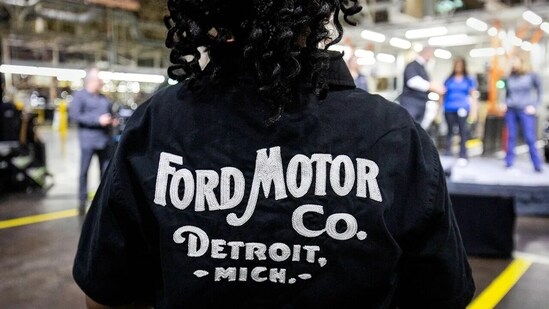
The Art Deco skyscrapers of downtown Detroit, built when money flooded into the Motor City in the 1920s, attest to the early years of America’s long dominance of carmaking. Though the industry’s centre of gravity has shifted to China, the stamp of the “Big Three” on Detroit endures. This year General Motors (GM) opened swish new headquarters. Last year Ford moved house within its home suburb of Dearborn. The American base of Stellantis, of which Chrysler Group is now part (and whose biggest shareholder, Exor, part-owns The Economist’s parent company), is still in Auburn Hills, another suburb.
Photograph: Getty Images
Signs of confidence, or a circling of the wagons? America’s tariffs and regulatory fixes have favoured gas-guzzlers over the electric vehicles gaining popularity elsewhere. Detroit dominates the making of the giant pickup trucks and monster SUVs that Americans love, and which are highly profitable. But in relying on petrol power behind protectionist barriers, America’s carmakers risk falling behind competitors—mainly from China—in an industry that evs will one day take over.
The Big Three have a recent “history of retrenchment”, says Philippe Houchois of Jefferies, a bank. In 1950 three-quarters of the world’s cars were made in America; now barely an eighth are. GM quit Europe in 2017, selling chronically lossmaking Opel to Groupe PSA, now part of Stellantis. Ford’s share of the European market collapsed after it discontinued popular smaller models and failed to excite motorists with its evs. In China, ultra-competitive locals have routed both GM, whose market share has fallen by roughly half in a decade, and Ford, which has lost two-thirds.
In 2004 GM was the world’s biggest carmaker, selling 8.4m vehicles. Last year it was fourth, with 6.2m. Ford has slid from third to seventh. Even at home, the Big Three’s share has dwindled from over 90% in 1965 to 40% or so. Stellantis, a mix of American and European brands formed by the merger of Fiat-Chrysler and PSA in 2021, sold just 1.3m cars in America last year, less than half the tally in 2004.
The supposed safety of insulation from the forces reshaping the industry—electrification and the rise of China—has come at a price. Joe Biden’s administration imposed 100% tariffs on Chinese evs in 2024, shutting out the cars that have rapidly taken nearly a tenth of the European market. Donald Trump’s rolling-back of Mr Biden’s emissions regulations and subsidies for EVs has allowed America’s carmakers to ease up on electrification. But past bullishness on EVs has been costly. Ford wrote down nearly $20bn last year and Stellantis $26bn, mostly for scaling back EV plans; GM took an $8bn hit.
Mr Trump’s trade policies have also hurt. Past free-trade deals encouraged shifting production of cars and parts to Mexico and Canada. Now hefty tariffs on non-American content, intended to bring manufacturing home, have cost Detroit billions. A renegotiation of the latest agreement, due to begin in July, may require even greater American content of vehicles to qualify for tariff-free trade, potentially raising costs further.
Still, in the past year the share prices of Ford and GM have surged (see chart): investors prize the short-term chance to sell petrol vehicles in America for longer. Stellantis, whose shares have shed 30% since Antonio Filosa became its boss last June, is placing a similar bet. A plan unveiled on May 21st proposes that 60% of the €36bn ($42bn) to be invested in its brands in the next four years go to North America, where returns will be greatest. Analysts welcomed the plan, but question whether it can be put into practice.
To focus on the world’s largest car market after China is not exactly daft, even if it has shrunk by around 1m vehicles since the pandemic—to 16m a year—and growth will be sluggish at best. “Our international footprint is smaller than it was historically,” says Paul Jacobson, GM’s chief financial officer, “so we’re primarily focused on our strongest market, North America, and also regions like South America and China.” There is scant foreign competition for the biggest money-spinners, and so far electrification of these has been unsuccessful. Ford discontinued its F-150 Lightning, an electric version of its bestselling pickup, in 2025. gm and Stellantis have scrapped plans to make their big pickups in EV form.
Mark Wakefield of AlixPartners, a consultancy, says the “wall” to keep out the Chinese gives American carmakers the runway and money to catch up. Despite everything, cashflow is buoyant at both GM and Ford. Although some factories once earmarked for ev production are being repurposed for petrol vehicles, Stephanie Brinley of S&P Global, an information provider, points out that ev investment is “shifting in scale but still happening”.
Thus Ford’s “skunkworks” in California brims with software engineers and other techies. A new ev platform that can underpin several models is positioned to go “head to head” with the Chinese, says Andrew Frick, president of Ford’s petrol- and electric-car businesses. The first product, a $30,000 small pickup, is expected by 2027. At GM’s global tech centre in Warren, half an hour’s drive from HQ, work continues on developing batteries with novel lithium and manganese chemistry that will slash costs without hurting performance. Mr Filosa insists that Stellantis is not “abandoning evs” in America and that its large European business and collaboration with Chinese partners mean it will be ready to compete. “Europe is a laboratory for EVs.”
Will this be enough, at least to stay ahead at home? The combination of tariffs, regulations to ban cars with Chinese software and hardware and—in a politically divided country—broad agreement on the threat of Chinese tech, seems a formidable defence. Mr Filosa reflects the thinking of many in Detroit when he says he doesn’t foresee Chinese carmakers in America “at least for a few years”.
But the Chinese are far ahead and it is “only a matter of time” before they arrive, says Charlie Chesbrough of Cox Automotive, a data firm. They are patient. Chery, a state-owned carmaker, says it will launch in America at a “suitable time”. They already have toeholds. Geely, China’s second-largest car company, owns Volvo, a Swedish firm with a factory in South Carolina. It could produce cars there, even under its Chinese Zeekr and Lynk&Co brands. Several Chinese brands have design and R&D centres in America.
Mr Trump also seems open to letting in Chinese firms. In January Detroit’s bosses were aghast when he declared in the city that it would be “great” if the Chinese built factories and provided jobs in America. Jim Farley, Ford’s boss, has said that admitting them would be “devastating”. He has reportedly also suggested that Chinese carmakers be obliged to enter joint ventures under American control.
They are already just across the borders. GAC, another state firm, is about to start assembling cars in Mexico, where Chinese imports have swiftly captured 15% of the market. BYD and Geely are said to be eyeing factories there. BYD is also considering a factory in Canada, which recently agreed to allow annual imports of 49,000 Chinese vehicles with minimal tariffs.
Other foreign carmakers, battling the Chinese around the world, have also been forced to up their ev game. They will surely want to sell in America too. One way or another, competition is coming. The Big Three have their work cut out to live up to Detroit’s past grandeur.
To track the trends shaping commerce, industry and technology, sign up to “The Bottom Line”, our weekly subscriber-only newsletter on global business.