




For millions of salaried employees in India, the Employees’ Provident Fund (EPF) remains one of the most important financial safety nets. It helps build retirement savings, provides support during emergencies and serves as a long-term social security benefit that continues throughout an employee’s working life.India’s provident fund framework has now entered a new phase with the notification of the Employees’ Provident Funds Scheme, 2026 (EPF Scheme, 2026) under the Code on Social Security, 2020. The Ministry of Labour and Employment has also notified the Employees’ Pension Scheme, 2026 and the Employees’ Deposit-Linked Insurance Scheme, 2026, creating a comprehensive social security framework under the Code.The EPF Scheme, 2026 replaces the Employees’ Provident Funds Scheme, 1952, which governed provident fund administration for more than seven decades. Along with the new Scheme, the Government has also introduced special initiatives such as the Employees’ Enrolment Campaign, 2026, VISHWAS, 2026 and AMNESTY, 2026.While the new Scheme retains several familiar features, it also provides greater clarity on membership, contributions, withdrawals and provident fund protections for workers engaged through contractors. For employees, the changes are largely aimed at ensuring continuity, improving flexibility and supporting easier access to benefits.
Existing PF members continue without any disruption
One of the biggest concerns employees often have whenever a new law or scheme is introduced is whether their existing benefits will be affected.The EPF Scheme, 2026 addresses this concern by specifically providing that employees who were members under the EPF Scheme, 1952 will continue as members under the new Scheme. This means employees do not need to worry about losing their accumulated provident fund balances or undergoing a fresh enrolment process merely because the legal framework has changed.For employees who are already contributing to the provident fund, the transition is intended to be seamless. Existing membership continues and accumulated savings remain protected.The Scheme also retains the concept of an “excluded employee”. Employees whose wages exceed the prescribed wage ceiling (currently, Rs. 15,000 per month) at the time they first become eligible for membership continue to remain outside mandatory provident fund coverage, unless covered in accordance with applicable provisions.
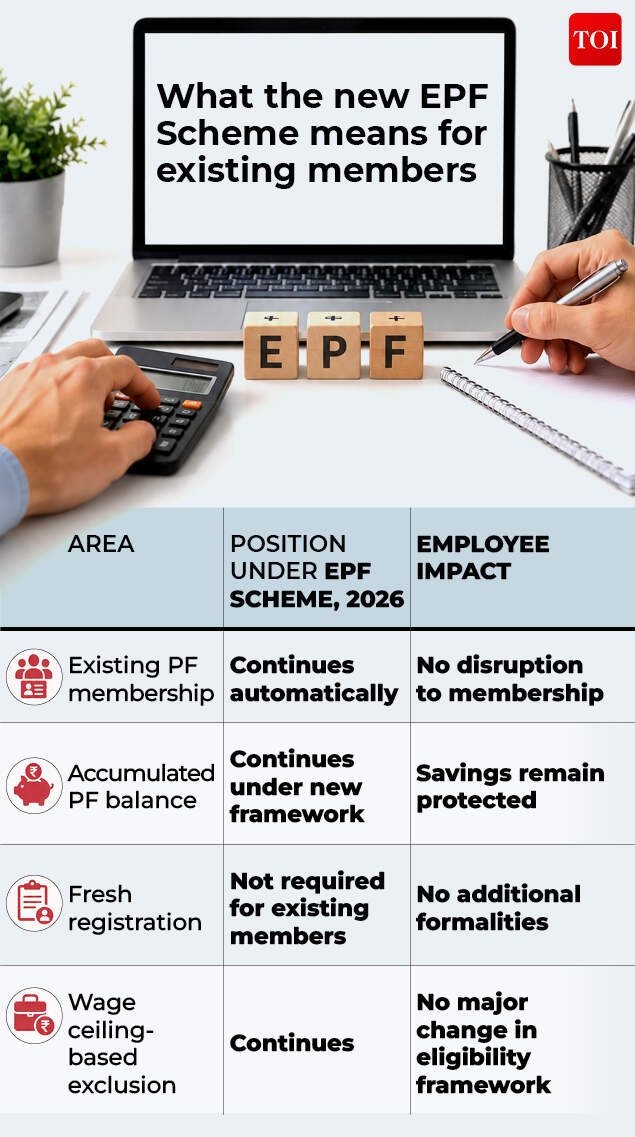
What the new EPF Scheme means for existing members
Greater flexibility to build retirement savings
The most noteworthy employee-focused feature of the new Scheme is the flexibility around provident fund contributions.The EPF Scheme, 2026 requires provident fund contributions at 12% of ‘wages’ from both employer and employee. It also specifically provides that where wages exceed the statutory wage ceiling, mandatory contributions will be restricted to the wage ceiling amount.Considering the current wage ceiling of Rs 15,000 per month, the statutory provident fund contribution is limited to Rs 1,800 per month each from the employer and the employee (12% of Rs 15,000). Any contribution beyond Rs 1,800 per month is voluntary. For instance, where an employee earns wages of Rs 1 lakh per month, the mandatory PF contribution remains Rs 1,800 per month. However, the employee may choose to make an additional voluntary contribution of Rs 10,200 per month (being 12% of Rs 1 lakh, less the statutory contribution of Rs 1,800). The employer may also opt to make a corresponding voluntary contribution.
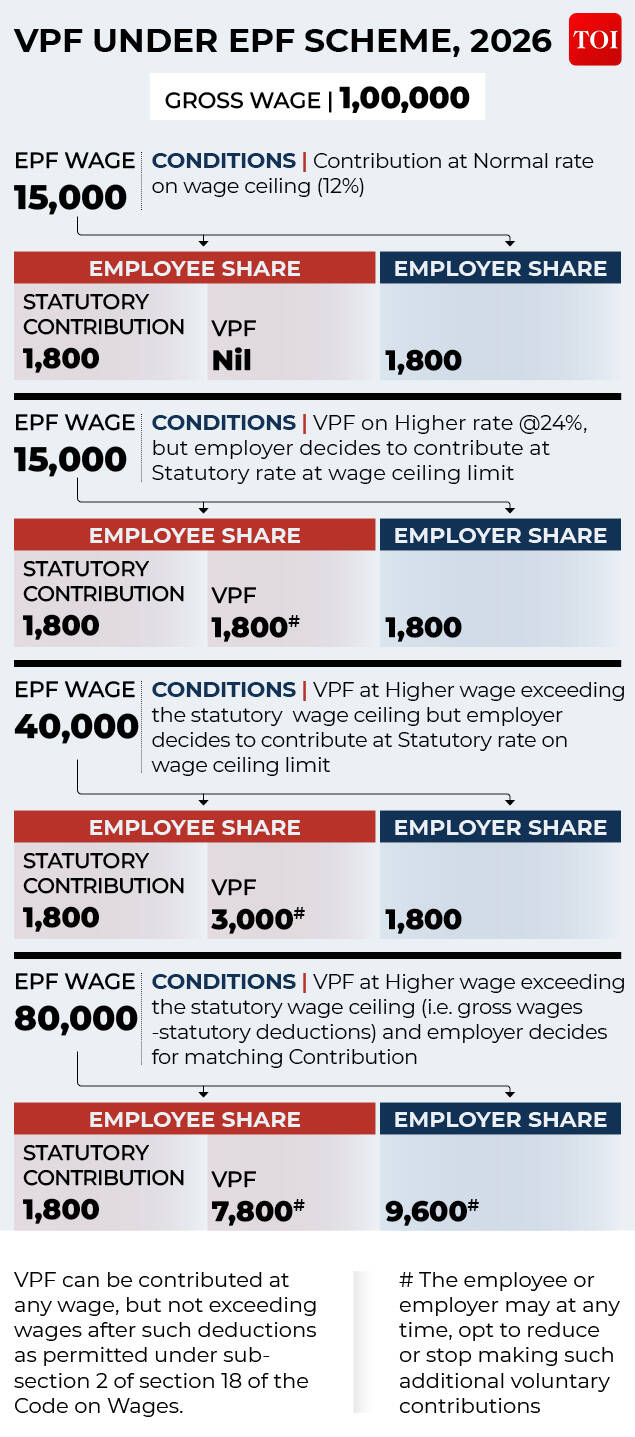
VPF Under EPF Scheme 2026
Employees who wish to build a larger retirement corpus can make voluntary contributions on wages exceeding the statutory wage ceiling or contribute at a rate higher than the prescribed 12%. Employers also have the option to make matching contributions against such voluntary contributions.Importantly, the new Scheme expressly provides that such additional voluntary contributions can subsequently be reduced or discontinued. This gives employees greater flexibility in managing their retirement savings based on changing financial circumstances.This could be particularly relevant for employees in the middle and higher income brackets who may wish to contribute more during certain years and reduce contributions when facing major financial commitments such as purchasing a home, funding higher education or meeting family responsibilities.ExampleConsider an employee earning Rs. 80,000 per month. While mandatory provident fund contributions may be restricted to the statutory wage ceiling, the employee may voluntarily choose to contribute on the full salary to build a larger retirement fund.A few years later, if the employee takes a housing loan and requires greater monthly cash flow, the employee may reduce or discontinue such additional voluntary contributions. The new Scheme expressly recognises this flexibility.For employees, this provides greater control over long-term savings planning without affecting the core provident fund benefits available under the Scheme.
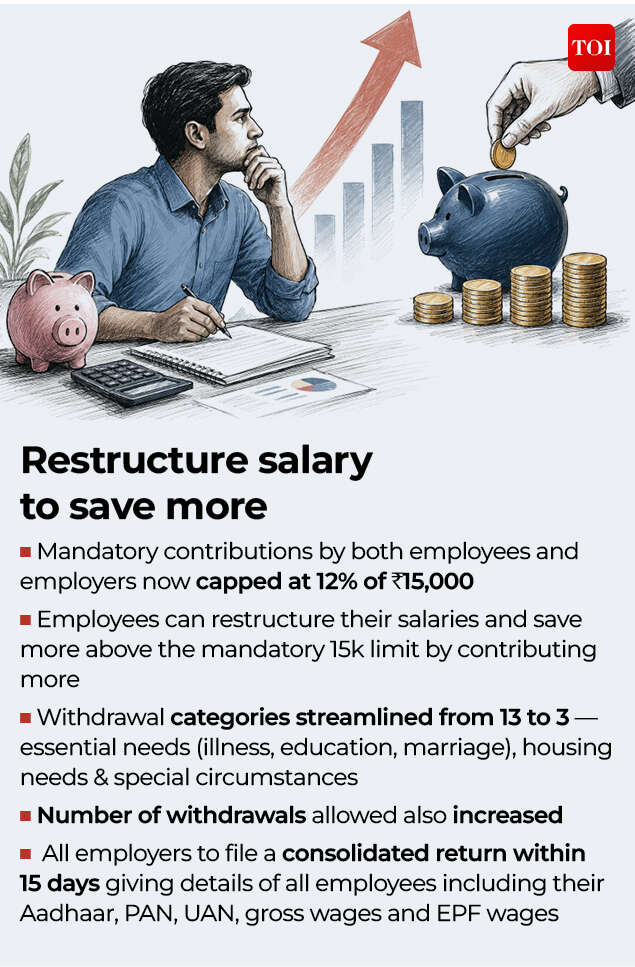
Restructure salary to save more
EPF continues to support important life events
Although provident fund is primarily intended as a retirement savings mechanism, it also serves as a financial safety net during significant life events.The EPF Scheme, 2026 continues to permit withdrawals upon occurrence of specified events such as retirement, migration from India for permanent settlement abroad, taking up employment abroad and other prescribed circumstances.In addition, employees can continue to access partial withdrawals for important needs such as illness, education, marriage and housing requirements, subject to prescribed conditions. This is particularly relevant because many employees use provident fund accumulations not only for retirement planning but also for addressing major financial needs during their working years.The Scheme seeks to balance these objectives by allowing partial withdrawals while also requiring maintenance of a minimum balance of 25% of aggregate total contributions in the Fund.For employees, this approach helps preserve a portion of retirement savings while still allowing access to accumulated funds when genuinely needed.
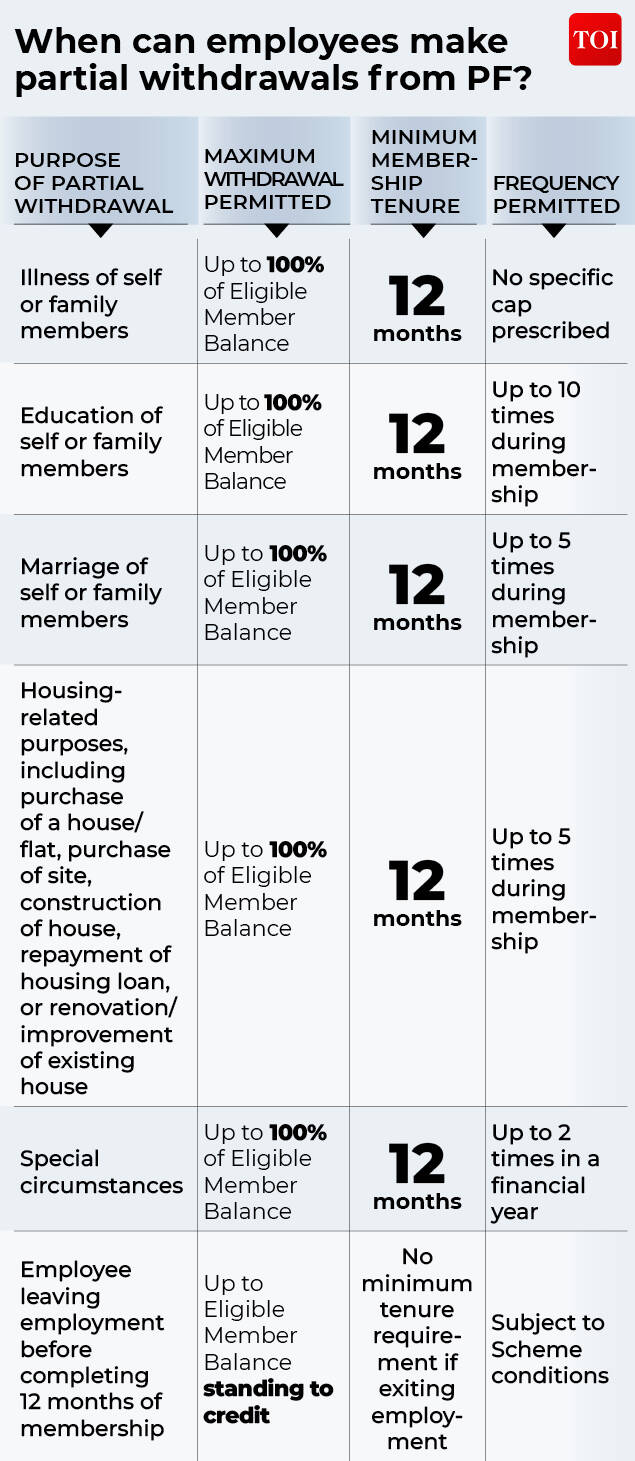
When can employees make partial withdrawals from PF?
Note: “Eligible Member Balance” means the balance standing to the member’s credit after maintaining the minimum balance required under the Scheme. Members are required to maintain a minimum balance equivalent to 25% of aggregate total contributions in the Fund.Partial withdrawals already availed under the earlier scheme will not be counted while determining the number of withdrawals available to a member under the new Scheme.ExampleAn employee facing substantial medical expenses or seeking financial assistance for a child’s higher education may continue to access provident fund savings under the prescribed withdrawal provisions. At the same time, a part of the retirement corpus remains protected for future needs.
Greater protection for contract workers
A significant number of workers in India are engaged through contractors in sectors such as manufacturing, logistics, facility management, security services, hospitality and construction.One of the important features of the EPF Scheme, 2026 is the express recognition of the role of the “principal employer” in relation to employees engaged through contractors.While this may appear to be a compliance-related provision, it has an important employee dimension. The Scheme clarifies that where a contractor is not independently registered, the principal employer is responsible for making provident fund contributions for employees engaged through such contractor.Even where the contractor makes the contributions, the ultimate responsibility continues to remain with the principal employer.For employees engaged through contractors, this provides greater clarity regarding responsibility for provident fund compliance. It reinforces accountability and strengthens the framework intended to protect provident fund benefits for contract workers.
Digital records become even more important
The EPF Scheme, 2026 places greater emphasis on maintaining accurate employee information.Employees are required to provide Aadhaar, Permanent Account Number (PAN), Aadhaar-seeded bank account details and Universal Account Number (UAN) to their employer.For many employees, this may appear to be a procedural requirement. However, accurate and updated records often play an important role in ensuring timely access to provident fund services and benefits.Properly linked information can help reduce processing delays, facilitate smoother withdrawals and support easier portability of provident fund accounts when employees change jobs.Employees should therefore review whether their Aadhaar, PAN, UAN and bank account information are correctly updated and linked.
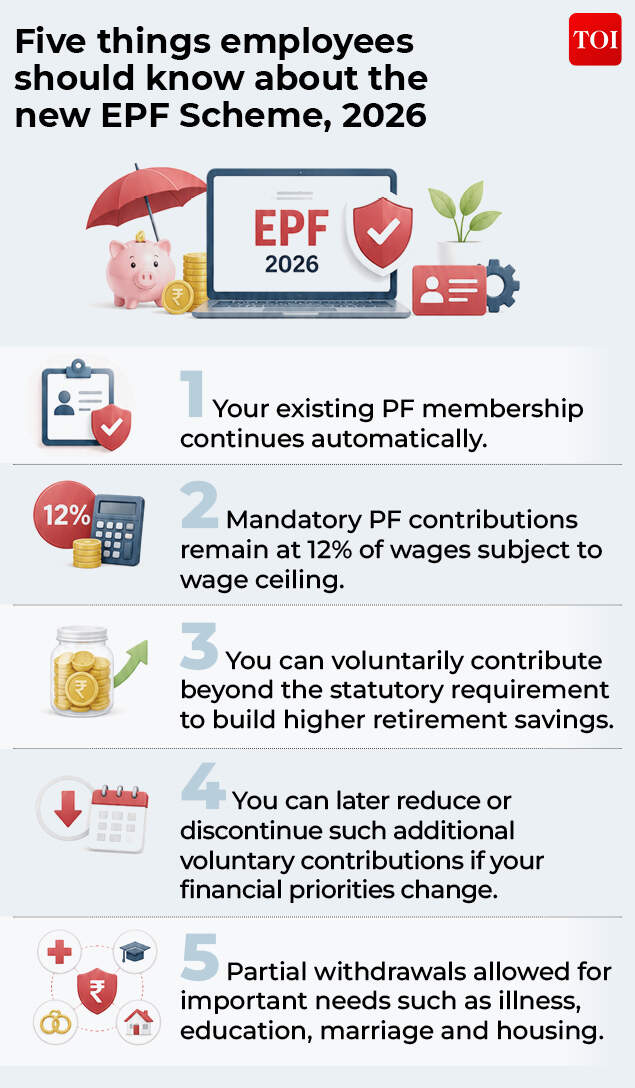
New EPF Scheme 2026: 5 things employees should know
Looking ahead
The EPF Scheme, 2026 is largely a continuity-driven reform that seeks to bring provident fund administration under the Code on Social Security, 2020 while preserving the core protections that employees are familiar with.For employees, the most relevant features are the seamless continuation of membership, greater flexibility in voluntary provident fund contributions, access to partial withdrawals for important life events and stronger accountability mechanisms relating to workers engaged through contractors.At a time when financial security and retirement planning are becoming increasingly important, the new Scheme provides employees with both continuity and greater flexibility. While most existing provident fund arrangements will continue as before, employees would be well advised to familiarise themselves with the new framework and ensure that their personal records remain updated so that they can fully benefit from the social security protections available under the EPF Scheme, 2026.(The author, Puneet Gupta is Partner, People Advisory Services Tax at EY India)


