



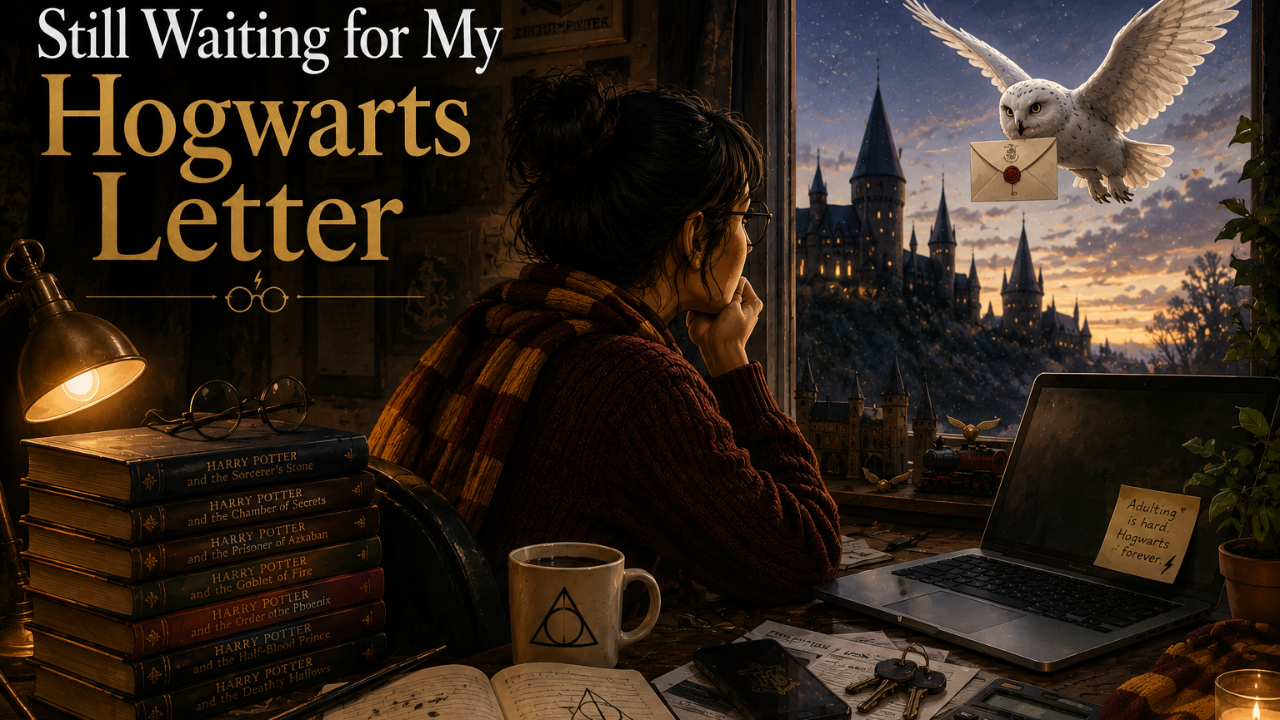
Between paying EMIs, dealing with workplace politics, scrolling through bad news and wondering if adulthood is always meant to feel this way, an entire generation is still waiting for an owl.Millennials know that there are no letters coming from that letterbox and no half-giant named Hagrid is going to knock on the door and announce that you are a wizard. Yet decades after the first Harry Potter book came out, many people still dream of Hogwarts with a devotion bordering on magic.They read books again. They host movie marathons. they sleep stephen fryDescription of his favorite books. They debate whether Snape was a hero or not,’ Dumbledore said calmly. They arrange themselves in the Hogwarts house again and again, hoping that the answer will remain the same. They quote Dumbledore on difficult days and whisper “mischief managed” at the end of the adventure.For the generation that grew up with Harry Potter, Hogwarts was never just a school. This was the second house. And maybe that’s why millennials have never really left.
School children holding the last Harry Potter book in Khan Market, Delhi in 2007. (TOI photo)
The generation that grew up with Harry
Unlike younger readers who discovered all the books in one sitting, the Millennial generation experienced Harry Potter in real time.Zeeshan Khan from Kolkata said, “I first saw Harry Potter and the Philosopher’s Stone in a theater with my brother when I was eleven years old – the same age as Harry. Because of this, I was instantly connected to the story. What attracted me most was the idea that a hidden magical world could exist alongside our own.”They were standing in queues outside bookshops at midnight. He speculated endlessly about Horcruxes and prophecies. He spent years wondering whether Sirius Black was the villain or the victim, whether Dumbledore could be trusted, whether Harry would survive.The story unfolded alongside his own life. “Growing up, Harry Potter was the first thing that really taught me what magic was like. It opened up a whole world that never felt imaginary but felt like it existed beyond our reach. Knowing that Harry and I had the same birthday felt magical to me, too. What I liked most was that everyone saw a little bit of themselves in some character, and it didn’t matter who you were, the stories made you believe that you could be a part of that magic,” said Nakul Jain from Bangalore.When Harry first boarded the Hogwarts Express, there were many millennial children. By the time Deathly Hallows came out, they were teenagers or young adults facing their uncertain futures.
the magic that never dies
In many ways, Harry Potter was not just a book series. It became a shared experience of aging.What started as a magical adventure story about an orphan boy eventually turns into a tale of friendship, love, loss, sacrifice, grief, courage and choosing what is right rather than what is easy.Those themes aged remarkably well as the millennial generation came of age with them.
Hogwarts will always be there to welcome you home.
JK Rowling, author
For many millennia, Hogwarts represented something deeper than escapism. It was a feeling of belonging.“Help will always be given to those who seek help at Hogwarts.” When Dumbledore said this, it filled the heart with a feeling of warmth and trust. It was the fantasy that somewhere in the world there existed a place where weirdness was celebrated, friendships were transformative and courage mattered more than popularity.Zeeshan said, “The thing I love most about Harry Potter is its sense of wonder. It is a story full of magic, mystery, friendship and adventure and it has remained special to me since I first discovered it at the age of eleven.”At an age when many readers were still figuring out who they were, Hogwarts provided language for identity. Part of the enduring appeal of Harry Potter lies in the knowledge scattered throughout the books.
Why is Harry Potter so popular among the younger generation?
Dumbledore’s Army
Many readers first encountered Dumbledore’s quotes as children. As adults they understood them differently.“It’s our choices, Harry, that show who we really are, more than our abilities.”As kids, this seemed inspiring. As adults confront career dilemmas, relationship decisions, moral compromises, and personal failures, this sounds like life advice.The same is true for other favorites: “Happiness can be found even in the darkest of times, if one only remembers to turn on the light.”“As a kid, I connected more with the trio of Hermione, Ron and Harry or even the Malfoys. But when you grow up, and then you re-read it or watch it, you connect a lot more with the adults too. You understand where Dumbledore was coming from. You understand what Sirius Black or Lupine were going through. You understand the politics of the ministry and you connect with it,” Shamin Alauddin said in Delhi. “So I think Harry Potter has that kind of charm that a child can relate to and an adult can relate to.“For a generation that has lived through recessions, pandemics, political turmoil, wars, climate concerns and a constant digital crisis, this line sounds less like imaginary dialogue and more like a survival strategy.Zeeshan said, “My favorite character is Professor Dumbledore because he is intelligent, kind, powerful and always believes in giving people a second chance. I also find Tom Riddle one of the most fascinating characters because of his complex background and obsession with power.”
grew up with harry potter
magic beyond mantras
The series repeatedly reminds readers that evil does not always arrive dramatically. Sometimes it enters institutions silently. Sometimes it takes the form of fear. Sometimes normal people enable this through silence.Harry Potter arrived when social media swallowed childhood, before information became static, before every moment was documented online.Returning to the series often means returning to a version of oneself. The child reading under a blanket with a flashlight, the teen debating theories with friends, the student dreaming about Platform 9¾.In uncertain times, nostalgia works almost like a Patronus charm.Perhaps the most profound reason why the Millennial generation remains connected to Harry Potter is that the story speaks of universal hope. Hope that somewhere beyond the ordinary there exists a world where we truly belong.The Hogwarts letter became a symbol of possibility. Most millennials joke that they are still waiting for them.
Deathly Hallows book launch in Mumbai in 2007. (TOI photo)
Why have some fans distanced themselves from HP?
Since 2020, Rowling has argued that biological sex should remain a legal and social category, particularly in areas such as women’s prisons, sports, changing rooms and rape crisis centres. They have expressed concern that some transgender rights policies could weaken protections for women.Rowling has said that she supports the rights of transgender people to be free from discrimination and violence, but she does not believe that trans women should not be automatically treated the same as biological women in every context.He has criticized concepts such as self-identification (allowing people to legally change their gender without medical requirements) and has supported organizations campaigning for gender-based rights.Due to these posts, the transgender community, LGBTQ+ organizations, and former fans have accused him of promoting views that exclude or stigmatize transgender people, leading to him being labeled a “TERF”. Rowling disputed this characterization, arguing that her views were about protecting women’s rights rather than opposing the transgender community.However, this argument did not appeal to everyone. Priyali Prakash, who started reading Harry Potter as a teenager, said, “For millennials Harry Potter is not just a fictional piece of literature, it showed us how important friendship and human connections are in life. But that said, I am well aware of Rowling’s TERF views and I do not condone them. It’s sad to see what she’s become, but if the cast of the Harry Potter films can distance themselves from her and the world she created, I think fans should be able to accept that too, no matter how heartbreaking it may seem. Reading/watching Harry Potter is a beautiful memory, but we should leave it at that.”
Boy monitors the sale of Harry Potter and the Deathly Hallows books in Bangalore in 2007.
The greatest love story of our generation
For the Boomers, it was the Titanic. For millennia, one of popular culture’s greatest love stories came wrapped in a black robe and years of misunderstanding.After spending six books hating on Severus Snape, readers discovered that the Hogwarts professor they feared most was quietly protecting Harry. His death revealed a truth that shocked the entire generation.This transformed Snape from Hogwarts’ most feared teacher into one of its most tragic personalities – a man who spent his entire life loving someone he could never have and protecting the son who reminded him of both his greatest love and deepest resentment.For many millennia, the revelation has remained one of the most emotional turning points in modern storytelling. Not because it was romantic, but because it was painfully human. It was about regret, sacrifice, loyalty, and the love that endures long after hope is gone.Maybe that’s why Harry Potter has never really lost its magic. The series grew with its readers. What once seemed to be a story of witchcraft and exorcism gradually became a story of friendship, grief, courage, choices and loss.Years have passed since readers first saw Harry in the cupboard under the stairs. The generation that grew up with the Boy Who Lived now has jobs, mortgages, kids, and responsibilities.Still, Hogwarts is crowded. Millennials continue to return to the Great Hall, wander the corridors, revisit Hogsmeade and board the Hogwarts Express whenever life becomes too normal.Because some stories just don’t entertain us.They become part of us.And for the generation that grew up believing that the owl could arrive any day, the magic never really ended.after all this time? Always


