



As air quality plunges in the national capital “Severe Plus” categoryThe Supreme Court earlier this week came down heavily on the Delhi government and the central government’s pollution monitoring agency Commission for Air Quality Management (CAQM) for the delay in implementing stringent restrictions under Phase IV. hierarchical response action plan (Grape).
Earlier this month, the court warned Delhi government for failing to ban the use of firecrackers during Diwali celebrations. In October, it condemned the governments of Punjab and Haryana as well as the Center to impose a minor penalty To burn stubble, which is a major contributor to the region’s pollution crisis.
However, these proceedings appear to follow a worryingly familiar pattern. The judiciary’s focus on pollution intensifies with the onset of autumn, persists through winter and subsides by February. Yet, Delhi’s air quality remains largely unaffected by this circular judicial intervention.
“The air pollution crisis stems from decades of poor planning and policy failures. This cannot be resolved merely through judicial orders issued during periods of intense pollution. “Even with good intentions, the power and ability of the judiciary to address this systemic issue is inherently constrained,” said Ritwik Dutta, environmental law expert and founder of Legal Initiative for Forest and Environment. The Hindu,

long battle
The Supreme Court has been grappling with Delhi’s air pollution crisis for almost four decades. In 1984, environmentalist MC Mehta filed a series of public interest litigations (PILs) addressing three important issues: increasing vehicular pollution in Delhi, environmental degradation of the Taj Mahal, and pollution of the Ganges and Yamuna rivers.
Through these petitions, the Court successively played a quasi-executive role in dealing with the crisis and delivered landmark rulings, resulting in some of the most transformative anti-pollution reforms. The court’s commitment was based on its interpretation of Article 21 of the Constitution, which guarantees the right to life and, by extension, recognizes access to clean air as a fundamental right.
In 1996, the court ordered relocation of polluting industries from residential areas to curb industrial emissions. In 1998, it directed By 2001, all public transport vehicles running on diesel will have to switch to compressed natural gas (CNG). Although air quality initially improved following the directive, passengers and vehicle operators soon faced several practical challenges including severe CNG shortage, frequent cylinder explosions and even vehicle collapse. Fire.
Criticizing the move to encourage greater reliance on private automobiles, Mr. Dutta pointed out that the court failed to anticipate how it would offset the benefits of clean technology.
“Fuel-efficient engines are both economically beneficial and environmentally beneficial. But they also encourage more vehicle purchases and increased travel, thus reducing expected benefits. The government needs to curb the number of vehicles in a city – a policy that will require stringent and unpopular measures”, he said.
In 2015, the top court imposed a temporary ban on diesel vehicles with engines larger than 2,000 cc and imposed environment compensation fee on trucks entering Delhi to curb vehicle emissions. A year later, this ban on sale of firecrackers To prevent seasonal pollution during Diwali.
In 2017, the court approved the Union Environment Ministry’s GRAP – a set of emergency measures that apply when air quality in the Delhi-NCR region reaches a certain limit. One of these measures was “Odd-Even” Vehicle Rationing SchemeWhich allowed vehicles to operate only on alternate days depending on the last digit of their registration number. However, Experts have given the green signal The scheme was largely ineffective due to inadequate public transport options and many exemptions given in it. In particular, two-wheelers, which are equipped with two-stroke engines that burn a mixture of gasoline and oil, producing high emissions, were exempted and continued to run on the roads.
In November 2019, The government was ordered For the smog towers to be set up in the capital by the court, the construction cost of each is around ₹23 crore. However, Research have indicated that such measures are largely ineffective because their impact is limited to the immediate vicinity, leaving the wider urban landscape unaffected. This finding was confirmed by the Delhi Pollution Control Committee (DPCC) when it informed the National Green Tribunal last year that two experimental smog towers in the city had proved ineffective in reducing air pollution.
The issue of stubble burning by farmers has also come under intense scrutiny in recent years, with the court directing state governments in 2019 to take action against the practice. Although CAQM the fine has been doubled For farmers engaging in this practice, the lack of strong financial incentives has made such measures largely ineffective. A typical bureaucratic response to a problem that requires political consent has further compounded farmers’ problems.

lack of political will
Despite these instructions, Delhi continues to be among the cities worst air quality Globally, especially during winter.
Debadityo Sinha, senior resident fellow at the Vidhi Center for Legal Policy, attributes the failure to implement these orders to inadequate accountability mechanisms and lack of political will.
“It is imperative to impose heavy fines to deter polluters and discourage violations. However, judicial directives alone are insufficient; Effective enforcement requires active government cooperation. Unfortunately, there is a severe lack of political will within the government,” Mr Sinha said. The HinduHe further emphasized that anti-pollution measures should be implemented equitably and should not adversely impact the informal sector.
Expressing similar concerns, Mr Dutta remarked that the courts were forced to intervene due to the government’s failure to address the issue.
“The judiciary cannot remain a mute spectator when the Air Quality Index (AQI) reaches dangerous levels. Even in such worrying circumstances, no inter-ministerial or crisis meeting is called by the Environment Ministry to take immediate action. “The government appears to have handed over the responsibility of addressing the city’s pollution crisis to the judiciary, which is a clear abdication of its constitutional duty.”
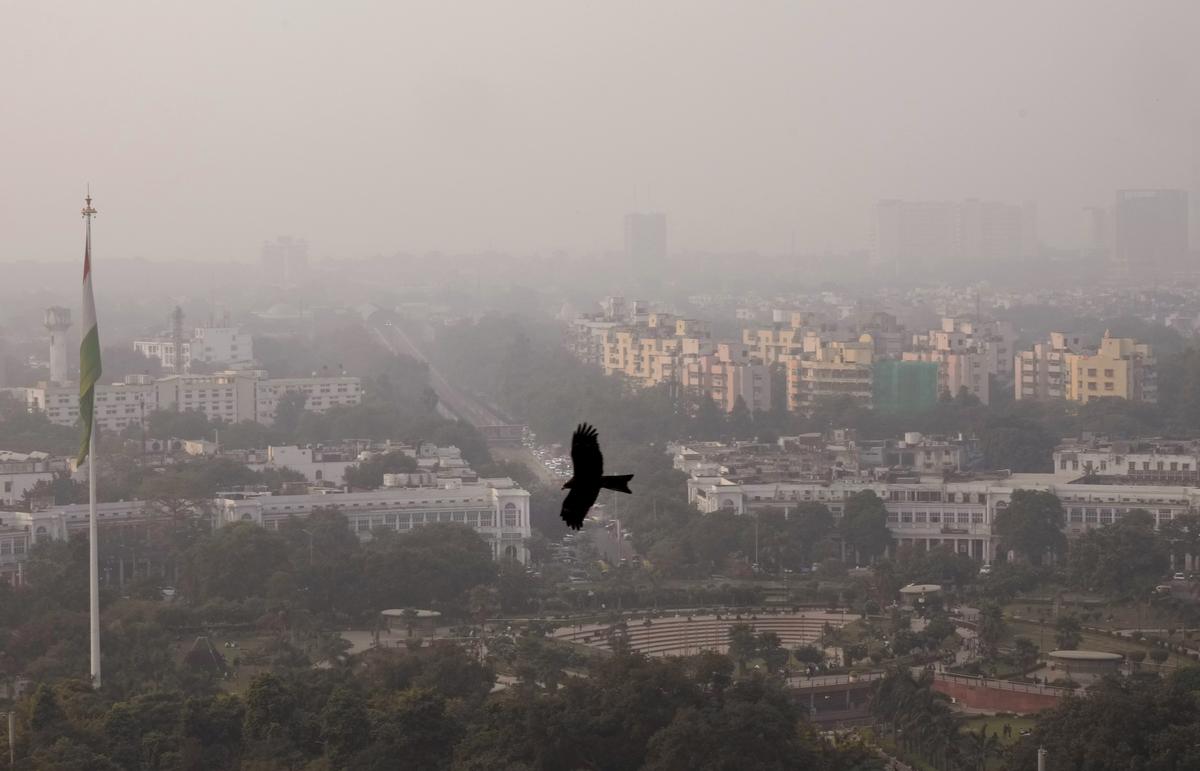
A bird flies amid a thick layer of smog in the sky as air pollution reaches its worst level this season in New Delhi. , Photo Credit: AP
The lack of political will is also reflected in the functioning of the CAQM. Within three years it replaced the Supreme Court-order Environment Pollution (Prevention and Control) Authority (EPCA) As Delhi’s nodal pollution control agency, the CAQM has faced criticism for adopting populist measures and failing to develop the necessary institutional capacity to tackle the city’s air pollution crisis.
“The continued increase in pollution despite the establishment of CAQM highlights its failure. Moreover, the negligible number of complaints filed for violations reflects the mindset that treats air pollution as a mere exception rather than a serious criminal offence”, Mr Dutta said.
It is noteworthy that the Supreme Court had taken cognizance of this on 22 November 2024. The Hindureport of It highlighted that CQAM was aware of a significant increase in incidents of stubble burning by farmers in Punjab and Haryana. This is in stark contrast to the statutory body’s repeated claims before the court of a “significant reduction” in such incidents in recent years. As a result, CAQM was directed to submit the documents cited in the report and provide detailed explanations.
current challenges
Shri Sinha emphasized that there is no quick solution to one of the most serious civic challenges of the capital and a permanent solution can be achieved only if it becomes a major election issue and is given priority throughout the year by the government. Go.
“Despite all our technological advances, the harsh reality is that most cities in India lack even basic air quality monitoring systems. The National Air Quality Monitoring Program (NAMP) has installed only 962 manual monitoring stations in 419 cities. However, there are about 4,000 cities in the country. This means that less than 10% of cities are actively monitoring air pollution, and the situation is even worse in rural areas”, Mr Dutta said.
He further highlighted that recent regulatory reforms have only weakened environmental protection regimes. For example, Public Trust (Amendment of Provisions) Act, 2023had decriminalized offenses under key environmental laws, including the Environment Protection Act, 1986 and the Air (Prevention and Control of Pollution) Act, 1986.
“Instead of the court imposing fine on the violator, the law now hands over all judicial powers to a government servant,” he said.
published – November 23, 2024 01:45 PM IST


