



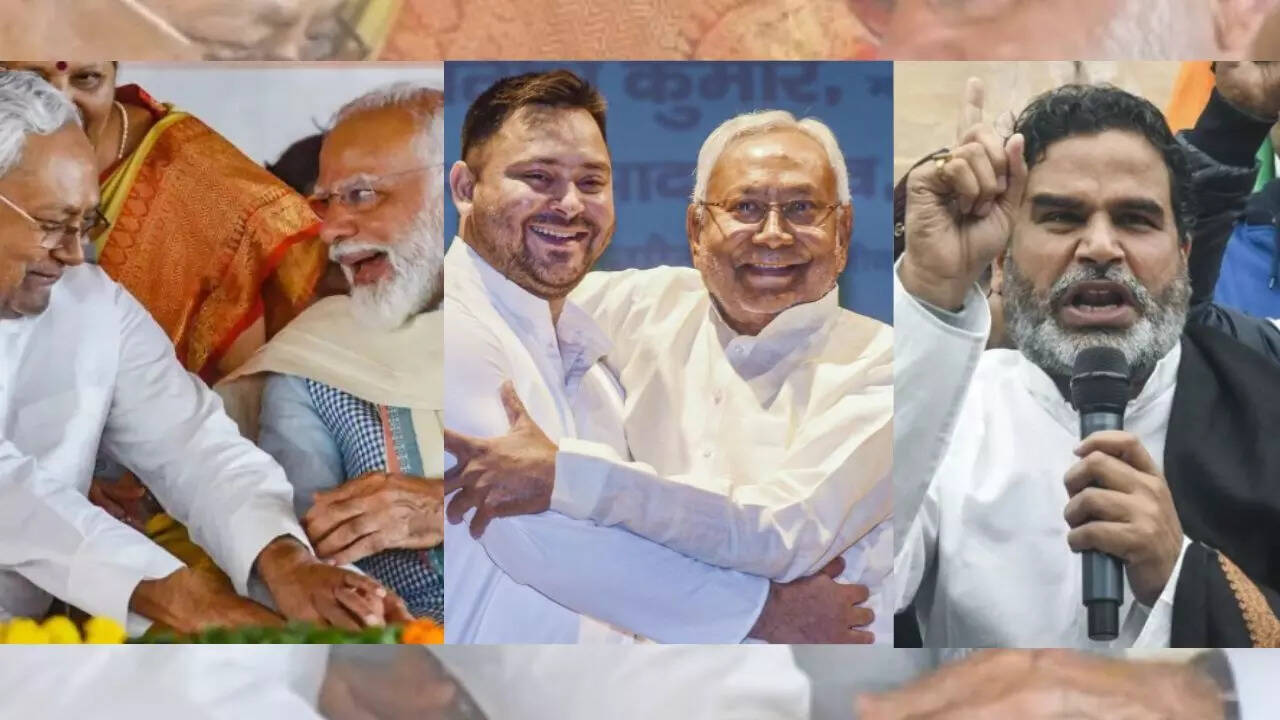
New Delhi: The ‘Teesra Morcha’ (third front) is often like that uncle in an Indian wedding who is not happy with the state of affairs, does nothing, but rarely impacts on the actual celebrations.There is also a rare presence of a third front, reflecting the two-party system at the Centre, with exceptions such as Uttar Pradesh and now Delhi.In Bihar, the date has been set, the red carpet has been rolled out and parties are fighting over who gets the largest share of seats in the alliance. The political arena is dominated by Rashtriya Janata Dal (RJD), Janata Dal (United) and Bharatiya Janata Party (BJP), while there are smaller but notable players like Lok Janshakti Party (LJP), Hindustani Awam Morcha (HAM), Vikassheel Insaan Party (VIP) and Communist Party of India (Marxist–Leninist) CPI. (ML) often floats in and out of alliances, shaping the margins of Bihar politics.Two political parties RJD and JD (U) are ruling the state independently. Nitish KumarThe ‘Aya Ram Gaya Ram’ of this century, who are famous for their alliances to remain in power.The parties that tasted power in the state in the last decade, JD(U), BJP and RJD, have done so as part of an alliance. The Third Front is either almost non-existent or has become a fragmented collection. Without a strong, unified leader or clear social coalition, it struggled to gain popularity and remained marginalized in Bihar’s tightly contested political landscape, but that seems to be no more.
BJP’s Aurangzeb dilemma!
Aurangzeb, the Mughal emperor who extended his empire to its greatest reach in India, was unable to conquer the Maratha strongholds in the west or the Ahom kingdom in the north-east. Currently, the Bharatiya Janata Party directly rules 15 states and six other states in alliance, but is unable to corner Patliputra, and is dependent on the JD(U) both for the lack of a CM face and the JD(U)’s significant voter base among certain caste groups after Sushil Modi’s demise. In the 2020 assembly elections, BJP was the second largest party with 74 seats, JD(U) came third with just 49 seats, but this allowed Nitish to retain the CM seat. However, the dynamics have changed slightly due to the anti-incumbency wave against Nitish Kumar, 20-year voter fatigue and alleged “decline in health”, which is evidenced by the BJP getting a larger share of seats than its “senior” alliance partner in the upcoming elections.
Middle Kingdom Syndrome of JD(U)
Middle Kingdom syndrome refers to a historical, political, and cultural mindset, mostly associated with China, that views itself as the world’s central and most important civilization, while viewing others as subordinate. Nitish Kumar, who has been the Chief Minister of Bihar since 2005, after a brief lull in 2015 when he replaced Jitan Ram Manjhi, has been the central force in Bihar, raising questions about whether the state is ruled by the BJP or the RJD. Kumar has changed sides five times since 2013.Both Kumar’s party King and Kingmaker do not have a large enough vote base to win a majority of seats on their own. According to the 2022 caste census, JDU’s main voter base, Kushwaha and Kurmi, both constitute 4.21% and 2.87% of the population respectively, which is not the case with RJD, which has Muslims (17.7%) and Yadavs (14.26%) as its voter base.
Karna’s stigma: RJD
The Mahabharata character Karna was born to Kunti before his marriage, but due to social stigma Kunti abandoned him and was brought up by a charioteer family. Tejashwi YadavThe RJD leader, though not abandoned by his father Lalu Prasad Yadav, as his brother has done recently, certainly carries the stigma of leading a party whose name has become synonymous with corruption, crime and neglect of development.There was a resurgence of the RJD after it came to power with the support of JD(U) in 2015, but things changed after Nitish came back to the NDA. It became the largest party then and again in 2020, although it missed out on forming the government. The 2025 elections could be Tejashwi Yadav’s best bet so far, as Nitish Kumar faces a clear anti-incumbency wave, and the BJP grapples with internal differences over leadership. Muslim-Yadav social engineering has not proven sufficient to bring him to power on its own. Tejashwi is aiming to capture Bihar in 2025 by carrying on from his father’s legacy and broadening his social alliance. However, the upper castes or upper castes had long ago found solace in the JD(U)-BJP.
Congress, then USSR
Congress, like the USSR, was once a monolithic power controlling vast territories. The oldest party, which was once the “only option” in Indian politics, ruled the state for decades, until the JP movement shocked it and ushered in the era of opposition parties. Over time, caste-based mobilization by the RJD and later by the JD(U) further exacerbated its decline. Its alliance with RJD also prevented it from building an independent identity in Bihar. Like BJP, Congress also does not have any known face in Bihar. The party has struggled to maintain its hold in the state and won only 19 of the 70 seats it contested in the last assembly elections, while the RJD got 75 of the 144 seats. In the 2015 Bihar Legislative Assembly election, the Congress contested 41 seats and won 27 of them, indicating its steady decline.In 2025, the Indian faction is grappling with internal strife over seat sharing, delaying the announcement of candidates and increasing controversies. In several constituencies, both Congress and RJD have fielded their own candidates, turning the contest into a “friendly fight”, threatening to split the alliance’s vote base.On the other hand, the NDA has almost completed its seat-sharing arrangement, with the BJP claiming a larger share of seats than the JD(U), a clear indication of the party getting a dominant position within the alliance.Apart from the wear and tear of the JD(U)-BJP alliance that began in 2005, the occasional truce between non-committal uncle and nephew, and the loose grand alliance between the RJD and the Congress, there is a whole list of political parties that play important roles in state politics, hold large portfolios at the Centre, but could never project a third front, let alone two-four.
Footnotes of Bihar politics
Always present, occasionally noticed, but never the main story. This has been the fate of small but important players in the political theater of Bihar. The Lok Janshakti Party, founded by the late Ram Vilas Paswan and now led by his son Chirag, has retained a strong hold among the SC community, especially the Paswans. In the February 2005 elections, the party won all 29 seats it contested, an achievement that indicated its ability to shape the government of Bihar. It is said that Paswan himself held the key to government formation.But Nitish Kumar’s strategic advances, which included the creation of the “Mahadalit” category, which did not include the Paswans, reduced the LJP’s dominance over Dalit votes. After the death of Ram Vilas Paswan, the split in the party also affected its vote share. LJP has got 29 seats within the NDA alliance this time, indicating that its stance in the alliance has increased the bargaining power of its party.After LJP, CPI(ML)L has made a significant presence in the northern districts of Bihar, winning 12 of the 19 seats it contested in the 2020 assembly elections. Parties like Union Minister Jitan Ram Manjhi’s HAM, Vikassheel Insaan Party, Jan Adhikar Party and Communist Party of India (Marxist) have a relatively small seat base and limited electoral reach. With fewer seats to contest, smaller alliance shares and stiff competition from larger parties, they struggle to make a significant impact on the political landscape of Bihar.Parties from other states have also made inroads in Bihar. The All India Majlis-e-Ittehadul Muslimeen (AIMIM) won five seats for the first time in 2020, mainly in the Seemanchal region. In the last elections, Jharkhand Mukti Morcha (JMM) and Bahujan Samaj Party (BSP) had won one seat each. In the 2025 elections, Asaduddin Owaisi has announced the formation of a third front, the Grand Democratic Alliance (GDA), which will contest at least 64 of the 243 constituencies to give way to other “secular parties”.Meanwhile, JMM has decided to pull out of the electoral fray following a dispute over seat sharing with the Grand Alliance.
Simba (The Lion King):
Simba returns to Pride Rock and reclaims his throne, turning the fortunes of the kingdom around. Prashant KishoreThe strategist living in exile realized he could do much more than he thought. The man who once led the BJP and then the RJD-JD(U) alliance to victory is today being seen as the creator of a possible third front in Bihar. His approach combines grassroots involvement with strategic fielding of candidates who are clean, non-dynastic and committed to social justice through his extensive padayatra across Bihar. Unlike traditional parties, Kishor’s Jan Suraj aims to distance itself from caste-based politics and has repeatedly made it clear that it will not formally join any alliance, distancing itself from the two major fronts.Political analysts suggest that Kishor’s Jan Suraj could act as a disruptive vote cutter, snatching away support from both the major alliances and complicating their path to a majority. Some people also see him as a potential kingmaker or future chief ministerial contender depending on the election results. However, Kishor has announced that he will not contest the elections to focus on organizational work. Combining vote-share disruption with a development-focused agenda, Kishor is being seen as a credible third front in Bihar’s political landscape.The coming elections will be decisive not only for Bihar but also for the idea of a third option in the state. Will Kishor repeat LJP’s limited success of 29 seats, or will he change Bihar’s electoral mathematics by ushering in a new third option, reshaping the political landscape? And if he fails to make an impact, the absence of a viable third front will remain a drawback in Bihar politics.


