



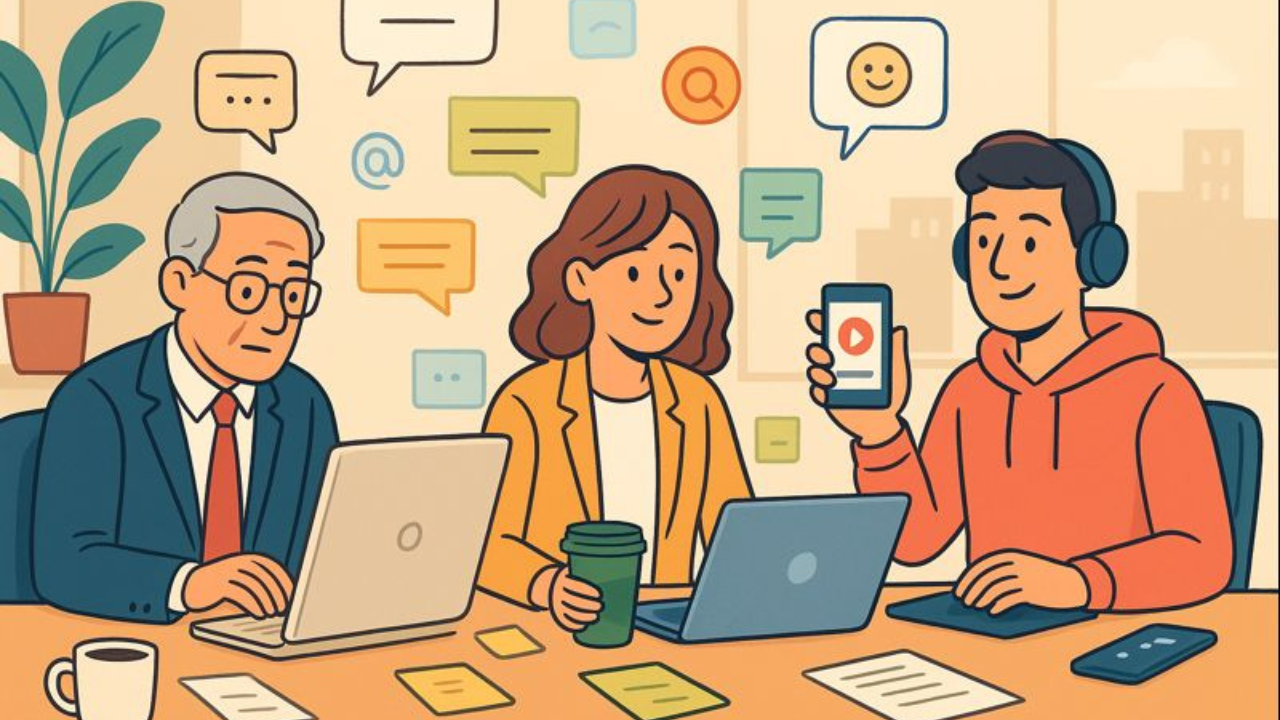
Walk into any corporate office today, and you’re likely to see a scene that feels less like a workplace and more like a group project assigned by the universe. At one end of the floor, a Boomer is carefully crafting an email that starts with “Dear Team,” while a GenZ intern is wondering why the email wasn’t just replaced with a three-second voice note. Sitting between them is a Millennial, with a reusable coffee cup in his hand and the emotional weight of being sandwiched between two generations that insist They Raised the hard way.Welcome to the modern office: a place where three generations collide daily, armed with their own communication styles, work philosophies and keen opinions. For example, is “…” at the end of a message a passive-aggressive statement or simply a grammatically correct continuation. It’s a place where Boomers are still trying to understand why anyone needs a “mental health day,” Millennials are trying to avoid burnout for the third time this quarter, and GenZ is trying to figure out how to turn their hobby into a side hustle during their lunch break.While all three groups technically have similar job descriptions, they often approach work as if they are playing different levels of the same video game. Boomers work by the rule book, because of course there are Is A rule book, and have mastered the fine art of surviving long meetings without blinking. Millennials rely on collaboration, Google Docs, and a strong desire to appear competent at all times. GenZ, meanwhile, is increasingly pursuing corporate life with tabs open to both shared drives and Instagram Reels.Yet, despite all their differences, what makes this inter-generational mash-up particularly entertaining is how much each group recognizes that the other is a little unusual. Boomers think Millennials take too many notes. Millennials think Boomers send emails like they’re writing novels. GenZ believes that everyone sends too many emails overall.Still somehow the work gets done. Projects get completed, presentations are given, and HR quietly updates its conflict-resolution guidelines every quarter. What looks like chaos from the outside is, in fact, a delicate balancing act: Boomers bring stability, Millennials bring efficiency, and GenZ brings innovation with existential comedy.So if you’ve ever wondered why the office feels like it’s missing a laugh track in a sitcom, you’re simply watching the daily dance of three generations trying their best to navigate a changing work culture, one shared spreadsheet and one misunderstood emoji at a time.
From landline to livestream: how growing up online changed the way we work
Baby Boomers or Boomers, Millennials, and Generation Z are often talked about in shorthand, but each group has its own background and work style that is shaped by the time in which they grew up. Baby Boomers, born roughly between 1946 and 1964, are the only generation officially defined by the US Census Bureau, a government body, named after the surge in births following World War Two, as cited by the BBC. In the workplace, they are known for being committed, self-reliant, and competitive, qualities that probably come from growing up in a crowded, fast-paced world where standing out matters.Millennials, born between approximately 1980 and the mid-1990s, are the most debated and stereotyped generation, often inaccurately labeled “lazy” or frivolous. In fact, they were the first true digital natives, who grew up alongside the Internet, which made them confident, curious, and highly self-reliant.
AI generated image
GenZ, the youngest group, includes people born in the late 1990s or early 2000s and have never seen a world without smartphones, social media, or constant connectivity. Often called iGen, they are ambitious, tech-savvy and confident, entering workplaces with new expectations and an intuitive comfort with digital tools. Together, these generations bring very different perspectives to the same office floor, shaped not only by age, but also by history, technology, and the world they grew up in.
Hanging out, calling it in: How three generations are quietly (and not so quietly) redefining office life
When asked, “What’s one workplace habit of older generations that absolutely surprises you?” Generation Z member Aastha Jha didn’t hesitate: “Be ready whenever the company demands.” Soumya Banerjee, who works in an IT firm, expressed a different frustration. He pointed to a familiar pattern seen among seniors: “Always comparing who gets more done and who doesn’t, mostly in a fun way but sometimes it makes you nervous.”The troubles of a millennium are quite different. When asked how it feels to be sandwiched between Boomers and GenZ, Natasha said, “While Millennials are on the receiving end of Boomer toxic culture, it’s a nice place to be. While we grew up hearing stories of when they had to work through serious physical ailments, the humor of a GenZ asking for time off because they’re ‘not feeling the vibe’ isn’t lost on you.,Sneha had a simple answer to the question whether she ever felt guilty about logging off at the right time: Yes. I don’t care.When a Boomer was asked, ‘What’s the biggest change you’ve seen in workplace culture?’, the response reflected decades of experience: “There has been a huge change in workplace culture in 20-25 years, and most of the changes have been for the better. The pace of work has increased, and people have adapted to that pace. Twenty-five years ago, no matter what field you were working in, the availability of technical tools was not so easy. There was no AI, social media or even computers were not used as actively as they are currently. Therefore, the pace has increased with the advent of new technology. And secondly, you have young workforce in every sector. People are taking up responsibilities which only a senior person can take up.”This reflection from someone who has been part of the workforce for the last 30 years highlights how technology and a young workforce have increasingly reshaped the way work gets done.He also said that the younger generation needs to develop ‘ownership of work’, something they can learn from the work ethic of the older generation. “People do a lot of work, but sometimes you feel like they don’t have any ownership over that specific work,” he said.On the other hand, HR professionals today find themselves acting as cultural interpreters, peacekeepers as they juggle the competing expectations of all three generations. They must balance Boomers’ preference for structure and visibility with Millennials’ need for flexibility and Gen Z’s emphasis on boundaries and mental well-being. This often means redesigning policies, rewriting communication norms, and mediating misunderstandings that arise from everything from email etiquette to attitudes toward overtime. For HR, the challenge isn’t to pick sides, it’s to create a workplace ecosystem where all three generations feel heard, respected, and able to collaborate without turning every team meeting into a generational tug-of-war.When asked whether any significant changes have been made in the recruitment strategy to accommodate young professionals, KaranAn HR executive said, “There has been a significant change in strategy, with authenticity and investment in marketability now being prioritized to secure the latest wave of talent. The messaging focuses less on abstract corporate rhetoric and more on demonstrating the company’s commitment to concrete skills development and job security, which appeals directly to the risk-averse nature of young professionals. Recruitment outreach focuses on high-engagement digital platforms and exclusive professional networks, employing candid employee testimonials to convey a transparent, genuine culture.He also points out that for Millennials, staying with a company often depends on seeing a clear, fast-paced career path and knowing that the organization is truly committed to social impact through its CSR or ESG efforts. When it comes to older professionals, he says the key is to keep them in meaningful advisory roles and provide strong technical support, so that their deep experience and institutional knowledge remains an active part of the company’s modern, hybrid way of working.Ultimately, the generational divide in today’s workplaces is less about conflict and more about coexistence in transition. Boomers, Millennials, and GenZ are all responding in different ways to the same pressures, faster work, changing technologies, and evolving ideas of success that are shaped by their experiences. As adaptations continue in offices, the challenge is not to declare one generation “right” and another “wrong,” but to find common ground where experience meets adaptability and ambition meets balance. As work culture evolves, offices have the opportunity to become places that value both productivity and people, whether it’s through a formal “Dear Team”, impromptu log-off, or a “no vibes today” day off.


