



The United States remains a top destination for international students worldwide due to its strong economy, world-class institutions, and “can-do” atmosphere. Today India sends the largest number of students to America and is leaving behind China, which earlier held the first position. But will Trump’s return to power affect the influx of international students to the US? The US also has some of the top ranked institutions in the world. However, is ranking the major factor that students should consider when choosing a higher-education college?
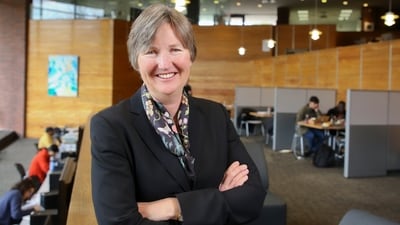
To answer some of the pressing questions from international students, especially those from India, HT Digital spoke to Katherine Grady, Dean of Brandeis International Business School. With her impressive credentials and educational journey spanning Princeton, Columbia, Oxford and Tulane University, Katherine brings a unique perspective on education, career opportunities and the evolving demands of the global job market.
In this in-depth conversation, Katherine discusses why the US remains the top choice for ambitious students, the role of rankings, and how Brandeis programs prepare students for the emerging job market. She also highlights career options for economics graduates, the growing impact of AI in business education, and how Indian students are thriving at Brandeis.
For those who wish to pursue an education abroad, Katherine’s advice provides invaluable clarity on choosing academic options, exploring career options, and getting the most out of a U.S. education.
Here are edited excerpts from that interview:
Why do students globally wish to study in the US? What is it about America that attracts them?
Without getting too transactional, I would say that the economy is booming right now, and with that comes tremendous opportunities for everyone. America has always been a place where people aspire to be. I’ve lived in the UK for 14 years and I love Oxford—it’s beautiful—and London is incredibly cosmopolitan. But when it came to my family, with three young children and all girls, we felt the opportunities were better in America.
Personally, Brandeis has provided me with even more excellent opportunities as a professor, and it has been a great journey for us. All three of my daughters started robotics at an early age. Two are still in school, and one has graduated from a top engineering program. America offers a “can do” environment. I grew up in a small town in Florida and attended Tulane on a full scholarship and it shaped my belief that it doesn’t matter where you come from, you can achieve anything here.
So, yes, the opportunities and experiences attract students to America, but you should also ask the students themselves what they think.
How do you think Trump’s potential return to the presidency might affect the influx of students to American universities?
It is important to remember that there was no reduction in H-1B visas during Trump’s first term as President. His mentors include tech entrepreneurs who need talent, and there aren’t enough American students filling roles in fields like engineering, computer science and finance.
For high-skilled students, I guess there will be no significant problems. However, for students studying humanities or liberal arts, the situation is more challenging, and students should know this. Are you familiar with STEM vs. non-STEM designations? All of our business school programs are STEM-designated, allowing students to stay for up to three years after graduation. For humanities programs, you can only stay one year, and it is hard for both international and domestic humanities students to find a job in this environment.
You have been enrolled in some of the top universities in the world. What advice would you give to students who want to study in prestigious institutions?
Getting into a top university should not be the end goal. It is important to focus on more than just gaining admission. The ultimate goal should be what you are getting from your education – how prepared you are to succeed in your career and in your life.
Take the example of Brandeis University, a small private research institution with excellent academics, top-notch professors, and a strong publication record. But we’re not as big as other schools, which sometimes works against us in some ranking methods. But we consider our size a unique strength. At Brandeis, students receive an excellent education, and an important part of that is their ability to form lasting relationships with their peers, their professors, and our alumni.
Interestingly, engineering students may find it more challenging to excel at more prominent state universities than at a place like Harvard, which does not place as much emphasis on engineering. My advice is to look beyond the rankings. Talk to students and professors at the universities you are considering. Find out where professors got their PhDs. Remember, you can get an excellent education at many institutions.
Nowadays, students rely heavily on the rankings of institutions while choosing a college to study. Should they focus on those or consider other factors?
Rankings matter to some extent, but it’s not the whole story. As I mentioned, we consider our size a strength at Brandeis – and among America’s small universities we rank second only to Caltech in Times Higher Education. Being small means students get the chance to work closely with professors and build strong relationships. Rankings can help, but students need to know deeper.
You are a distinguished professor of economics. Many students want to make their career in economics. How has the study of economics evolved over the years?
The basic principles are the same, but there have been significant changes. Today, students need to be more tech-savvy. Programming and modeling are essential skills that were not as important when I went to graduate school. Additionally, most published research is now data-centric. Thirty years ago, this was not the case. The availability of data has transformed the field. Another change is the rise of large research groups. In the past, research often involved a professor and a few students. However, it now allows five or six professors to work together, almost like a laboratory structure.
Does having larger research groups and access to larger amounts of data make research more complex?
It does, but it also allows for much more ambitious projects. When I did my research, I created the first dataset on art auctions. I went to Christie’s in London, sat in their basement and manually recorded data from their catalogue. Today, data is available everywhere, although it often comes at a cost. The accessibility and volume of data has fundamentally changed the nature of research.
How important is the knowledge of mathematics for economics students? Is the study of mathematics mandatory if one wants to study advanced economics?
When I graduated a few years ago, I majored in math. So yes, I would recommend doing as much math or computer science as you can. Even if you are doing economics, combine it with mathematics or computer science. This gives you a better perspective on the topic and helps you understand the details of the theory and statistics you are applying when analyzing data.
What career options are available today for students choosing economics at the higher level, especially given the research opportunities and the emerging job market?
Here we are not just talking about Master but about PhD. They should keep an open mind and do only what interests them. It is important to write a good thesis and perform well, so focus on your interests. Also keep an eye on the market to see what kind of economists are in demand. There are huge opportunities right now, especially in the private sector. When I graduated, most economists went to universities or government jobs, but now there are really interesting private sector jobs. Amazon, Google, and hedge funds all employ economists. There is a new wave of opportunities in the private sector. It is making more noise than before.
Let’s talk about Brandeis. What types of programs attract Indian students to Brandeis?
In the Business School, we have a Master of Science in Business Analytics, a Master of Science in Finance, an MBA, and a Master and PhD in International Economics and Finance. Historically, we have had many Indian students.
How does Brandeis prepare students for today’s changing job market?
Over the summer, students send in their resumes and our career coaches check them over to make sure everything looks good. When they arrive, they take credit-bearing courses to learn how to write cover letters, understand different job roles, and develop networking skills. We also have networking events like Speed Networking Nights, where students can talk to alumni. Throughout their time here, each program has a career coach who helps them – through mock interviews, treks to companies, internships and field projects.
Have curriculum changes been made to integrate more technology into courses?
Absolutely. We began to integrate data courses into our Master of Arts in International Economics and Finance and MBA programs, which led to the creation of our Master of Science in Business Analytics in 2018. We were one of the first business schools in the US to offer this. Fintech concentration in our Master of Science in Finance program. Now, we are launching the AI concentration. We are committed to integrating AI into all our courses.
Do you have programs focused on understanding the financial markets?
Yes. Our Master of Science in Finance program is a strong program. Many of our alumni go to Wall Street. We often take groups on overnight trips to New York where they visit companies like JP Morgan and Goldman Sachs, we call these trips Industry Treks and they allow our students to connect with alumni who work there. And provide the opportunity to gain a solid understanding of the industry. , Fidelity in Boston is a close industry partner for field projects.
What kind of placements do Indian students get after graduating from Brandeis?
Our Indian students get placed in top companies. Top students may get jobs at BlackRock or E&Y. For business analytics, we place students at Amazon and Google. I am proud to say that most of our Indian students achieve good jobs in various industries. Of our recent Indian alumni (Classes 21-23), 100% were employed and 97% were employed in the US.
What financial aid or scholarships are available for Indian students?
We are committed to making graduate business education possible for students around the world. Admitted students starting their Business Master’s program in the fall of 2025 will automatically receive a generous scholarship covering 50% of their tuition


