



Kolkata’s night skyline has changed over the past year, with 50 heritage buildings now bathed in warm yellow light, giving the entire city a mesmerizing glow. Iconic landmarks such as the General Post Office, Chowringhee Mansion, the Old Mint and the Queen’s Mansion have been illuminated, bringing their architectural grandeur to life after dark.
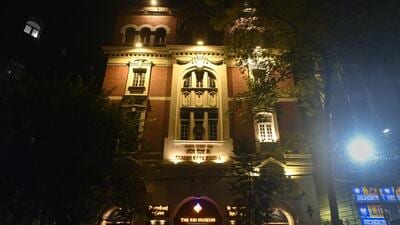
This amazing transformation has been made possible through a crowdfunding initiative led by a citizens’ group, Kolkata Restorers. The group aims to light up 50 more buildings by next year, adding even more sparkle to the City of Joy’s nighttime glory.
“The project started with painting the dome in Maniktala market and repairing the clock with my own money. But when I realized that it would not be visible at night, I asked the owner for permission to burn it. When I got the cost estimate from a lighting designer, I realized I would need some crowdfunding for its lighting,” says Mudar Patheria, who anchored the project and was instrumental in starting the crowdfunding initiative.
Patherya sent a few WhatsApp messages to some high-net-worth individuals in his circle and managed to secure his required amount of money. “With the money I got, I managed to light two buildings. I was amazed to see that Kolkata has some of the most magnificent buildings that can be transformed with light,” he says.
So, he sent another message to 15 people, telling them how he had lit up two buildings. Patheraya asked for Rs 5 lakh. By the next morning, he was up 55 lakhs. So far, he has collected 90 lakhs for the ongoing project.
Patheria believes that illuminating these buildings will highlight their historical importance and redefine their neighborhood. “Lighting up these landmarks creates a sense of identity and pride for the community. We have established trust and credibility, so it will be easy to raise funds for the remaining buildings. When people see tangible results, they are willing to contribute. This crowdfunding model for urban regeneration can be easily replicated in other cities,” he said.
untapped potential
Globally, this approach has funded public art, parks, playgrounds, and heritage conservation efforts, directly engaging communities. Indian cities, most of which are constrained by tight municipal budgets, have not yet explored the potential of crowdfunding for urban rejuvenation. The success of Kolkata’s citizen-driven initiative to illuminate heritage buildings underlines the untapped opportunities offered by crowdfunding to transform urban spaces in India.
A November 2022 World Bank report estimates that India needs to invest $840 billion over the next 15 years in urban infrastructure to effectively meet the needs of its rapidly growing urban population, or an average of $55 billion per year. Will be required. Currently, the central and state governments finance over 75% of city infrastructure, while urban local bodies (ULBs) contribute 15% through their own surplus revenue. Currently only 5% of the infrastructure needs of Indian cities are being financed from private sources.
“Crowdfunding has immense potential, especially for small-scale projects like restoring heritage sites or creating public spaces that connect deeply with people. This approach has its roots in India’s cultural traditions – think of community-driven efforts to build a temple or school through ‘chanda’. I believe that crowdfunding can significantly complement traditional financing mechanisms,” says Dikshu Kukreja, urban designer and principal architect at CP Kukreja Architects.
He says crowdfunding presents a mix of challenges as well as opportunities for shaping urban spaces in India. “Building trust among contributors is a big challenge, especially in a country where people are often skeptical about how funds are used. Therefore, it is important to ensure transparency in resource allocation and impact. Integrating crowdfunded resources into formal urban planning involves administrative complexities that need to be handled carefully,” he says.
Encouraging community participation
Urban finance expert Ravikant Joshi says crowdfunding has great potential to encourage community participation and collaboration with the government to finance local projects such as community gardens, playgrounds, libraries and community centres. “When local bodies work with citizens on a project, it helps build trust and cooperation between the two, which is often lacking in governance today,” he says.
“In any crowdfunding campaign, a hybrid model combining direct citizen contributions with government funds will work best. However, officials have to give up the ‘mai-baap’ (patriarchal) attitude and involve people in decision making,” says Joshi.
However, he expresses doubt as to whether municipalities – most of which, he says, have not already made efforts to secure available CSR funds – will take the initiative to create and support such campaigns.
“This crowd-sourcing initiative needs to be government-led as such projects require multiple permissions,” says KK Pandey, who teaches urban management and finance at the Indian Institute of Public Administration. “However, citizens should be involved in monitoring to ensure transparency. The government can run campaigns, provide match funding. In many cities, residents’ welfare associations (RWAs) have already taken up the responsibility of maintaining parks and lakes. This model just needs to be taken forward,” he added.
Kukreja says crowdfunding provides an opportunity to engage India’s diaspora, whose emotional ties to their cities make them potential contributors to such efforts. “Digital platforms can play a vital role by simplifying outreach and making it easier to raise funds from contributors around the world.”
global success
Crowdfunding has fueled a number of successful urban rejuvenation projects around the world, including the High Line in New York City, where an abandoned railway was transformed into a vibrant urban park, and Finsbury Park in London, which was built using community contributions. Was restored with. Another extraordinary thing is the Luchtsingel pedestrian bridge in Rotterdam, a 400 meter long structure that reconnects three city districts.
In recent years, online platforms such as Spacehive in the UK and IOB in the US have transformed the funding of civilian projects. On any given day, Spacehive organizes several campaigns daily for projects such as parks, gardens, playgrounds, road infrastructure, public artwork and the revitalization of city centers and local markets. Similarly, IOB focuses on supporting efforts in grassroots initiatives, urban gardening, safe streets and public art.
But in India, crowdfunding platforms like Keto are mainly used to raise funds for patients with serious illnesses who do not have access to adequate health care financing. Despite being highly effective in this sector, their potential to transform urban spaces in India is yet to be explored.
“So far, we have seen few drives for civic projects, including cleaning the lake or repairing potholes on roads. But I think our platform has huge potential in funding small civic projects for which people currently approach local municipal councilors and MLAs for funding, which doesn’t always work,” said Founder and CEO of Ketto. Varun Seth says. “Most of our donors are in metro cities, so I believe crowdfunding campaigns on our platform will be more successful for projects in these cities. Such projects should be divided into milestones with funding in phases.
“To make an impact, crowdfunding needs to be done on a large scale and it needs to be sustainable,” says Milan Mhaske, CEO of Praja Foundation, which works to promote accountability in urban governance. There needs to be a clear model with proper guidelines and norms on how to use the money and acknowledge people’s contributions. I think true acknowledgment is an important incentive for people.”
But some people may question why they should contribute when they are already paying taxes. “Mandatory tax payments and voluntary donations to projects are different. Taxes fund many public services while crowdfunding for projects is an individual choice, often driven by a community’s desire to improve local infrastructure or meet specific needs. So, I don’t think it could be a challenge,” he says.
Indore, a city at the forefront of innovative fundraising methods including an oversubscribed green bond for the construction of a solar plant last year, has also experimented with crowdfunding in some areas of the city. “In industrial areas and illegal colonies, when people asked us to give priority to roads, we asked them to collect funds, in which we had a major contribution. And people have contributed. We will also explore crowdfunding for other projects,” says Indore Mayor Pushyamitra Bhargava.


