



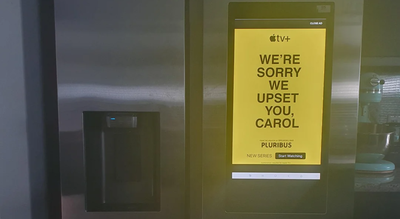
Over the past week, a claim has circulated widely online suggesting that a smart fridge advertisement triggered a psychotic episode in a UK woman, leading to her hospitalisation. The story spread rapidly across Reddit, X, and tabloid news sites, prompting alarm, sympathy, and a broader debate about advertising inside the home. For readers encountering this for the first time, the claim centres on a Reddit post published in the r/LegalAdviceUK subreddit. The post was written by a user who said their sister, diagnosed with schizophrenia and with a documented history of periodic psychotic episodes, believed her fridge was communicating directly with her. According to the post, this belief led the woman to admit herself to hospital for monitoring.The advert was tied to Pluribus, a new Apple TV+ series created by Vince Gilligan, best known for Breaking Bad and Better Call Saul, with Rhea Seehorn playing a character named Carol. The campaign included advertisements appearing on the screens of certain smart fridges, displaying unsettling messages tied to the show’s themes.
What the Reddit post claimed
In the original post the Reddit user explained that their sister had recently been discharged after spending two days under medical supervision. The sister, they wrote, believed she was experiencing the onset of a psychotic episode after seeing a message appear on her smart fridge’s screen.The message, read: “WE’RE SORRY WE UPSET YOU, CAROL.” It was displayed in stark lettering against a yellow background. To the sister, who, the post said, has schizophrenia and a history of psychotic episodes roughly every two years, the message felt personal, targeted, and alarming. She believed the fridge was communicating with her.Fearing she was losing touch with reality, she drove herself to hospital and spent two days under observation. Her medication was reviewed. The user said that the incident led clinicians to reassess her antipsychotic medication. Several days after bringing their sister home, the user claimed they encountered the same message while scrolling through social media, this time clearly labelled as an advert for Pluribus. They sent a screenshot to their sister, who allegedly confirmed that this was the exact message she had seen. The post concluded with a legal question: whether it was permissible for advertisements to appear on household appliances in this way, particularly when the advertiser could not know who would see them.
How the story spread, and why it resonated
Screenshots of the Reddit post began circulating across X, Facebook and Instagram, often accompanied by captions expressing shock or anger at the idea of advertising inside domestic appliances. Several tabloids were quick to pick up the story, in some cases linking it to Samsung smart fridges specifically, despite the original post not naming a brand. Some coverage framed the incident as an example of technology “going too far,” while others focused on its mental health implications. Users reacted in markedly different ways. Many expressed sympathy for the woman described in the post, particularly given her existing diagnosis. Others questioned why a fridge would display adverts at all, or why consumers would purchase appliances with screens connected to the internet. A recurring response was that even without a psychiatric condition, an unsolicited message addressing someone by name could be unsettling. Several users said they would likely panic or assume a malfunction if their fridge behaved similarly. At the same time, scepticism emerged quickly. Some users pointed out that smart fridges displaying promotional content is not new, and that such features are typically disclosed in product terms. Others questioned the plausibility of the sequence of events as described.
The advert itself, and the timeline questions
The Pluribus advert referenced in the post does exist. Images shared online show a fridge screen displaying the message “WE’RE SORRY WE UPSET YOU, CAROL” against a stark yellow background. The image that circulated most widely, and that many tabloids and social media posts later reused, originated from a separate Reddit post titled “Apparently my Samsung fridge has ads now…”, shared by a user named Shellnanigans. That original post focused on how to disable advertising on a Samsung smart fridge, which is where the brand association appears to have come from, despite the later legal advice post not naming a manufacturer.Weeks later, after the “Carol” story went viral, Shellnanigans edited their original post to clarify the situation. In a second edit, they wrote: “Hello, I am the original poster of the Carol AD image from a month ago. I am a male from America and my name is not Carol. The story about a schizophrenic woman named Carol was most likely inspired from the 3rd top comment on this post.” They also flagged their own suspicion, labelling it “Inspired post?,” and linked directly to the now-viral r/LegalAdviceUK thread.That earlier comment, which users later resurfaced, read: “Just imagine your name is Carol, you’re in psychosis, and you see this on your fridge…” Its existence, and its timing, added a new layer of scepticism to the viral claim without definitively disproving it. The timing matters. That comment appeared approximately three weeks before the viral Reddit post. This overlap has led some to suggest that the Reddit story may have been inspired by the comment rather than the other way around. Further scrutiny showed that the Reddit account used to publish the legal advice post was newly created. While this does not prove fabrication, throwaway accounts are common in sensitive discussions, it added to doubts among readers. No independent verification of the hospitalisation has emerged. No journalists have been able to contact the individuals involved, and no medical or legal documentation has been provided publicly.
What can, and can’t, be concluded
At present, there is no definitive proof that the incident occurred exactly as described. There is also no definitive proof that it did not. The story sits in an ambiguous space that is increasingly common online, where plausible claims spread faster than they can be substantiated. Legally, experts and commenters broadly agree that advertising on smart appliances is permitted in the UK if users have agreed to the device’s terms and have not disabled such features. Ethically, opinions are more divided. Advertising inside private domestic spaces raises concerns about consent, predictability, and psychological impact, particularly when campaigns are intentionally unsettling. Even if the Reddit post was fictional or exaggerated, it resonated because it highlighted something real: the discomfort many people feel about invasive technology operating inside their homes without clear boundaries. Whether this specific incident happened exactly as claimed remains unclear. What is clear is that the idea of a fridge delivering targeted, unsettling messages struck a nerve, and that alone was enough to propel the story across the internet.


