



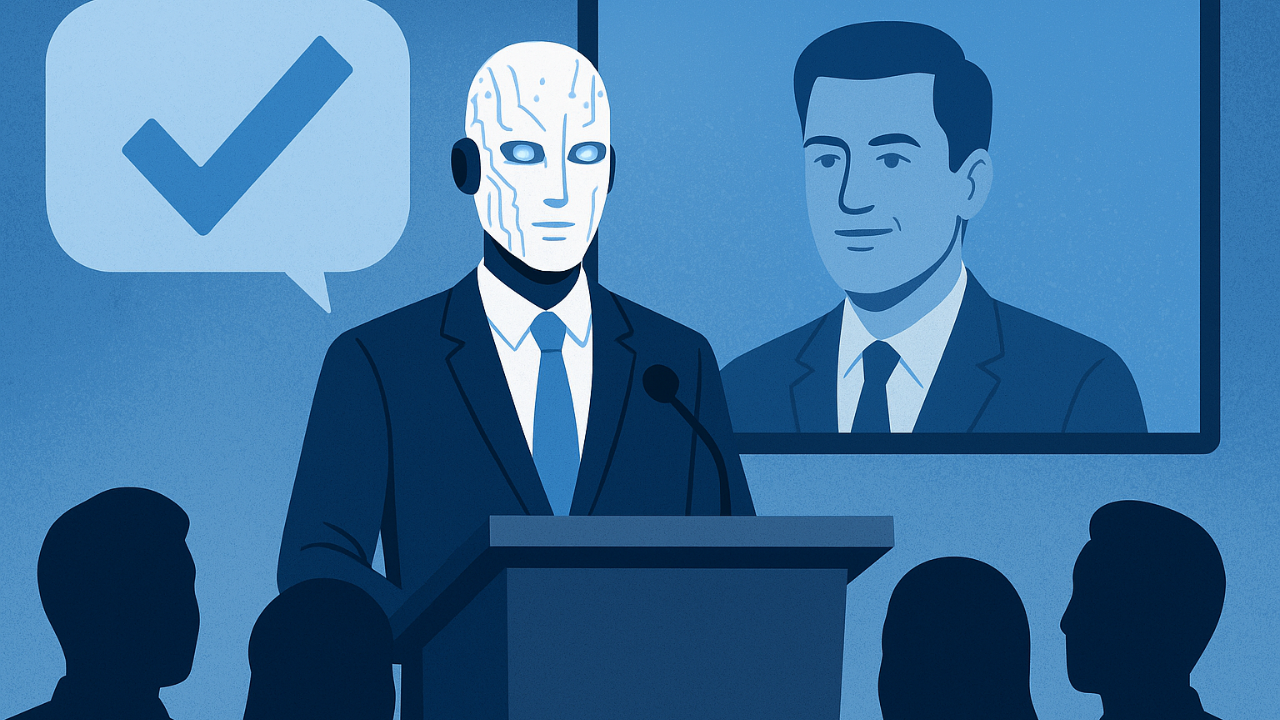
New Delhi: For a decade, Prashant Kishor has been the undisputed master architect of India’s elections, the strategist who can bend narratives, build alliances and turn emotions into seats to steer leading politicians to victory. However, the 2025 Bihar Assembly elections delivered a shock: Kishor, despite months of padyatra, booth-level outreach and the full weight of Jan Suraj, failed to win a single seat.This disappointment was more than a personal shock. It signaled a change already unfolding beneath the surface: the old era of political strategy, built on instinct, experience and human networks, is being steadily eclipsed by a new actor who never tires, never forgets and never stops adapting.2020 has introduced a political strategist unlike any before: Artificial Intelligence (AI).Always awake, endlessly scalable and able to generate personalized persuasion at a fraction of the cost of a traditional campaign team. By 2025, Impact will no longer be created by professionals in war rooms; It is engineered by algorithms to suit the mood of voters in real time.
The story is no longer just about deepfakes. It is no longer just about copying politicians or reviving long-dead icons of the political past. The greater threat and opportunity lies in AI’s ability to convince. Studies published this year show that AI chatbots can change voting trends at far greater rates than traditional advertising. There was a time when politicians needed speeches, rallies and media placements to move the needle. In 2024, a ten-message exchange with a chatbot has been shown to have greater impact than a multimillion-dollar television campaign.
How has AI slipped in the polls?
Artificial intelligence has entered election campaigns around the world not as a novelty but as a tool of influence. In the 2024 Lok Sabha elections, political parties used generative AI to navigate the linguistic diversity of the country, translate speeches into regional languages, and produce personalized outreach that addresses local audiences.The AI tool also created images, videos and voice clips that were shared widely on social media and messaging apps, blurring the line between real and fake political content. In the United States, AI was used less to regurgitate statistics than to shape narratives. Advanced models generated millions of messages, memes, and automated responses designed to appeal to specific voter groups, turning mass campaigns into hyper-targeted persuasion. MIT researchers have documented how AI can produce and test myriad versions of political content, learning over time which messages resonate most.
Okay, but why should I care?
What makes the current wave of AI so powerful is not just its reach, but also its accuracy. Campaign technology can create content not only for broad demographics, but also for specific segments – and increasingly individuals.
Using voter data and language models, parties can now create personalized videos, voice messages or WhatsApp clips that address voters by name or reference hyper-local issues. In India’s 2024 elections, some campaigns reportedly used AI to send personalized campaign messages to local volunteers or voters with voice-cloned content that made it sound as if a regional leader was speaking directly to them.Here’s an example: Below are two images put together – one is real, and the other has been altered using AI. Can you tell which is which?
If you’re comfortable with the technology, the “obvious” choice might be the right-hand image as an AI-generated image. But in a world already overloaded with information and shrinking attention spans, it is easy for many people to become misled.Not long ago, creating this kind of edit with traditional software took hours of careful work. Now, AI can create it in minutes with nothing more than a simple prompt.
How did India compete with AI in elections?
India’s size, linguistic diversity and huge WhatsApp economy have made it a vibrant laboratory for election-grade AI. During the 2024 Lok Sabha campaign, parties experimented with voice clones, personalized videos and hyper-local ads, which would have once required expensive local teams. Media reporting found that synthetic video and voice cloning were deployed to reach voters in their own languages and dialects, sometimes reviving familiar faces to inspire nostalgia or loyalty. Deepfakes of late leaders like M Karunanidhi and audio clones of Jayalalitha were circulated at campaign centers and on WhatsApp.The 2025 Delhi election cycle portrayed a similar duality of benefits and risks. The parties used AI to create smart creatives and chatbots that answered voters’ questions about municipal plans and voting logistics.Meanwhile, rival campaigns weaponized visuals and memes, many created by AI, to caricature opponents and stoke outrage on social platforms.
Bihar showed how regulators and institutions need to align. Ahead of state elections, officials demand labels and disclosures for AI content and warned parties about misuse. The Election Commission issued an advisory asking parties to identify AI-generated or digitally enhanced content and immediately remove misleading content. This reflects growing official concern that unlabeled synthetic media could distort voters’ understanding of where, when and how to vote.
When the dead returned on campaign
In Tamil Nadu Politics, AI’s impact reaches into the dramatic realm. Actor-politician Vijay’s party, Tamizhaga Vetri Kazhagam (TVK), released an AI-generated video that shows rival DMK’s iconic founder CN Annadurai, who is seen supporting Vijay’s leadership. mk stalinThe synthetic material, using the late leader’s likeness and voice pattern in the context of the campaign, attracted widespread attention for its audacity and emotional appeal,
What AI can do: A brief practical guide
AI platforms can be combined into simple, high-impact campaign stacks.Real-time translation and localization: Tools like the Government of India’s Bhashini are already being used to translate speeches in real-time and reach multilingual audiences in a single event. This makes national data understandable across linguistic divides. Personalized media: AI can put a person’s name into a video or voice message, speak in a local dialect, and reference a local plan to create a one-to-one conversation experience.Chatbots and P2P messaging: Campaign chatbots on messaging apps can answer voter questions, persuade undecided voters, and provide step-by-step voting information. Initial field tests show that conversation bots can modestly boost turnout when used responsibly.Synthetic resurrection: Voice cloning and facial generation can create the speech and visuals of living or dead public figures. It can be used for commemoration or to enhance nostalgia, but it also creates a powerful vector for deception.Micro-testing at scale: AI enables the automated generation of hundreds of message permutations and near-instant A/B testing to find out which language or framing works for which segments.
Ethical and regulatory fault lines
The promise of AI for civic inclusion is real. Translation and simplification can make the policy accessible. Chatbots can help elderly or remote voters get voting details. Yet the same features that improve outreach also enable fraud on a larger scale. The question facing democracies is not whether to use AI, but how to shape rules and infrastructure so that the technology empowers voters, not predators.Regulatory responses are emerging. The Election Commission has sought to require prominent labeling of synthetic materials and direct parties to maintain records of AI-generated campaign materials. The platform has experimented with provenance labels and advertising disclosure rules. At the technical level, researchers and agencies emphasize watermarking, provenance metadata, and traceability tools.
The strategist is no longer a human being
The lesson from recent elections is clear: AI has not stolen votes, but it has quietly entered the game, learning faster and getting tougher with every cycle. Its impact depends on public awareness, transparency and ethical use.Campaigns always involve a combination of messaging, persuasion and spectacle. AI doesn’t change politics; It accelerates it, accelerates it, and takes it beyond human limits. Just as TV reshaped image and social media reshaped attention, AI is reshaping belief.The strategist is no longer just a human being. That voice in your phone, that video in your feed, even that argument that swayed you may never have come from a person.


