



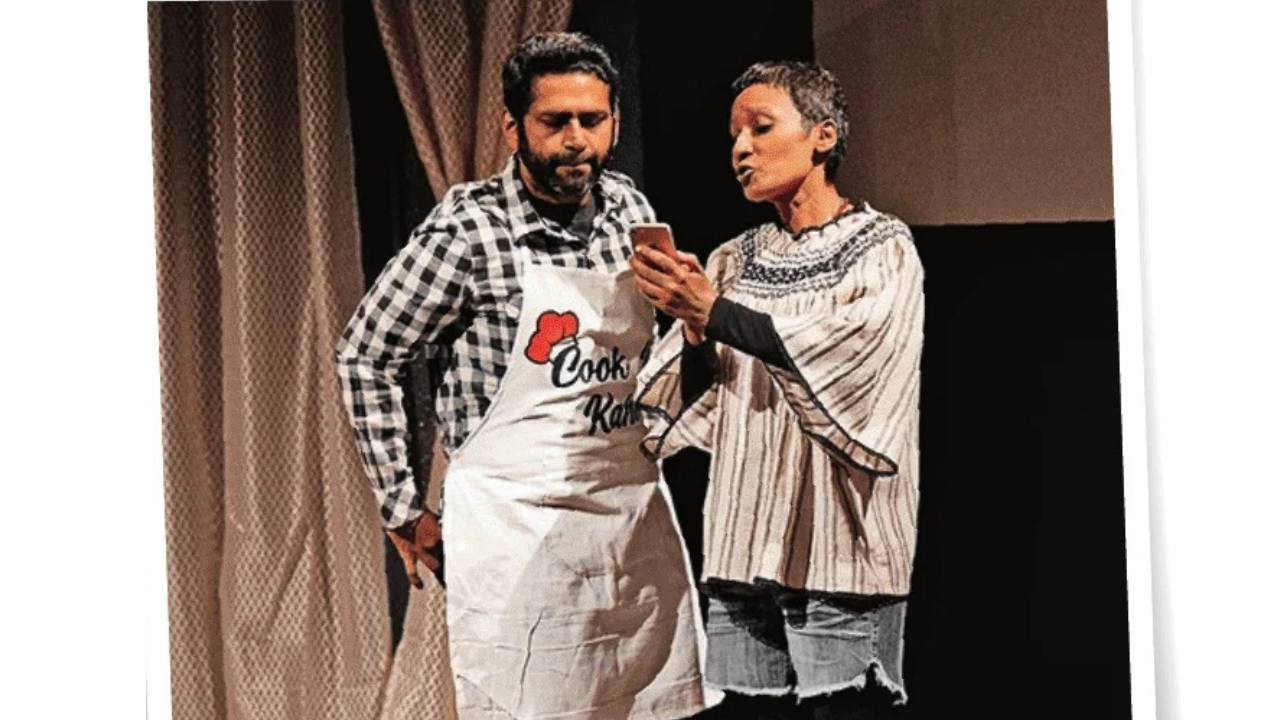
So, your doctor is a man? he asks, eyes on the road.“Yeah,” she shrugs, the scarf wrapped around her head. “The oncologist is a man. My gynecologist referred him to me.”“Okay. Then he must be sure about her credentials.”“That. My gynecologist is a man.”“What? You mean he touches you?”₹Questioning questions, awkward sentences, well-timed expletives and many unrequited high-fives enliven ‘Breast of Luck’, a play whose protagonists choose to sing, dance and laugh through the dire situation of cancer.Co-written and staged by Tannishtha Chatterjee – who were diagnosed with stage IV oligometastatic cancer in the last year – and Sharib HashmiThe musical comedy, directed by Leena Yadav, whose wife has defeated oral cancer four times, recently opened to a packed house at G5A in Mumbai. Apart from Naseeruddin Shah, Dia Mirza, Tanvi Azmi and Divya Dutta, Chatterjee’s doctors and cancer survivors were also present in the room. At the end of the first show, Chatterjee turned to the room and said, “To be honest, I don’t know how I’m doing except that I’ve stopped chasing certainties.Shah reassured him: “It’s the most cathartic and the best thing you could do for yourself.”songs on sadnessIn this script, which will be staged at the Kala Ghoda Arts Festival on February 4 on the occasion of World Cancer Day, opposites distract attention before they attract. Sheela Roy is a cool, laid-back classical singer, while Arun Mohan is a goofy divorced stockbroker who punctuates dad jokes with high-fives. When she starts riyaaz at 5 am every morning, he gets nervous and calls her on the intercom asking her to stop. Their heated bickering turns into real-world meetings on a dating app. Just as Roy begins to enjoy Mohan’s company, the story changes: she is diagnosed with Stage IV oligometastatic breast cancer.She pushes Mohan away, convinced that love will only expose her weakness. He refused to go, insisted on staying, and was constantly taunted while in his care. The refusal to sacrifice humor, intimacy, or companionship in the face of illness establishes the emotional center of the play. The Big C, often presented as a serious subject in films, finds its own strange role in the play. “Absolutely. That’s the USP,” says Hashmi. “Otherwise, this could have easily turned into a tragic story. We chose to look at it from a lighter side – with songs, jokes, laughter.This play comes from a deep personal well. The second part includes real hospital scenes – insurance IVRs (interactive voice responses), chemotherapy rooms and injections. At one point, you see Chatterjee singing through an injection. “The targeted drug was extremely painful. But when I sang, those 10 minutes went by faster,” says Chatterjee, who invited her friend, a documentary cinematographer, to shoot her on her last day of chemo.Music, laughter and community sustained Chatterjee during her medical journey. Coincidentally, Chatterjee – who is known for her performances in ‘Dekh Indian Circus’ (2011), ‘Gulaab Gang’ (2013), and ‘Angry Indian Goddesses’ (2015) – was to meet Hashmi of ‘Family Man’ and ‘Filmistaan’ fame on the same day as her biopsy report. Hashmi was shooting for his film ‘Full Plate’ and he casually discussed the collaboration.She recalls, “The day I got my report, I was supposed to meet Sharib for coffee. I almost cancelled.” “I was devastated. But I thought if I went home, I would have to tell my mother and I would feel bad. So I left.”A year before Chatterjee was diagnosed, he lost his father to cancer. “He died in my arms in the hospital ICU. He was so full of life. When I found out, my main concern was my mother, who was over 70. How did I break this news to her? Because it wasn’t stage one, or stage two, or even stage three – it was stage four.”When he confided in Hashmi, he called his wife Nasreen, who has been suffering from cancer since 2018. “He gave me a lot of strength,” says Chatterjee. “She said, ‘Look at me. I’ve relapsed four times. I’m here. I’m doing everything.’ After that call, I looked at Sharib and said, let’s write a play for him.The script took shape during chemotherapy. Rehearsals were scheduled between hospital visits. The reforms were shaped as much by pain as by laughter. “I was writing during treatment. I wanted to laugh constantly. I didn’t want to disappoint myself,” says Chatterjee, who found humor in mundane things — doctors medically debating silicone implants, nurses scolding him and his friends for laughing too loudly in hospital rooms.Rehearsal was not easy. “I had and still have terrible nerve damage in my shoulder and left arm. Everyone had to be careful when hugging me or touching me because if it went beyond a certain range of mobility it was excruciating.”Hashmi considers Arun Mohan not only as an artist but also as a caregiver. “After my wife’s diagnosis, our life completely changed,” he says. “But he treated cancer like a fever – with courage, humor, incredible strength. We tried to bring that feeling into the play.”Medical professionals echo that sentiment carefully. Breast oncoplastic surgeon Dr Vani Parmar says a cancer diagnosis often comes as a shock, especially for young women. She says, “The treatments – radical surgeries, long chemotherapy sessions, hair loss, weakness – cause immense physical, emotional, social and financial stress as well as constant fear of recurrence and death.” She says changes in appearance often cause anxiety and depression. “‘Chemo brain’, or brain fog, is also part of this area.”Chatterjee remembers the days when she told her doctor that she could not do another chemo cycle. “He understood. He knew that in three days, I would feel different.” That reassurance — from doctors and fellow survivors — means a lot.Although psychological counseling is not routinely integrated in many hospitals, it is increasingly recognized as an essential part of cancer care. Priyadarshini Dev, consultant, cancer and palliative care center at Kokilaben Dhirubhai Ambani Hospital, says studies show that humor and movement-based activities can significantly enhance emotional health. “Humor and lightness relieve stress, reduce anxiety, improve communication and strengthen relationships, especially with caregivers,” she says.argument for lightnessA case of levity comes in actor Lisa Ray’s memoir Close to the Bone, in which she recalls the day a “nervous, rabbit-faced doctor” diagnosed her with cancer. “He spoke very slowly, with long pauses between each word, as if gauging my reaction. You have.” Multiple. Myeloma.” Ray writes that the doctor reminded her of the rabbit from ‘Alice in Wonderland.’ “When he kicked me into the pit, he never said the word ‘cancer’.““Oh,” Ray replied. “Do you want me to bring you some water?”Her reaction may seem strange, she writes. “But that seemed drained. Plus, it never occurred to me that I couldn’t get better… I was just treating it as another adventure.”Besides music, what sustained Chatterjee after her diagnosis was community. “I used to cry alone in my car with my report,” she says. “My sister told me – you can’t save yourself alone.” Friends video called him and made fun of everything from Trump’s antics to local absurdities. “It helped me sleep. It made me feel lighter.”We ask him why in popular culture cancer is so often portrayed only through gloom and seriousness? “Because it usually comes from an outside perspective, not from lived experience,” says Chatterjee. “I think there’s a fear – how can I be sensitive (to the subject matter)? I was fearless because it’s who I am.”The drama does not trivialize his struggles, including his lengthy insurance battle. His arguments with the automated voice express his frustration. “The day my insurance refused me, I was at my lowest. Treatment is extremely expensive. I’m not a commercial actor. I’m an alternative, art actor. I’m not hanging around for money. And I have a mother and a daughter to take care of,” says Chatterjee. His daughter lived with the actor’s sister in America during treatment.Dr. Parmar reminds us that caring for the caregiver is important, too. “There is emotional burnout, financial stress and disrupted routines. Clear communication, shared decision making and emotional support make the biggest difference.” She urges integration of psychological and financial support into standard cancer care. “Good healthcare at an affordable price is a right.”“My doctors told me it’s not just about cancer,” Chatterjee says. “In any disease, people need to see it — to see how art, music, laughter and community are therapeutic.”The audience reaction shows that the message has been delivered. Survivors have cried and laughed in equal measure. The caregivers have identified themselves. Those who have lost loved ones have found something better than grief alone. Hashmi’s wife has seen this play three times. “She loved it,” he says.


